Your cart is currently empty!
You may check out all the available trips and book one that suits you.
Continue Browsing Trips
Mathura and Vrindavan Tour Package , Have you ever felt the pull toward something greater than yourself? A longing to walk where legends were born and divinity once walked the earth? Welcome to Mathura and Vrindavan, the twin cities where every stone has a story, every temple resonates with devotion, and the air itself seems filled with divine love.
These aren’t just tourist destinations—they’re pilgrimage sites that have drawn seekers, devotees, and curious travelers for thousands of years. According to Hindu tradition, Lord Krishna, one of the most beloved deities, was born in Mathura and spent his childhood performing miracles and spreading joy in Vrindavan. The spiritual energy of these places is palpable, whether you’re a devout believer or simply someone seeking peace and cultural enrichment.
A tour package to Mathura and Vrindavan offers more than sightseeing—it’s a journey into the heart of bhakti (devotional) tradition, where ancient temples stand alongside the Yamuna River, where devotional songs fill the evening air, and where spirituality isn’t confined to prayer halls but permeates every aspect of daily life. Ready to explore this sacred landscape? Let’s begin this divine journey together.
To understand why millions of pilgrims visit these twin cities annually, we need to delve into their mythological and historical importance. Mathura, one of Hinduism’s seven sacred cities, is believed to be the birthplace of Lord Krishna over 5,000 years ago. According to the Bhagavata Purana and Mahabharata, Krishna was born in a prison cell where his parents, Vasudeva and Devaki, were held captive by the tyrannical king Kansa.
Vrindavan, just 15 kilometers from Mathura, is where Krishna spent his childhood as a cowherd, performing divine leelas (miraculous acts) and engaging in his famous raas leela (divine dance) with Radha and the gopis (cowherd maidens). Every grove, every ghat, and every temple in Vrindavan is associated with episodes from Krishna’s life, making the entire town a living scripture.
The relationship between Krishna and Radha, celebrated as the ultimate expression of divine love, has inspired centuries of poetry, art, music, and devotional practice. Vrindavan’s temples don’t just commemorate these stories—they keep them alive through daily rituals, festivals, and the devoted worship of millions who see Krishna not as a historical figure but as a living presence.
What makes these places truly special is how the ancient past continues to shape present-day life. The temples aren’t museums—they’re vibrant centers of worship where traditional practices continue unchanged for centuries. Walking through these streets, you’re not just observing religious culture; you’re stepping into a continuous tradition of devotion that bridges millennia.
At the very heart of Mathura’s spiritual landscape stands the Krishna Janmabhoomi Temple, marking the exact spot where Lord Krishna is believed to have been born. This isn’t just any temple—it’s the holiest site in Mathura, drawing devotees from across the world who come to offer prayers at the birthplace of their beloved deity.
The temple complex has a complex history. The original temple built here was destroyed and rebuilt several times over centuries. Today’s structure includes the prison cell (now a sanctum) where Krishna was born, marked by a small shrine. The atmosphere inside is intensely devotional, with continuous chanting, prayers, and offerings creating an environment of deep spiritual energy.
Adjacent to the temple stands the Shahi Idgah mosque, built in the 17th century during Mughal rule, which has been a subject of historical and legal discussions. This juxtaposition represents the layered history of Mathura, where different periods of rule left their architectural marks.
Visiting the Janmabhoomi Temple requires patience, especially during festivals and weekends when crowds can be overwhelming. Security is stringent—no phones, cameras, or bags are allowed inside. But standing in that sacred chamber, surrounded by devotees whose faith is palpable, creates a powerful experience regardless of your personal beliefs. The emotional intensity of worship here offers profound insights into the depth of Hindu devotional traditions.
If the Janmabhoomi Temple represents Krishna’s earthly arrival, the Dwarkadhish Temple celebrates his divine persona as the king of Dwarka. Built in 1814, this temple showcases exquisite architecture with intricate carvings and a magnificent sanctum housing the black stone deity of Krishna.
What makes Dwarkadhish Temple extraordinary isn’t just its beauty but the living devotional practices that unfold here daily. The temple follows an elaborate schedule of aartis (ritual worship with lamps) throughout the day, each with its own significance. The Mangala Aarti before dawn awakens the deity, the Shringar Aarti adorns him with fresh decorations, and the evening Sandhya Aarti is a spectacular affair with bells, drums, and devotional fervor that fills the entire complex.
The temple’s courtyard becomes particularly vibrant during festivals. The Holi celebrations here are legendary, continuing for several days with colors, music, and joyous worship. During Janmashtami, the temple is decorated elaborately, and thousands of devotees queue for hours just to catch a glimpse of the deity adorned specially for his birthday.
What’s fascinating is how the temple adapts Krishna’s deity care to mirror royal treatment—the deity is “woken up,” “dressed,” “fed,” and “put to rest” according to daily schedules, reflecting the bhakti tradition’s intimate, personal relationship with the divine. Participating in or witnessing these rituals provides deep insights into how Hindu worship transcends mere prayer to become a relationship of love and service.
Among Mathura’s numerous ghats (riverside steps), Vishram Ghat holds special significance. According to tradition, this is where Krishna rested after defeating the tyrant Kansa, and bathed in the Yamuna to cleanse himself. The name “Vishram” literally means “rest,” commemorating that moment.
This ghat is the most important of Mathura’s twenty-five main ghats and serves as the primary location for ritual bathing, especially during auspicious occasions. Early morning and evening aartis at Vishram Ghat are spectacular events. As priests perform synchronized rituals with lamps, bells, and chants, the river seems to come alive with spiritual energy. Devotees float small leaf boats carrying diyas (lamps) and flowers on the Yamuna, creating a mesmerizing sight as hundreds of tiny lights drift downstream.
The ghat’s architecture features numerous temples and dharamshalas (pilgrim rest houses) along its length. The steps descend gradually into the Yamuna, and during favorable weather, the reflection of temples and lamps on the water creates picture-perfect moments, especially at sunset.
Sitting at Vishram Ghat at dusk, watching devotees perform their evening worship while temple bells ring in the background and the aroma of incense fills the air, offers one of those transcendent travel moments where you feel connected to something timeless. This isn’t staged for tourists—it’s authentic devotional practice that has continued for generations, making you a privileged witness to living tradition.
If Vrindavan has a beating heart, it’s the Banke Bihari Temple. This 19th-century temple houses a unique deity of Krishna in his three-fold bending (tribhanga) form, playing his flute—an image that captures Krishna’s playful, enchanting essence perfectly. The name “Banke Bihari” translates to “one who stands in a bent posture,” referring to Krishna’s characteristic stance.
What makes this temple extraordinary is the intensely personal relationship devotees feel with the deity. Unlike many temples where the deity is visible continuously, here the curtain covering the sanctum opens and closes repeatedly during darshan (viewing). This tradition arose from the belief that the deity’s gaze is so captivating that devotees would stand transfixed for hours, forgetting the outside world.
The temple atmosphere is unlike any other—chaotic, devotional, and utterly joyous. There are no organized queues or rigid rules. Devotees push forward eagerly for those brief glimpses of Banke Bihari, devotional songs play continuously, and priests throw flower petals and distribute prasad (blessed offerings). It can feel overwhelming, but it’s also authentically alive with spiritual energy.
The lane leading to Banke Bihari Temple is equally fascinating—packed with shops selling everything from devotional items to sweets, with street vendors offering cold drinks and snacks. This commercial bustle doesn’t detract from spirituality; rather, it demonstrates how in Vrindavan, the sacred and everyday life are inseparable.
During festivals, particularly Janmashtami and Holi, the temple transforms into a celebration center. Special darshans, elaborate decorations, and extended hours allow more devotees to participate in the festivities. If you can handle the crowds, experiencing Banke Bihari during major festivals offers unforgettable insights into mass devotional fervor.
The ISKCON (International Society for Krishna Consciousness) Temple, officially known as Krishna-Balaram Mandir, represents modern devotional architecture and the global spread of Krishna consciousness. Built in 1975 by the movement’s founder, A.C. Bhaktivedanta Swami Prabhupada, this temple complex blends traditional devotion with contemporary infrastructure.
The temple’s architecture is impressive—white marble structures surrounding beautifully landscaped gardens create a peaceful environment. The main temple hall houses deities of Krishna-Balarama, Radha-Shyamasundara, and Gaura-Nitai, with the sanctum area featuring exquisite altar decorations that change seasonally.
What distinguishes ISKCON from traditional temples is its approach to accessibility and education. Multilingual information boards explain Hindu philosophy and temple rituals. The daily schedule includes kirtans (devotional singing), philosophy classes, and elaborate aartis that welcome all visitors regardless of their religious background. The emphasis is on participation and understanding rather than passive observation.
The temple complex includes a museum presenting Krishna’s life through dioramas, a guesthouse offering comfortable accommodation, and a restaurant serving delicious vegetarian meals. The bookstore carries spiritual literature in multiple languages, making Krishna philosophy accessible to international visitors.
ISKCON’s evening aarti is a must-attend event. The combination of traditional devotional practice with organized presentation—clear visibility, good sound systems, and space for everyone—creates an experience that’s both spiritually moving and comfortable. The devotional dancing and singing that accompany the aarti often see participation from visitors worldwide, creating a truly universal spiritual celebration.
For those new to Hindu spirituality or unfamiliar with temple protocols, ISKCON serves as an excellent introduction—welcoming, explanatory, and deeply devotional without being intimidating.
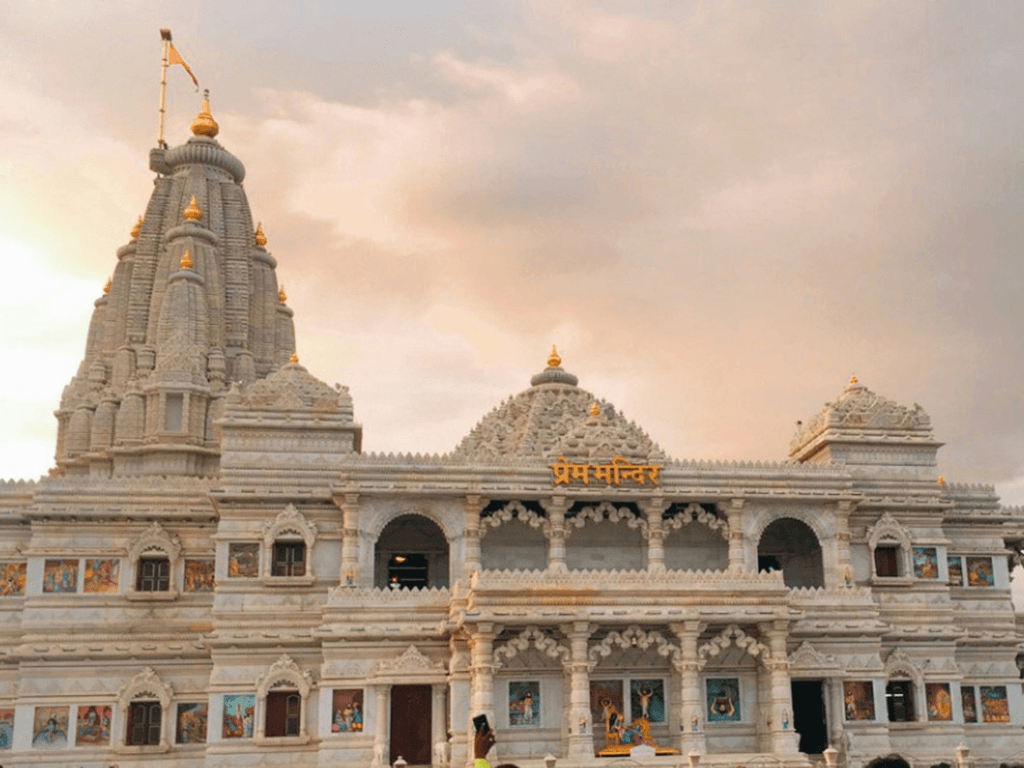
Completed in 2012, Prem Mandir (Temple of Love) is Vrindavan’s newest major attraction and represents contemporary temple architecture at its finest. Built entirely of white Italian marble, this magnificent structure took 11 years and numerous artisans to complete, showcasing scenes from Krishna’s life carved into its outer walls with incredible detail.
The temple’s design follows traditional Vrindavan architecture but on a grand scale. The main structure rises majestically, with intricate carvings covering every surface. As you walk around the temple’s periphery, you encounter elaborate marble panels depicting episodes from Krishna’s childhood, his interactions with Radha and the gopis, and teachings from the Bhagavad Gita. Each panel is a masterpiece of sculptural art, with figures so lifelike they seem ready to step out of the marble.
What truly sets Prem Mandir apart is its evening illumination. As darkness falls, the entire temple is bathed in changing colored lights, transforming it into something ethereal. The combination of white marble, intricate carvings, and artistic lighting creates a visual spectacle that’s both devotional and aesthetic. Musical fountain shows in the temple gardens add to the enchantment.
Inside, the sanctum houses beautiful deities of Radha-Krishna and Sita-Ram, worshipped with traditional rituals throughout the day. The temple’s devotional emphasis is on prema or divine love—the unconditional, selfless love exemplified by Radha’s devotion to Krishna.
The spacious temple complex includes well-maintained gardens, sitting areas, and informative displays about Krishna philosophy. Unlike the cramped, chaotic environment of older temples, Prem Mandir offers space to breathe, reflect, and appreciate both the artistic achievement and spiritual message.
For photographers and architecture enthusiasts, Prem Mandir offers endless opportunities, especially during the evening lighting. For devotees, it provides a contemporary space for traditional worship. For all visitors, it demonstrates how ancient devotional traditions can find fresh expression in modern contexts.
Among Vrindavan’s thousands of temples, the Radha Raman Temple holds a special place as one of the oldest and most revered. Established in 1542, this temple houses a self-manifested (swayambhu) deity of Krishna that appeared miraculously from a shaligram shila (sacred stone) in the presence of the saint Gopala Bhatta Goswami, one of the six Goswamis of Vrindavan who established the town’s devotional traditions.
What makes Radha Raman particularly significant is that the deity worship has been maintained in an unbroken tradition by descendants of Gopala Bhatta Goswami for nearly 500 years. This continuity ensures that ancient rituals and practices continue exactly as prescribed in medieval devotional texts, making it a living link to Vrindavan’s golden age of Krishna bhakti.
The temple architecture is relatively simple—a small complex with intimate courtyards and the main sanctum. What it lacks in size, it compensates with spiritual intensity. The deity is exquisitely beautiful, and the elaborate seasonal decorations (different for each season and festival) represent traditional Vrindavan artistic traditions.
The temple follows strict traditional protocols. Unlike modern temples with extended viewing hours, darshan times here are limited and follow the traditional schedule of deity care—wake up, bath, breakfast, rest, lunch, afternoon nap, evening activities, and sleep. This reinforces the bhakti tradition’s concept of treating the deity as a beloved person with needs and preferences rather than an inanimate idol.
During festivals, particularly Sharad Purnima when the raas leela is commemorated, Radha Raman Temple offers unique celebrations. The deity is adorned specially, and devotional practices intensify. Experiencing these traditional observances provides insights into how Vrindavan maintains its connection to its spiritual heritage.
Among all Vrindavan’s sacred sites, none captures imagination quite like Nidhivan—the mysterious grove where, according to devotional tradition, Krishna continues to perform his raas leela with Radha and the gopis every night. This small, densely wooded area contains twisted basil trees (tulsi) that devotees believe transform into gopis (divine companions) after dark.
The grove has an eerily mystical atmosphere even during the day. The trees grow in peculiar formations—low to the ground with intertwining branches creating natural shelters. Local tradition holds that no one is allowed in Nidhivan after sunset, and priests ensure the temple within the grove is securely closed each evening, leaving offerings of clothes, food, and makeup for Krishna and Radha, which are purportedly found in disarray the next morning.
Numerous stories surround this place—tales of people who defied the rules and stayed overnight, only to be found next morning struck blind, mute, or insane. While such stories can’t be verified, they’ve created an aura of mystery that makes Nidhivan one of Vrindavan’s most intriguing sites. Even skeptical visitors acknowledge the grove’s unusual atmosphere.
A small temple within Nidhivan, called Rang Mahal, contains a chamber with a bed where devotees believe Radha and Krishna rest after their nightly raas leela. The bed is made fresh each evening and found unmade each morning, perpetuating the belief in their continued presence.
Visiting Nidhivan during the day allows you to walk among these sacred trees, meditate in the peaceful environment, and ponder the mysteries that devotional tradition assigns to this place. Whether you interpret it literally or metaphorically, Nidhivan represents the living nature of Krishna consciousness in Vrindavan, where the divine past remains vibrantly present.
About 25 kilometers from Mathura lies Govardhan Hill, a low sandstone formation that holds immense significance in Krishna lore. According to the Bhagavata Purana, when Indra (the god of rain) flooded the region to punish Krishna for encouraging people to worship Govardhan instead of him, young Krishna lifted the entire hill on his little finger for seven days, sheltering all the villagers and cattle underneath.
This episode symbolizes several philosophical concepts—the importance of nature worship over ritualistic practices, Krishna’s protective nature, and the supremacy of bhakti over traditional Vedic rituals. Govardhan Hill is therefore venerated not just as a site of a miracle but as a manifestation of Krishna himself.
The traditional practice is Govardhan Parikrama—circumambulating the entire hill, a distance of about 21 kilometers. Devout pilgrims perform this parikrama by fully prostrating themselves, measuring the entire distance with their bodies—a process that can take weeks. Most visitors walk the route, which takes about six to eight hours, passing numerous temples and sacred spots associated with Krishna’s pastimes.
Key sites along the parikrama route include Manasi Ganga (a sacred pond where Krishna is said to have bathed), Kusum Sarovar (a beautiful reservoir with ornate ghats), and Radha Kund (considered the most sacred bathing spot in the entire Krishna tradition). Each location has its own legends and devotional significance.
The town of Govardhan at the hill’s base offers basic amenities for pilgrims. During the festival of Govardhan Puja (the day after Diwali), the entire hill becomes a massive celebration site with thousands of devotees performing parikrama and offering elaborate worship.
Even for those not inclined toward the full parikrama, visiting Govardhan offers beautiful rural scenery, peaceful temple complexes, and insights into how geographical features become focal points of devotional practice. The hill’s relatively untouched environment provides welcome relief from the bustle of Mathura and Vrindavan.
No understanding of Mathura-Vrindavan’s spiritual landscape is complete without appreciating the Yamuna River’s significance. In Hindu tradition, Yamuna is not just a river but a goddess—the daughter of the sun god Surya and one of the most sacred waterways in India.
Krishna’s connection with the Yamuna is intimate and multifaceted. He played on her banks as a child, subdued the serpent Kaliya in her waters, performed his raas leela along her shores, and crossed her at critical moments in his life. The river witnessed all his divine pastimes, making her an active participant in Krishna lore rather than merely a setting.
The numerous ghats (riverside steps) in both Mathura and Vrindavan serve as primary sites for religious rituals. Pilgrims bathe in the Yamuna to purify themselves, believing her waters wash away sins. Morning and evening aartis at major ghats create spectacular scenes of devotional practice, with hundreds of lamps floating on the water, bells ringing from riverside temples, and devotees performing synchronized rituals.
Sadly, the Yamuna today faces severe pollution challenges. Industrial waste, urban sewage, and reduced water flow have degraded her condition significantly. This environmental crisis has spiritual dimensions—how can the faithful worship a polluted goddess? Various cleanup initiatives and awareness campaigns work toward restoration, and visiting pilgrims increasingly participate in river-cleaning activities as a form of devotional service.
Despite pollution concerns, the Yamuna remains central to Mathura-Vrindavan’s spiritual identity. Sitting at any ghat during sunset, watching the river reflect the colors of the sky while temple bells announce evening prayers, still offers moments of profound beauty and contemplation. The river connects contemporary visitors to millennia of devotional practice, reminding us that sacred spaces require not just reverence but also responsible stewardship.
Janmashtami, celebrating Krishna’s birth, transforms Mathura and Vrindavan into epicenters of devotional celebration. This festival, occurring in August or September (on the eighth day of the dark fortnight in the month of Bhadrapada), sees hundreds of thousands of pilgrims descending upon these twin cities.
In Mathura, the Krishna Janmabhoomi Temple becomes the focal point. The midnight hour when Krishna was born is marked with special ceremonies—the temple adorned elaborately, priests performing intricate rituals, and devotees singing devotional songs throughout the night. The atmosphere is electrifying, with spiritual energy and joyous celebration merging into an unforgettable experience.
Vrindavan’s temples compete to create the most elaborate Janmashtami celebrations. Banke Bihari Temple organizes special darshans, ISKCON hosts elaborate reenactments of Krishna’s birth with spectacular lighting and stage design, and smaller temples throughout the town hold their own unique observances. The entire town stays awake through the night, immersed in Krishna consciousness.
Dahi Handi (the pot-breaking ceremony) reenacts Krishna’s childhood butter-stealing exploits. Human pyramids attempt to reach and break pots filled with yogurt and butter suspended high above streets. This event, combining athletic skill with devotional enthusiasm, attracts huge crowds and exemplifies how Krishna’s playful nature is celebrated through joyful participation.
The week surrounding Janmashtami sees continuous cultural programs—classical music concerts, dance performances, Krishna katha (narrations of Krishna’s stories), and devotional singing. The towns become open-air theaters where Krishna’s life is celebrated through every artistic medium imaginable.
While Holi is celebrated throughout India, experiencing it in Vrindavan and Mathura offers something incomparable—this is where the tradition originated, where Krishna and Radha first played with colors, where every splash of color carries spiritual significance.
Holi in Vrindavan isn’t a one-day affair but extends over a week, with different temples celebrating on different days according to their traditions. The Banke Bihari Temple’s Phoolon Wali Holi (Holi with flowers) sees priests showering thousands of devotees with flower petals instead of colors—a fragrant, gentle celebration that’s as beautiful as it is joyous.
Barsana, a village near Vrindavan associated with Radha, hosts the famous Lathmar Holi where women playfully beat men with sticks while men try to protect themselves with shields—reenacting the traditional battle between Radha’s friends and Krishna’s group during their color play. This unique celebration attracts tourists and photographers worldwide.
The main Holi day sees the entire town erupt in color. Streets become rivers of gulal (colored powder), no one is spared from color attacks, and the atmosphere is one of complete abandon to joy. Temples organize special celebrations with colored water, music, dancing, and continuous devotional singing. The philosophical message is clear—in Krishna’s love, all barriers of caste, class, and status dissolve into colorful unity.
Safety note: Holi celebrations can become quite boisterous. Solo travelers, especially women, should preferably join organized tour groups or temple celebrations rather than wandering streets alone during peak celebrations. The energy is joyous but can occasionally become overwhelming.
A well-designed tour package elevates your Mathura-Vrindavan experience from simple temple visits to genuine spiritual immersion. The best packages offer more than transportation and entry arrangements—they provide context, access, and experiences that independent travelers might miss.
Expert guides make crucial differences here. A knowledgeable guide doesn’t just point out temples but narrates the stories associated with each site, explains the philosophical concepts behind rituals you’ll witness, and helps you understand the devotional traditions that shape these towns. They can decode the symbolism in temple art, explain the significance of different deities and their forms, and share local legends that bring the entire landscape to life.
Timing is critical in Mathura-Vrindavan. Major temples have specific darshan hours, aartis happen at particular times, and crowds vary significantly throughout the day. Good tour packages schedule visits strategically—reaching popular temples during less crowded hours, timing your visits to coincide with important aartis, and building in flexibility for the spontaneous delays that temple visits often entail.
Many packages include experiences beyond standard temple visits—boat rides on the Yamuna during sunrise or sunset, participation in temple aartis (not just watching), visits to ashrams where you can interact with spiritual practitioners, attendance at evening bhajan sessions, or even simple walks through old town lanes where you’ll discover family temples and community devotional practices invisible to casual tourists.
Accommodation is carefully chosen to match the spiritual nature of your journey. Rather than generic hotels, packages might include stays in dharamshalas (pilgrim rest houses), ashrams that welcome guests, or heritage properties run by traditional families who can share personal perspectives on living in these sacred towns.
The best packages also handle practical challenges—negotiating the chaos of festival crowds, ensuring vegetarian meals that meet quality standards, managing rest time between intense temple experiences, and providing sacred spaces for personal reflection. This logistical support allows you to focus entirely on the spiritual and cultural experience rather than worrying about practical details.
How long should you spend in Mathura and Vrindavan? The answer depends on your interest level and what you hope to experience, but most comprehensive packages range from two to four days.
A two-day itinerary covers the essential temples—Krishna Janmabhoomi, Dwarkadhish, and Vishram Ghat in Mathura on day one, followed by Banke Bihari, ISKCON, Prem Mandir, and one or two additional temples in Vrindavan on day two. You’d experience major aartis, get a taste of both towns’ atmospheres, and visit the most important sacred sites. This works well for travelers on tight schedules who want a meaningful introduction to Krishna bhakti.
Three days allows a more relaxed pace with deeper immersion. You could add Nidhivan, include a proper Yamuna aarti experience, visit additional temples like Radha Raman or Rangji Temple, explore local markets, and perhaps include a cooking class or craft workshop. This duration provides time for spontaneous discoveries and personal reflection without constant rushing.
Four to five days opens possibilities for day trips to Govardhan Hill and Barsana, attending multiple aartis at different temples to compare traditions, spending quiet time in less-visited temples or ashrams, and truly soaking in the devotional atmosphere. Some travelers use this extended time for personal spiritual practice—meditation, chanting, reading sacred texts, or simply being present in these charged environments.
For those on very limited schedules, even a well-planned one-day tour can provide a meaningful glimpse of both towns, though you’ll need to prioritize ruthlessly and accept that you’re sampling rather than immersing. The day would typically cover three to four major sites split between Mathura and Vrindavan, with at least one aarti experience.
Choosing the right time to visit significantly impacts your experience. The ideal period is from October through March when pleasant weather makes extensive temple visits and outdoor activities comfortable.
October and November offer lovely post-monsoon freshness with clear skies and moderate temperatures. This period is excellent for photography, with good natural light and comfortable walking conditions. However, it also coincides with Diwali and Govardhan Puja, meaning significantly larger crowds and higher accommodation prices.
December through February brings cooler weather—mornings and evenings can be quite chilly (temperatures occasionally drop to 5-7°C), but daytime remains pleasant for temple visits. This is prime pilgrimage season, so expect substantial crowds, especially on weekends. The winter months are perfect if you want to experience the full intensity of devotional activity.
March marks the transition to warmer weather but remains comfortable. This month often includes Holi celebrations, making it extraordinary if you specifically want to experience this festival at its origin, but also meaning extreme crowds, booked accommodations, and premium pricing.
Summer months (April through June) bring intense heat, with temperatures often exceeding 40°C. Unless you have specific spiritual commitments or festival participation requires it, this period is challenging for travel. If you must visit during summer, schedule temple visits for early morning and late evening, rest during midday heat, and stay extremely well-hydrated.
Monsoon season (July through September) brings relief from heat but makes travel unpredictable with intermittent heavy rains. However, this period includes Janmashtami, Krishna’s birthday celebration, which is arguably the most significant time to visit despite weather challenges. The spiritual energy during Janmashtami makes crowds and weather inconveniences worthwhile for many devotees.
Mathura and Vrindavan offer diverse accommodation options catering to different budgets, comfort levels, and spiritual orientations. The choice of where to stay can significantly shape your experience.
Ashrams and dharamshalas provide the most authentic pilgrimage experience. These facilities, run by religious organizations or temples, offer basic but clean accommodation at minimal cost (some are even free with voluntary donations). Staying in an ashram immerses you in devotional life—you’ll wake to morning aartis, participate in communal meals, and experience the disciplined routine of spiritual seekers. ISKCON’s guesthouse in Vrindavan offers slightly more comfortable ashram-style accommodation with organized programs.
Mid-range hotels in both towns provide modern amenities while remaining accessible to most travelers. Properties near major temples offer convenience, though they can be noisy with temple bells and street activity starting before dawn. Slightly distant hotels provide quieter environments but require transportation to reach temples.
Luxury resorts and heritage hotels have emerged, particularly around Vrindavan, offering upscale accommodation for travelers seeking spiritual experiences without sacrificing comfort. These properties typically feature landscaped gardens, good restaurants serving vegetarian cuisine, and sometimes organize their own spiritual activities like morning yoga or meditation sessions.
Homestays with local families provide intimate cultural experiences. Hosts share personal perspectives on living in these sacred towns, offer home-cooked meals, and can guide you to lesser-known temples and local practices that typical tourists miss.
When selecting accommodation, consider proximity to temples you most want to visit, noise tolerance (temple areas are vibrant but loud), and whether you want to be immersed in devotional activity or prefer a peaceful retreat after temple visits. During festivals, book well in advance—rooms fill months ahead for Janmashtami and Holi.
Note that both towns are vegetarian zones—no meat, eggs, or alcohol are available or permitted. All accommodations strictly follow these guidelines, so plan accordingly.
Mathura and Vrindavan’s cuisine reflects their spiritual character—completely vegetarian (or rather, vegan in many cases) and often prepared according to sattvic principles that emphasize purity, freshness, and positive energy. Eating here becomes part of your spiritual journey.
The most iconic food is prasad (blessed offerings) from various temples. Each major temple has its specialty—the pedas (milk-based sweets) from Mathura are legendary, particularly those from Brijwasi or Shankar Sweets. These aren’t ordinary sweets but preparations that have been offered to Krishna first, making them spiritually blessed.Street food in Mathura offers delicious options—kachori with aloo sabzi for breakfast, various chaats in the evening, and the famous Mathura peda that has been made according to traditional recipes for centuries. The local kachori here differs from other regional versions, with specific spicing that locals claim is unique to Krishna’s land.
Vrindavan’s food scene includes numerous small eateries serving simple, sattvic thalis (plated meals) that include fresh rotis, seasonal vegetables, dal, rice, and yogurt. These meals, while simple, are prepared with devotional care and often taste remarkably delicious despite minimal ingredients.
ISKCON temple’s restaurant, Govinda’s, serves excellent multi-cuisine vegetarian food in a clean, organized environment. Their menu includes South Indian, North Indian, Chinese, and continental options, all strictly vegetarian and prepared with high hygiene standards—ideal for travelers adjusting to Indian food or seeking familiar options.
Special preparations appear during festivals—countless varieties of sweets during Janmashtami, thandai and gujiya during Holi, and seasonal specialties throughout the year. Participating in langar (free community meals) at temples or ashrams provides both nourishment and insights into the selfless service tradition central to bhakti practice.
For many visitors, the simple, pure food of Mathura-Vrindavan becomes a revelation—demonstrating how restraint and devotional preparation can make even basic meals satisfying and nourishing.
Shopping in Mathura and Vrindavan offers opportunities to take home pieces of this sacred landscape—from religious artifacts for worship to souvenirs commemorating your spiritual journey.
The most popular purchases are Krishna deities and images in various forms—brass idols of baby Krishna, Krishna with his flute, Krishna and Radha together, or Krishna performing his raas leela. These range from small, affordable pieces to large, intricately crafted sculptures. Shops near major temples offer extensive selections, with knowledgeable sellers who can explain the significance of different forms and postures.
Tulsi beads (sacred basil wood) are another essential purchase. These prayer beads, used for chanting mantras, are considered particularly auspicious when obtained from Vrindavan. Quality varies significantly—genuine tulsi has a distinctive appearance and aroma, while cheaper versions might be ordinary wood.
Devotional music CDs and books about Krishna philosophy make excellent souvenirs, especially from ISKCON’s bookstore which offers titles in multiple languages. For those interested in deepening their understanding of Krishna consciousness, these resources provide valuable learning tools beyond your visit.
Traditional clothing—cotton kurtas, devotional shawls with printed mantras, and even complete traditional outfits— are readily available. Many visitors purchase simple cotton garments as they’re practical for temple visits and comfortable in the climate.
Yamuna water bottles, though controversial given pollution concerns, are sold everywhere with claims of spiritual significance. More practical are beautiful water bottles and containers designed for carrying sacred water, which serve functional purposes beyond any spiritual connotations.
The famous Mathura peda in decorative packaging makes an excellent gift for sweet-loving friends and family. Ensure you purchase from reputable sweet shops for quality assurance.
Bargaining is expected in markets but maintain the devotional atmosphere of these towns—negotiate pleasantly and recognize that many sellers are also devotees for whom commerce is a service to Krishna. In temple shops selling consecrated items, fixed prices are standard and appropriate.
Visiting Mathura and Vrindavan requires some specific preparations and awareness to ensure both a smooth journey and respectful engagement with local spiritual traditions.
Dress modestly and appropriately. Both men and women should cover shoulders and knees when visiting temples. Many temples require head covering for all visitors, particularly at sacred sanctums. Carrying a light scarf solves this easily. Remove shoes before entering temples—most provide shoe-keeping services for a small fee.
Photography rules vary by temple. Some welcome it in courtyards but prohibit it inside sanctums, while others ban it entirely. Always ask permission before photographing people, especially sadhus (holy men) and during worship rituals. Some may request payment for photographs—clarify this beforehand to avoid misunderstandings.
Respect local customs around food and conduct. These towns are sacred spaces for millions of devotees—avoid public displays of affection, loud or inappropriate conversations, and behaviors that might offend religious sensibilities. Smoking and alcohol are strictly forbidden throughout both towns.
Temple visits during peak times require patience. Crowds can be overwhelming, especially at popular temples during festivals or weekends. Mentally prepare for pushing crowds, long queues, and limited personal space. If crowds trigger anxiety, visit during early morning hours or opt for less famous temples where spiritual atmosphere remains strong without crush of visitors.
Donations are customary at temples but should be voluntary. No one should pressure you for specific amounts. Contribute what feels appropriate from your heart, whether into donation boxes or during aartis when prasad is distributed.
Engage with locals respectfully. Many residents are devout practitioners for whom these towns aren’t tourist destinations but home and spiritual center. When asking for directions or information, approach with courtesy and appreciation for their time and knowledge.
Stay hydrated and protect yourself from sun—temple visits involve considerable outdoor walking. Carry water bottles, wear sunscreen, and if visiting during hot months, schedule midday rest periods.
Be prepared for basic hygiene challenges. Public facilities may not match international standards. Carrying hand sanitizer, tissues, and your own toilet paper proves wise. Many restaurants and eateries are simple but clean—use judgment about where to eat.
Booking a Mathura-Vrindavan tour package has become increasingly accessible through multiple channels, each offering different advantages.
Online travel platforms allow easy comparison of various packages, itineraries, and prices. Look for operators specializing in religious or spiritual tourism, as they better understand the unique aspects of pilgrimage travel versus standard sightseeing. Read recent reviews carefully, particularly noting comments about guide knowledge, respect for religious traditions, and flexibility in accommodating devotional interests alongside tourism.
Local tour operators in Mathura and Vrindavan often provide more personalized service and deeper local knowledge. They maintain relationships with temples, ashrams, and local guides that can enhance your experience. Many have offices near major hotels or railway stations and can arrange custom itineraries on relatively short notice.
ISKCON centers worldwide can often arrange or recommend tours to Mathura-Vrindavan. They typically connect travelers with devotee-run tour services that emphasize spiritual aspects alongside sightseeing. These tours might include additional elements like philosophy discussions, temple service opportunities, or meetings with spiritual teachers.
Hotels and guesthouses in both towns partner with reliable local guides and operators. While booking through your accommodation might include a markup, it offers convenience and the assurance that your hotel has vetted the service provider.
When evaluating packages, look for comprehensive details about what’s included—transportation type, guide qualifications, temple entry arrangements, meal inclusions, and accommodation categories. Clarity about the daily schedule helps you assess whether the pace matches your preferences.
Ask specifically about the guide’s expertise. For a meaningful spiritual experience, you want a guide who understands devotional traditions and can explain philosophical concepts, not just someone who knows temple locations. Some operators offer specialized guides—scholars, practicing devotees, or even priests—for travelers particularly interested in deep spiritual engagement.
Discuss customization possibilities. The best operators welcome tailoring itineraries to your specific interests—whether that’s spending more time in meditation at particular temples, including lesser-known sacred sites, attending specific cultural programs, or building in adequate personal time for reflection.
Mathura and Vrindavan’s location in Uttar Pradesh positions them conveniently for combining with other significant destinations, creating more comprehensive tour experiences.
Agra, home to the Taj Mahal, lies just 60 kilometers from Mathura—about an hour’s drive. Many travelers combine these destinations, experiencing both spiritual heritage and architectural magnificence in one trip. Two to three days in Mathura-Vrindavan followed by a day or two in Agra creates a balanced itinerary covering religious, historical, and architectural dimensions of this region.
Delhi, India’s capital, is approximately 150 kilometers away, connected by good road and rail links. Starting or ending your journey in Delhi allows you to experience metropolitan India alongside sacred small towns. Delhi itself offers significant religious sites including temples, the Lotus Temple, and Akshardham complex for travelers interested in spiritual diversity.
Bharatpur’s Keoladeo National Park, a UNESCO World Heritage Site and one of Asia’s finest bird sanctuaries, lies about 40 kilometers from Mathura. Nature enthusiasts can add a day trip to this park, experiencing India’s biodiversity alongside its spiritual heritage.
Gokul and Barsana, smaller villages closely associated with Krishna’s life, lie within easy day-trip distance. Gokul is where Krishna spent his earliest years, while Barsana is Radha’s birthplace. Both offer quieter, less commercialized temple experiences and deep devotional atmospheres. Barsana is particularly worth visiting during its unique Lathmar Holi celebration.
Ayodhya, another major Hindu pilgrimage site associated with Lord Rama, is approximately 300 kilometers away. For travelers particularly interested in religious tourism, combining these sites creates a comprehensive spiritual circuit through Uttar Pradesh.
Most tour operators can arrange combined packages covering multiple destinations. The advantage is integrated logistics—single booking, coordinated transportation, and guides who understand the connections between different sites. However, ensure the combined itinerary allows adequate time at each destination rather than creating an exhausting rush through multiple locations.
Mathura and Vrindavan aren’t merely destinations to visit—they’re experiences to absorb, spiritual landscapes to explore, and living traditions to witness. From the moment you step into these sacred towns, you enter a world where the divine feels present, where ancient stories are continuously reenacted through daily worship, and where devotion shapes every aspect of life.
Whether you’re a devout Krishna worshipper seeking connection with your beloved deity’s birthplace, a spiritual seeker exploring different traditions, a culture enthusiast interested in India’s religious diversity, or simply a curious traveler wanting unique experiences, these twin cities offer something profoundly meaningful.
The temples—from ancient Radha Raman to modern Prem Mandir, from intimate Banke Bihari to organized ISKCON—each express different aspects of Krishna devotion. The Yamuna River, despite contemporary challenges, continues carrying millennia of prayers and devotion. The festivals transform these towns into celebration centers where joy and spirituality merge indistinguishably.
A well-planned tour package removes logistical barriers and provides knowledgeable guidance that transforms sightseeing into genuine understanding. Expert guides bring stories to life, explain traditions that might otherwise seem foreign, and help you navigate both physical spaces and spiritual landscapes with respect and appreciation.
Beyond the monuments and rituals lies something intangible but unmistakable—an atmosphere of devotion so pervasive that even skeptical visitors often find themselves moved. In a world increasingly focused on material pursuits, Mathura and Vrindavan offer reminders that love, devotion, and connection to something greater than ourselves remain essential human needs.
So why wait? Book your Mathura-Vrindavan tour package and prepare for a journey that engages your senses, touches your heart, and perhaps changes your perspective. Whether you come seeking spiritual awakening, cultural understanding, or simply extraordinary experiences, the land where Krishna played awaits with open arms and eternal blessings.
Yes, absolutely! Most temples in Mathura and Vrindavan welcome visitors of all faiths and nationalities. The devotional traditions here emphasize universal love and inclusivity, with Krishna philosophy teaching that divine love transcends human-created boundaries. ISKCON temples particularly welcome international visitors with multilingual information and explanations of Hindu practices. However, show respect by following temple protocols—removing shoes, dressing modestly, maintaining quiet during worship, and avoiding photography where prohibited. Some smaller, traditional temples might have specific restrictions during certain rituals, but these are rare. Your respectful interest will be appreciated regardless of your religious background.
Generally, yes. These towns are pilgrimage centers with strong religious atmospheres that encourage respectful behavior. However, solo female travelers should follow standard precautions—dress modestly in traditional clothing, avoid isolated areas after dark, stay in reputable accommodations, and preferably join organized tours or groups for temple visits during major festivals when crowds become dense. The devotional atmosphere and presence of families, sadhus, and pilgrims create relatively safe environments. Many female spiritual seekers travel alone to these towns without issues. Trust your instincts, maintain awareness of your surroundings, and don’t hesitate to seek help from temple authorities or police if needed.
Prasad is food that has been offered to the deity and then distributed to devotees as a blessed gift. Receiving and consuming prasad is an integral part of temple worship in Hindu tradition. It typically includes sweets, fruits, or simple foods prepared in temple kitchens under strict vegetarian guidelines. For Hindus and those comfortable with the practice, accepting and eating prasad is considered auspicious and is encouraged. If you have dietary restrictions, allergies, or personal preferences against consuming it, you can still accept it respectfully and later give it to others or dispose of it reverently. Never refuse prasad rudely, as this can offend devotees. Most prasad is vegetarian, fresh, and safe to consume, though travelers with sensitive digestion might exercise caution.
Festivals transform Mathura-Vrindavan dramatically. During Janmashtami and Holi, populations swell from tens of thousands to hundreds of thousands. Temples become extremely crowded, with hours-long queues for darshan, limited movement, and intense energy. Accommodation becomes scarce and expensive, requiring advance booking. However, these festivals also offer the most extraordinary spiritual experiences—the energy, devotion, and celebrations are unparalleled. If crowds overwhelm you or if you prefer quiet contemplation, avoid major festivals. If you want to experience Krishna devotion at its most intense and joyous, these festivals are ideal despite practical challenges. Consider your priorities: crowds and inconvenience versus extraordinary spiritual atmosphere. Mid-level solution: visit during minor festivals when celebrations occur without overwhelming crowds.
Participation is generally welcomed and encouraged! Most temples invite visitors to join in aartis (waving lamps before deities), accept prasad, offer flowers or donations, and sing devotional songs. ISKCON temples particularly encourage participation regardless of your background, with clear explanations of how to join various activities. Traditional temples might have certain inner sanctum restrictions for non-Hindus, but courtyard participation is usually welcome. Some rituals like temple service (sweeping, helping with food distribution) can be arranged through ashrams or organizations. The key is respectful participation—follow others’ lead, ask permission when uncertain, and approach with genuine interest rather than casual tourism. Most devotees appreciate sincere participation and will help guide you through unfamiliar practices.


One Comment
Comments are closed.