Your cart is currently empty!
You may check out all the available trips and book one that suits you.
Continue Browsing Trips
Kashi (Varanasi) The City of Temples and Ghats , magine a city where every stone whispers prayers, where dawn breaks to the sound of temple bells echoing across sacred waters, and where the boundary between the earthly and the divine seems to dissolve with each passing moment. Welcome to Kashi—or as the world knows it, Varanasi—the eternal city that Mark Twain famously described as “older than history, older than tradition, older even than legend, and looks twice as old as all of them put together.”
Kashi isn’t just another Indian city dotted with temples and religious sites. It’s a living, breathing embodiment of Hindu philosophy, a place where spirituality isn’t practiced but lived every single moment. The city’s identity is inextricably woven with its ghats—those magnificent stepped riverbanks descending to the holy Ganges—and its countless temples that pierce the skyline with their spires and domes.
But what makes this city so special? Why do millions of pilgrims journey here annually, believing that dying in Kashi guarantees moksha, or liberation from the cycle of rebirth? Let’s embark on a journey through the ghats and temples of this mystical city, understanding not just what you’ll see, but what you’ll feel and experience in this timeless spiritual capital.
Kashi’s origins disappear into the mists of time, making it one of the world’s oldest continuously inhabited cities. According to Hindu mythology, Lord Shiva himself founded this city, making it his permanent abode. The name “Kashi” literally means “the luminous one” or “the city of light,” referring to the divine light believed to emanate from this sacred ground.
Ancient texts including the Rigveda, dating back over 3,000 years, mention Kashi, establishing its incredible antiquity. The city appears in the great epics—the Mahabharata and Ramayana—cementing its significance in Hindu consciousness across millennia. For Buddhists, Kashi holds equal importance as it’s near Sarnath, where Buddha delivered his first sermon after enlightenment.
Kashi (Varanasi) The City of Temples and Ghats , The city has always been more than a religious center. It evolved as a major center of learning, music, art, and Sanskrit scholarship. Scholars, poets, and philosophers gravitated here, creating an intellectual and spiritual atmosphere that persists today.
Kashi has witnessed the rise and fall of countless dynasties, yet maintained its spiritual essence through every historical upheaval. The city flourished during the Mauryan Empire when Emperor Ashoka promoted Buddhism here. Later Hindu dynasties revived and expanded its temple complexes.
The medieval period brought Islamic invasions that destroyed many temples, including earlier iterations of the Kashi Vishwanath Temple. Yet Kashi’s spiritual significance never diminished. Temples were rebuilt, sometimes multiple times, by devoted rulers and communities who refused to let the city’s sacred character fade.
During British colonial rule, Varanasi became a center for the Indian independence movement while maintaining its religious importance. Post-independence, the city has struggled to balance preservation of its ancient character with modern development needs—a tension visible in its narrow lanes filled with motorcycles and its ancient ghats bordered by concrete structures.
Today’s Kashi represents layers of history coexisting simultaneously. You might find a 16th-century temple next to a modern hotel, ancient cremation rituals performed beside tourists with smartphones, and Sanskrit chants mixing with Bollywood music from nearby tea shops—all forming the complex, contradictory, magnificent fabric of this eternal city.
If you’re unfamiliar with Indian cities, the concept of ghats might be new. A ghat is essentially a series of steps leading down to a water body—in Kashi’s case, the sacred Ganges. These aren’t simple staircases but elaborate architectural structures, some spanning hundreds of meters along the riverbank, featuring platforms, temples, shrines, and pavilions.
Ghats serve multiple purposes simultaneously. They’re bathing places where pilgrims perform ritual ablutions, believing the Ganges water purifies them spiritually. They’re cremation grounds where Hindus bring their deceased for final rites. They’re prayer spaces where priests conduct elaborate ceremonies. They’re social gathering spots where locals meet, chat, play, and watch the river flow by. And increasingly, they’re tourist attractions where visitors worldwide witness India’s spiritual traditions in action.
Each ghat has its own character, history, and associated legends. Some are bustling with activity from dawn to midnight, while others remain relatively quiet. Some are primarily bathing ghats, others focus on cremations, and still others host specific festivals or ceremonies. Together, they create a 6-kilometer riverfront that forms the spiritual and cultural heart of Kashi.
Kashi officially has 84 ghats, though the exact number depends on how you count smaller subsidiary ghats versus major ones. The number 84 holds spiritual significance in Hinduism, representing the 84 lakh (8.4 million) forms of life through which a soul might pass before achieving human birth.
These ghats weren’t built at once but developed over centuries, commissioned by various rulers, wealthy merchants, royal families, and religious orders. Each reflects the architectural style and religious priorities of its era. Some ghats are grand with elaborate stone work and temples, while others are simpler structures serving specific communities or purposes.
Not all 84 ghats are equally accessible or interesting to visitors. Approximately 15-20 ghats see regular tourist and pilgrim traffic, while others remain primarily local spaces. Understanding which ghats to prioritize helps you experience Kashi’s diversity without overwhelming yourself trying to visit them all.
If Kashi has a beating heart, it’s Dashashwamedh Ghat. This is the city’s most vibrant, crowded, and spectacular ghat, functioning as the de facto center of riverfront activity. The name translates to “the ghat of ten sacrificed horses,” referring to a legendary ritual performed by Lord Brahma to welcome Lord Shiva.
From early morning to late night, Dashashwamedh pulses with life. Dawn brings bathers performing traditional ablutions, priests conducting private pujas for families, boatmen preparing for the day’s tourists, and devotees offering flowers to the river. Midday sees a slight lull, but as evening approaches, the energy intensifies.
The ghat is wide and well-maintained with good stone work, making it easily accessible. Numerous smaller shrines and temples dot its expanse. Vendors sell flowers, incense, lamps, and religious offerings. Photographers capture the endless parade of human activity. Tour groups gather for explanations from guides. And local residents go about daily routines as if the surrounding circus of spirituality and tourism doesn’t exist.
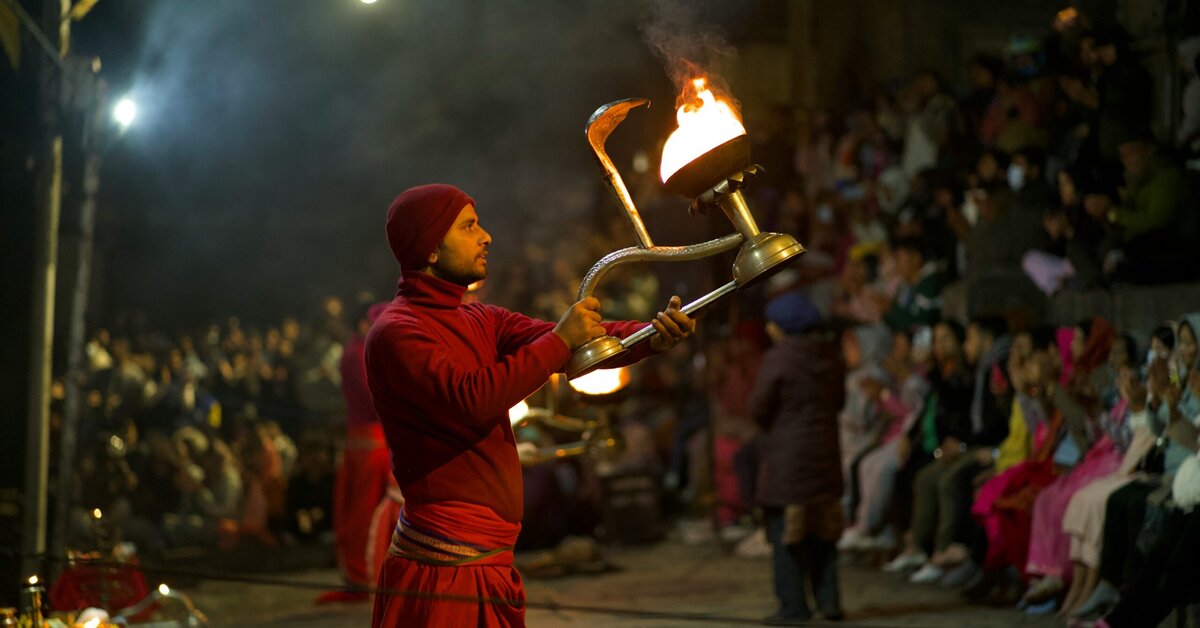
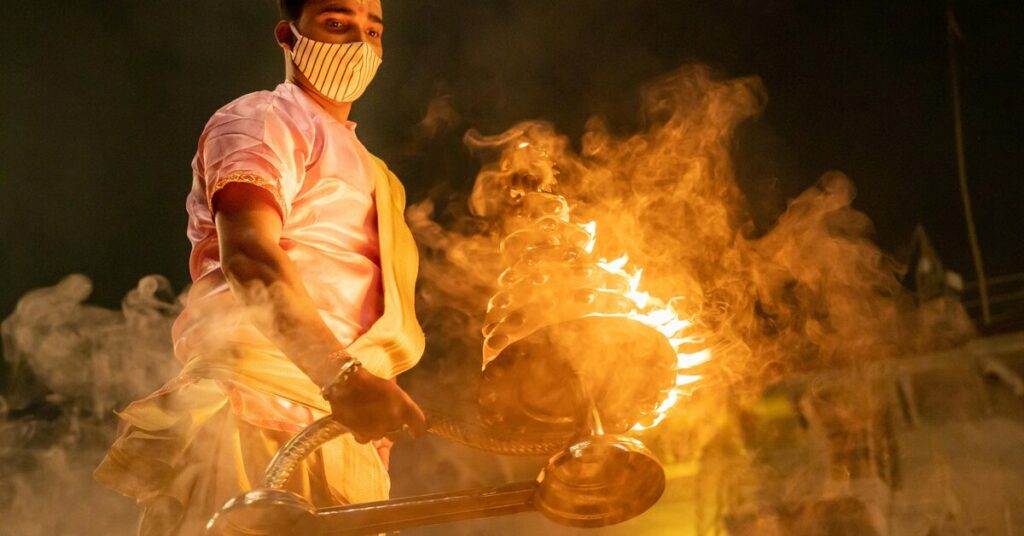
But Dashashwamedh truly comes alive during the evening Ganga Aarti, performed daily around sunset. This synchronized ritual involves young priests in traditional dress performing choreographed movements with massive brass lamps, accompanied by devotional songs, conch shells, and bells. The ceremony lasts about 45 minutes and attracts thousands of spectators.
The aarti isn’t ancient tradition but rather a relatively recent innovation, formalized in its current form only decades ago. Yet it has become quintessential Kashi for most visitors—a spectacular display of devotion, light, sound, and collective spirituality that feels both timeless and theatrical.
Witnessing the aarti from a boat on the river provides the best perspective. As darkness descends and the flames dance against the night sky, the illuminated ghats stretching in both directions create an almost surreal atmosphere. It’s easy to understand why this ceremony has become iconic, even if purists argue it’s more performance than authentic ritual.
At Kashi’s southern end lies Assi Ghat, where the small Assi River meets the Ganges. This ghat has a completely different character from Dashashwamedh—calmer, slightly more modern, and popular with both young Indian travelers and international visitors.
Assi Ghat’s relaxed vibe has attracted cafes, yoga centers, guesthouses, and restaurants catering to longer-term travelers. The area has become a hub for cultural activities, with regular classical music performances, meditation sessions, and the famous Subah-e-Banaras morning concert series that brings renowned musicians to perform at dawn.
The ghat itself is relatively simple architecturally but offers lovely river views. A large peepal tree provides shade, and a Shiva lingam under the tree attracts devotees. Early mornings see yoga practitioners on the ghat, pilgrims performing rituals, and locals taking their morning exercise walks along the river.
Assi has managed to balance tradition with contemporary comfort, making it ideal for travelers who want to experience Kashi’s spirituality without completely leaving modern conveniences behind. It’s become the de facto base for many visitors, explaining the proliferation of accommodations and eateries in the surrounding lanes.
Now we come to perhaps Kashi’s most profound and intense location—Manikarnika Ghat, the main cremation ground that operates 24 hours a day, 365 days a year. This isn’t a tourist attraction in the conventional sense, but rather a window into Hindu philosophy regarding death, rebirth, and liberation.
The name derives from “manikarnika,” the jeweled earring that Lord Shiva or Goddess Parvati is said to have dropped here while creating the universe. The ghat’s waters are believed to be especially sacred, and the smoke from its funeral pyres never stops rising skyward, carrying souls toward moksha.
Hindus believe that dying in Kashi and being cremated at Manikarnika Ghat guarantees liberation from the cycle of birth and death. This belief draws families from across India to bring their deceased loved ones here for final rites, considering it the ultimate blessing for the departed soul.
Witnessing cremations can be emotionally overwhelming and philosophically challenging, especially for visitors unfamiliar with Hindu death rituals. Bodies wrapped in colored cloth arrive on bamboo stretchers, accompanied by male family members (traditionally, women don’t attend cremations). The body is dipped in the Ganges, placed on a pyre of stacked wood, and cremated in open air.
The Dom Raja, an hereditary guardian of the sacred fire that has burned here for thousands of years, oversees the process. His family maintains this fire and provides services to grieving families, occupying a unique position in Hindu society—ritually polluted due to handling death, yet essential and respected for maintaining this most sacred function.
Photography is strictly prohibited at Manikarnika, and this rule must be respected absolutely. This is a place of profound grief and sacred ritual, not a spectacle for tourist cameras. Observe respectfully from a distance if you choose to visit, maintaining silence and avoiding intrusive behavior.
The philosophical lesson of Manikarnika is powerful: in Kashi, death isn’t hidden or feared but acknowledged as a transition. The openness about mortality, the acceptance of impermanence, and the belief in something beyond physical existence all manifest in this ghat’s continuous cycle of cremation and ritual.
While Manikarnika is more famous, Harishchandra Ghat claims to be Varanasi’s oldest cremation ground, named after the legendary King Harishchandra who worked here as a cremation ground keeper during his period of extreme testing by the gods.
This ghat operates similarly to Manikarnika but handles fewer cremations and sees fewer visitors, making it slightly less overwhelming. The same rules apply—no photography, respectful observation only, and awareness that you’re witnessing sacred family moments during their most difficult times.
Both cremation ghats offer profound insights into Hindu perspectives on mortality. For philosophical travelers willing to contemplate death openly, these ghats transform from morbid curiosities into deeply meaningful experiences that reframe how we think about life’s impermanence.
Panchganga Ghat derives its name from the belief that five rivers (panch = five, ganga = rivers) converge here: the Ganges, Yamuna, Saraswati, Kirana, and Dhutpapa—though only the Ganges is physically visible. This makes it especially sacred for ritual bathing.
The ghat features impressive architecture including the prominent Alamgir Mosque, built by Mughal Emperor Aurangzeb on the ruins of a Vishnu temple. This architectural palimpsest—layers of religious structures built atop each other—physically represents Kashi’s complex history of destruction, resilience, and religious coexistence.
Panchganga is particularly active during festivals when pilgrims flock here for ceremonial baths. On normal days, it’s relatively quieter than Dashashwamedh, offering opportunities to observe local life and rituals without overwhelming crowds.
Named after the great 16th-century saint-poet Tulsidas, who lived here while composing the Ramcharitmanas (the Hindi version of the Ramayana), this ghat attracts devotees of Lord Ram. A temple dedicated to Tulsidas stands nearby, along with the Lolark Kund, an ancient step-well considered especially sacred.
Tulsi Ghat has a scholarly, contemplative atmosphere fitting for a place associated with one of Hindi literature’s greatest figures. During Nag Panchami festival, thousands gather here to worship at the Lolark Kund, transforming the usually peaceful ghat into a hub of devotional activity.
Kedar Ghat’s main attraction is the Kedareshwar Temple, dedicated to Lord Shiva. Pilgrims believe that worshiping here provides the same merit as visiting the famous Kedarnath temple in the Himalayas—convenient for those unable to make the difficult Himalayan pilgrimage.
The ghat has characteristic red and white striped walls and relatively good stone work. It attracts steady pilgrim traffic but rarely becomes overcrowded, making it pleasant for contemplative visits. The temple’s architecture displays typical North Indian style with a tall shikhara (spire) visible from the river.
Scindia Ghat tells a dramatic story—part of its Shiva temple submerged into the river during construction due to the structure’s weight. The temple’s partly submerged remains create an eerie, photogenic scene, especially during low water when more of the structure becomes visible.
Built by the Scindia family of Gwalior, this ghat showcases impressive Maratha architecture. The remaining temple structures and ghats are well-maintained and atmospheric. Early morning visits reveal local residents using the ghat for bathing, prayer, and exercise, providing glimpses of Kashi beyond the tourist experience.
The Kashi Vishwanath Temple stands as Varanasi’s spiritual nucleus, housing one of the twelve Jyotirlingas—the most sacred Shiva shrines in Hinduism. “Vishwanath” means “Lord of the Universe,” emphasizing Shiva’s supreme position in Hindu theology and this temple’s significance as his primary earthly abode.
The current structure, built by Maharani Ahilyabai Holkar of Indore in 1780, replaced earlier temples destroyed during various invasions. The 800-kilogram gold plating on its spire, donated by Maharaja Ranjit Singh of Punjab in 1835, gives the temple its “Golden Temple” nickname and creates a stunning sight gleaming above the city’s rooftops.
Accessing the temple requires navigating through crowded, narrow lanes in the old city—part of the experience that filters casual visitors and maintains a pilgrim atmosphere. Security is tight with multiple checkpoints. Non-Hindus are generally not permitted inside the inner sanctum, though policies sometimes vary and respectful visitors might gain limited access to outer areas.
Inside, the main lingam (symbolic representation of Shiva) sits in a silver altar. Pilgrims line up for darshan (viewing of the deity), often waiting hours during peak times. The temple compound includes several smaller shrines dedicated to various deities, and the atmosphere vibrates with intense devotion—bells ringing constantly, priests chanting, devotees prostrating.
The recent Kashi Vishwanath Corridor project has dramatically transformed access to the temple. This ambitious urban renewal demolished hundreds of structures to create open approaches, better facilities, and improved pilgrim management. While controversial for displacing residents and businesses, the project has made the temple more accessible and created impressive public spaces around this ancient shrine.
Whether you enter the temple or observe from outside, the devotion it inspires is palpable. For Hindus, especially Shaivites (Shiva devotees), visiting Kashi Vishwanath represents a lifetime spiritual goal, the fulfillment of deep religious aspiration.
Founded by the saint-poet Tulsidas in the early 16th century, Sankat Mochan Temple is dedicated to Lord Hanuman, the monkey deity celebrated for devotion, strength, and service. “Sankat Mochan” translates to “reliever of troubles,” and devotees believe sincere prayers here resolve their problems.
The temple sits about 3 kilometers from the main ghat area, in a slightly more residential neighborhood. Its atmosphere differs markedly from the intense crowds at Kashi Vishwanath—more spacious, calmer, with better facilities. The temple complex includes a large courtyard where devotees sit, pray, and sometimes sleep overnight before important life events.
Tuesdays and Saturdays draw enormous crowds as these days are especially auspicious for Hanuman worship. The temple also hosts the annual Sankat Mochan Sangeet Samaroh, a prestigious five-day classical music festival attracting India’s finest musicians—a beautiful fusion of devotion and art that exemplifies Kashi’s cultural richness.
The temple’s resident monkeys add character (though guard your belongings—they’re expert thieves!). Watching devotees sing bhajans (devotional songs) together creates a communal spiritual atmosphere very different from individual prayer-focused temples.
Built in the 18th century, Durga Temple’s distinctive red color and North Indian nagara architecture make it visually striking. Dedicated to Goddess Durga, the temple attracts devotees seeking the goddess’s powerful protection and blessings.
The temple complex includes the Durga Kund, a rectangular water tank considered sacred. During Navaratri, the nine-night festival celebrating Durga, the temple becomes the focal point of massive celebrations with special prayers, music, and thousands of devotees.
Like Sankat Mochan, this temple has numerous resident monkeys, earning it the popular nickname “Monkey Temple.” The monkeys add lively chaos to visits—entertaining but requiring vigilance with belongings. The temple’s location near Banaras Hindu University makes it easily accessible and popular with students and academic visitors.
Unlike ancient temples, Tulsi Manas Temple is relatively modern, built in 1964 by a wealthy Hindu family. What makes it special is its connection to Tulsidas and the Ramcharitmanas—the walls are inscribed with verses from this beloved epic.
The temple’s architecture draws from various Indian styles, creating an eclectic but harmonious appearance. The marble structure gleams white, quite different from the aged stone of older temples. Inside, scenes from the Ramayana are depicted in paintings and murals, making it both a temple and an artistic celebration of this epic’s cultural significance.
During Ram Lila season (the month-long dramatic reenactment of the Ramayana preceding Dussehra), the temple becomes a major activity center. The atmosphere is generally peaceful and welcoming, making it comfortable for visitors less familiar with Hindu temple protocols. Shoes must be removed, but photography is typically permitted outside the main shrine.
The Nepali Temple (also called Kathwala Temple) stands out dramatically from typical Hindu temples due to its Newari architecture—wooden structure with pagoda-style design and intricate terracotta work. Built in the 19th century by the King of Nepal, it showcases Nepali artistic traditions transplanted to Kashi.
The temple complex includes miniature replicas of the Pashupatinath Temple from Kathmandu and features erotic carvings similar to those found at Khajuraho, though smaller in scale. These sexual sculptures, common in Hindu temple architecture, represent tantric philosophies about the sacred nature of all aspects of life.
The temple isn’t on the main ghat area, requiring a short auto-rickshaw ride, but its unique architecture makes it worthwhile for those interested in diverse temple styles. It’s generally less crowded than major temples, allowing leisurely exploration and photography.
The Alamgir Mosque, standing prominently at Panchganga Ghat, represents Kashi’s complex religious history. Built by Mughal Emperor Aurangzeb in 1669 on the remains of a destroyed Vishnu temple, it physically embodies the city’s layers of conquest, destruction, and architectural palimpsest.
The mosque’s base clearly shows Hindu temple foundations, and architectural elements reveal its composite history. For visitors interested in the intersection of religious history and architecture, it offers tangible evidence of how buildings become battlegrounds and symbols in religious conflicts.
Today, the mosque functions normally with Muslim worshippers while sitting amid predominantly Hindu surroundings—a testament to contemporary coexistence even as its history reminds of past conflicts. Non-Muslim visitors can view it from outside, appreciating its architectural significance without intruding on active worship.
Dedicated to Kal Bhairav, a fierce manifestation of Shiva associated with annihilation of evil and protection of the city, this temple has a distinctive atmosphere—intense, slightly ominous, and powerful. Bhairav is considered Kashi’s guardian deity, and the temple draws devotees seeking protection and justice.
What makes this temple particularly unusual is the offering practice: devotees offer alcohol to the deity. Watching priests pour liquor before the idol surprises first-time visitors unaccustomed to alcohol in Hindu worship, but it reflects Bhairav’s transgressive, tantric nature—a deity beyond conventional moral categories.
The temple sits away from the main tourist areas, attracting primarily serious devotees rather than casual visitors. The atmosphere is markedly different from more mainstream temples—darker, edgier, with an undercurrent of tantric practice that reveals Hinduism’s esoteric dimensions rarely visible in touristy temple circuits.
Understanding Kashi requires understanding the Ganges’ sacred status in Hinduism. The river isn’t merely holy—it’s worshipped as a goddess, Ganga Ma (Mother Ganges), believed to flow from heaven to earth through Shiva’s matted hair, purifying everything it touches.
Mythologically, the Ganges descended from heaven through the austerities of King Bhagiratha, who sought to purify his ancestors’ ashes. Scientifically, the river flows from Himalayan glaciers through the plains to the Bay of Bengal, supporting millions through irrigation, drinking water, and fisheries. But for devotees, these physical facts matter less than the spiritual truth: the Ganges washes away sins and brings the divine into earthly contact.
The water is considered so pure that it doesn’t spoil even when stored for long periods—a claim with some scientific basis due to bacteriophages (viruses that kill bacteria) present in higher concentrations than in other rivers. Devotees collect Ganga jal (Ganges water) to take home for rituals, considering it the most purifying substance available.
In Kashi specifically, the Ganges flows northward for a short stretch—the only place in its long journey where this occurs. This unusual northern flow adds to Kashi’s mystique, interpreted as the river’s respect for the sacred city, bowing toward the divine Himalayas rather than following its natural course.
Dawn at the ghats reveals the Ganges’ role in daily spiritual life. Pilgrims descend the steps for ritualistic bathing, immersing three times while facing the rising sun, performing prayers with water cupped in their hands, and offering flowers and lamps to the river.
These aren’t exotic rituals for tourists but essential spiritual practices followed by millions. For devout Hindus, bathing in the Ganges—especially in Kashi—purifies not just the body but the soul, washing away accumulated karma and spiritual impurities from countless lifetimes.
Priests offer paid services, conducting elaborate pujas for families. These ceremonies involve complex sequences of mantras, offerings of flowers, incense, and food to deities, and concluded with the floating of flower-filled leaf boats with lit candles on the river—the diyas that create such photogenic scenes as they drift downstream.
The rituals vary by caste, region, family tradition, and individual need. Some bathers complete their ablutions in minutes; others spend hours in prayer and meditation. Some hire priests; others perform self-directed worship. This diversity reveals Hinduism’s flexibility—no single correct way exists, only millions of personal paths toward the divine.
If you do nothing else in Kashi, take a sunrise boat ride. As dawn breaks over the Ganges, the ghats transform into something transcendent. The golden light paints ancient architecture in warm hues, the water reflects the awakening sky, and the city slowly comes to life in a symphony of bells, chants, and prayers.
From your boat, you’ll glide past dozens of ghats, each revealing different aspects of river life. Yogis perform postures on the steps. Bathers immerse themselves in morning devotions. Priests conduct fire ceremonies with smoke rising toward the lightening sky. Boatmen row traditional wooden boats. Laundry workers (dhobi wallahs) pound clothes on washing stones. Children play in shallow water. The elderly sit contemplating the flowing river.
Your boatman will likely provide commentary about various ghats, their histories and associated legends. But the real value is simply being present—watching the city wake, feeling the morning calm before day’s heat and crowds arrive, and experiencing Kashi’s timeless rhythms from the river that gives it meaning.
The boat ride typically lasts one to two hours, depending on how far you travel and whether you stop at any ghats. Early morning brings cooler temperatures, softer light, and quieter atmosphere—ideal conditions for photography, reflection, or simply absorbing the experience.
As day transitions to evening, the ghats undergo another transformation. The harsh midday light softens, temperatures cool, and activity increases as people emerge from afternoon rest. The evening aarti at Dashashwamedh becomes the focal point, but every ghat has its own evening character.
Some ghats host smaller aartis with local communities gathering for prayers. Others become social spaces where people stroll, chat, and watch the river. The dying light creates dramatic conditions for photography—silhouettes, reflections, the interplay of natural sunset with artificial lights beginning to glow.
Evening boat rides offer different perspectives than morning trips. Instead of watching the city wake, you observe it wind down from day’s activities. The aarti viewed from the river creates spectacular visual impact with flames and lights reflected in dark water, devotional music carrying across the river, and illuminated ghats stretching in both directions.
Many visitors find evenings more dramatic and photogenic, while others prefer morning’s peaceful spirituality. Ideally, experience both—they represent different facets of Kashi’s personality, equally valid and memorable.
Kashi has nurtured Indian classical music for centuries, producing legendary musicians and remaining a primary learning center. The city’s gharana (school) of classical music is distinctive, and tabla virtuosos, sitar maestros, and vocalists have studied here for generations.
Visitors can experience this heritage through regular performances at cultural centers, temples, and private venues. The Sankat Mochan music festival represents the pinnacle—five days of India’s finest classical music performed in a temple courtyard, free for all attendees. Other venues host more intimate concerts where you might sit on the floor in a traditional space with twenty other listeners, experiencing the music as it’s been heard for centuries.
Classical dance traditions also thrive here, particularly Kathak. Schools teach traditional forms, and performances occur regularly at cultural institutions and during festivals. This isn’t museum-piece culture—it’s living tradition continuously evolving while maintaining centuries-old techniques and philosophies.
Banarasi silk sarees represent one of India’s finest textile traditions, with weaving centered in Kashi for centuries. The craft came to prominence during Mughal times when Persian designs merged with Indian techniques, creating the distinctive brocade patterns that characterize Banarasi silk.
Thousands of families continue this tradition in small workshops throughout the city. Visiting these weaving centers reveals the painstaking work behind each saree—some designs requiring months of labor on traditional pit looms. The weavers’ skill is extraordinary, translating complex patterns into woven reality without written instructions, working from memory and aesthetic sense developed over lifetimes.
The silk trade provides livelihoods for significant portions of Kashi’s population, creating economic interdependence around artistic tradition. While mechanization and cheap imitations threaten traditional weaving, dedicated artisans continue producing high-quality handwoven silk, preserving techniques passed down through countless generations.
Purchasing authentic Banarasi silk directly from weavers supports traditional crafts while acquiring genuinely special textiles. The workshops welcome visitors, explaining processes and allowing observation of this remarkable craft in action.Sanskrit and Learning Centers
Kashi has been a learning center since ancient times, particularly for Sanskrit, Hindu philosophy, and traditional sciences. The city houses numerous Sanskrit schools (pathshalas), where scholars study ancient texts, debate philosophy, and maintain knowledge traditions thousands of years old.
Banaras Hindu University, established in 1916, represents modern continuation of this learning tradition—a massive institution with over 30,000 students studying everything from engineering to Sanskrit literature. The university’s campus is worth visiting for its beautiful architecture, museums, and the Bharat Kala Bhavan art museum with exceptional collections of miniature paintings and sculptures.
Visitors interested in Indian philosophy can find teachers offering courses in yoga, meditation, Vedanta, and Sanskrit. These range from serious academic study to tourist-friendly introductions, catering to various interest levels and time commitments. Engaging with this intellectual tradition adds depth to understanding why Kashi matters beyond its visual and ritual aspects.
Fifteen days after Diwali comes Dev Deepawali, when the gods themselves are believed to descend to Kashi to bathe in the Ganges. This festival transforms the ghats into seas of light—thousands upon thousands of earthen lamps lined along every step, creating one of India’s most spectacular visual displays.
The entire stretch of ghats blazes with lights reflected in the river, creating mirror-like beauty. Special aartis occur at multiple ghats simultaneously, cultural programs showcase music and dance, and the atmosphere crackles with festive energy. The sight of illuminated ghats stretching kilometers in both directions is genuinely magical—easily one of India’s most beautiful festival scenes.
Dev Deepawali attracts enormous crowds—both pilgrims and tourists—so expect dense crowds, higher prices, and challenging logistics. Book accommodations months in advance and prepare for significant crowds at every ghat. The spectacle justifies the difficulties, but arrive with patience and realistic expectations about navigating festival crowds.
The “Great Night of Shiva” is one of Hinduism’s most important festivals, and nowhere is it celebrated with more intensity than in Shiva’s own city, Kashi. The festival involves night-long vigils, fasting, and offerings to Shiva, with massive crowds at Kashi Vishwanath Temple and other Shiva shrines.
Devotees line up for darshan throughout the night, some walking from distant places as pilgrimage. Sadhus (holy men) from across India converge on Kashi, creating a colorful parade of ash-covered bodies, saffron robes, and various spiritual practices. The ghats remain active through the night with continuous prayers, bhajans, and celebrations.
For visitors, Mahashivratri offers insight into Hindu devotional intensity and the special relationship between Shiva and his beloved city. The challenge is the sheer number of people—millions visit during this period, straining infrastructure and requiring significant patience and flexibility.
Celebrating the Ganges’ descent to Earth, Ganga Dussehra draws pilgrims for ritual bathing believed to provide ten lifetimes’ worth of accumulated sin forgiveness. The festival spans ten days with special significance given to bathing in the river and performing prayers.
The ghats witness massive bathing activity, and the atmosphere is festive with religious fervor. Special boat processions, underwater lamps (symbolizing offerings to the river), and elaborate aartis mark the festival days. It’s less visually spectacular than Dev Deepawali but offers deeper insight into the Ganges’ religious significance and the devotion she inspires.
To truly understand Kashi, you must grasp the concept of moksha—liberation from the cycle of birth, death, and rebirth (samsara) that Hindus believe traps souls in endless repetition. Moksha represents ultimate freedom, the soul’s reunion with universal consciousness, escape from suffering inherent in mortal existence.
Achieving moksha normally requires lifetimes of spiritual work—purifying karma through righteous action, devotion, and spiritual knowledge. But Kashi offers a shortcut: die here, be cremated at its ghats, and Lord Shiva himself whispers the Taraka Mantra (prayer of crossing over) in your ear, guaranteeing liberation regardless of accumulated karma.
This belief makes Kashi the ultimate destination for Hindus—not just a pilgrimage site but the ideal final destination. It explains why families bring dying relatives here, why elderly devotees come to spend final years in Kashi’s holy atmosphere, and why cremation at Manikarnika Ghat commands premium costs despite being a “pollution” activity avoided by most castes.
Several institutions in Kashi specifically house dying individuals—primarily elderly people who’ve come to spend their final days in the holy city. The Mukti Bhawan (Salvation House) is famous for this, accepting guests for maximum 15-day stays to die in sacred surroundings.
These aren’t medical facilities but rather hospices where people await death surrounded by spiritual atmosphere, river access for prayers, and assurance they’ll be cremated at sacred ghats. Staff members help with basic needs, but the focus is spiritual—facilitating peaceful death in the holiest possible location.
This practice strikes many Western visitors as morbid or depressing, but for Hindu participants, it’s deeply positive—fulfilling life’s ultimate purpose by ending it in circumstances guaranteeing spiritual liberation. The dying individuals often appear peaceful, their families grateful for the opportunity to provide this ultimate blessing.
Understanding these death houses and cremation traditions reveals Hindu philosophy’s comfort with mortality, the belief that death isn’t ending but transition, and the conviction that physical life, while valuable, serves the purpose of spiritual evolution toward eventual transcendence.
Kashi faces enormous challenges balancing its ancient character with modern city needs. The old city’s infrastructure—narrow lanes designed for foot and cart traffic—struggles with motorcycles, cars, and modern services. Buildings crumble from age and monsoon damage. Sanitation systems are medieval. The Ganges suffers severe pollution from sewage, industrial waste, and ritual remains.
Yet aggressive modernization risks destroying precisely what makes Kashi special—its timeless character, architectural heritage, and spiritual atmosphere. This tension creates ongoing debates between preservationists and development advocates, with no easy resolutions.
Recent years have seen major infrastructure projects attempting to thread this needle: cleaning the Ganges, improving sewage treatment, widening some lanes while preserving character, and restoring crumbling buildings. Success varies—some projects genuinely improve conditions while respecting heritage; others feel heavy-handed, sacrificing character for efficiency.
The most ambitious and controversial recent intervention is the Kashi Vishwanath Corridor project—a massive urban renewal creating open approaches to the temple, improved facilities for pilgrims, and beautified public spaces around Kashi’s holiest site.
The project demolished hundreds of structures—homes, shops, historic buildings—displacing thousands of residents and businesses. It cost billions of rupees and fundamentally altered the temple’s context. Supporters argue it was necessary to handle massive pilgrim numbers, reduce congestion, and create dignified approaches to such an important shrine. Critics condemn it as cultural destruction, forced displacement, and imposing sterile “theme park” aesthetics on an organically evolved sacred city.
Walking through the completed corridor, you’ll experience both perspectives. The open spaces are undeniably impressive—clean, spacious, well-organized. The temple is more accessible than ever. But the dense, chaotic old city character has been replaced by planned, controlled spaces that feel less authentically Kashi-like.
This project symbolizes the larger challenge: how does an ancient sacred city modernize without losing its soul? Kashi’s answer remains unwritten as development continues and its impacts unfold over coming decades.
Different times offer different experiences. Early mornings (5-8 AM) provide peaceful atmosphere, beautiful light, and authentic spiritual activity without tourist crowds. This is ideal for boat rides and photography.
Evenings (5-8 PM) are more social and festive, culminating in the Dashashwamedh aarti. They’re crowded but energetic, offering spectacle and atmosphere.
Midday (11 AM-4 PM) is hottest and least interesting—many ghats are relatively quiet as people escape the heat. However, this timing works if you want to avoid crowds and don’t mind the temperature.
Seasonally, October through March offers pleasant weather. Summer (April-June) is extremely hot, while monsoon (July-September) brings rain, humidity, and sometimes flooding affecting ghat access.
Remember you’re visiting active religious sites, not museums. Dress modestly—cover shoulders and knees. Remove shoes before entering temples. Ask permission before photographing people, especially during worship. Avoid photographing cremation ghats entirely—this rule is absolute and non-negotiable.
Maintain respectful behavior—no loud conversations, inappropriate laughter, or disrespectful comments about practices you’re observing. If you don’t wish to participate in rituals, politely decline rather than mockingly refusing.
Be aware that some priests aggressively solicit payment for conducting pujas. You’re not obligated to accept these offers. Polite but firm refusal works—say “nahi dhanyavaad” (no thank you) and move on. If you do engage a priest, negotiate prices beforehand to avoid disputes afterward.
Photography is generally permitted at ghats and outside temples, though some temple interiors prohibit it. Always ask when uncertain. Never photograph cremation ghats—this is strictly forbidden and highly disrespectful.
When photographing people, ask permission through gesture or a few Hindi words. Many locals, especially older pilgrims, will graciously agree. Others may request payment—₹10-20 is reasonable if you agree. Don’t photograph unwilling subjects.
Best photography happens during golden hours—early morning and late afternoon when light is soft and warm. The harsh midday sun creates difficult lighting conditions.
Respect privacy during intimate spiritual moments. If someone is deep in prayer or emotion, observe respectfully without intruding with cameras. The best photographs balance capturing authentic moments with respecting subjects’ dignity and privacy.
Kashi isn’t simply a city of temples and ghats—it’s a philosophy made tangible, a spiritual concept given physical form along the banks of a sacred river. Every stone, every ritual, every prayer offered here carries millennia of accumulated meaning. The ghats aren’t just steps; they’re gateways between earthly and divine realms. The temples aren’t just buildings; they’re living embodiments of devotion spanning countless generations.
Walking through Kashi challenges comfortable categories. Is it ancient or alive? Holy or chaotic? Beautiful or overwhelming? The answer is always “yes”—it’s simultaneously all these contradictions, refusing to be simplified into easy tourist narratives. The city demands you experience rather than merely observe, feel rather than just see, and question rather than assume.
The temples and ghats form Kashi’s visible architecture, but they’re animated by something deeper—the millions of devotees across centuries who’ve believed this place offers what nowhere else can: direct contact with the divine and, ultimately, liberation itself. Whether you share that belief or not, witnessing it in action—seeing the faith burning as brightly as Manikarnika’s pyres—creates experiences impossible to forget.
Kashi changes people. Maybe not in dramatic conversion experiences, but in subtle shifts—greater comfort with life’s impermanence, deeper appreciation for sustained faith, and recognition that materialism doesn’t hold all answers. The city’s lessons arrive through senses rather than sermons: in the Ganges’ flowing permanence, the temples’ timeless devotion, and the ghats’ daily demonstrations of humans seeking meaning beyond ordinary existence.
Come to Kashi with open mind and patient heart. Let the city reveal itself gradually. Accept that you won’t understand everything—neither do lifetime residents. And recognize that the temples and ghats aren’t separate from the city but rather Kashi’s very essence, the physical manifestations of humanity’s eternal search for connection with something greater than ourselves.
1. How many days should I spend exploring Kashi’s temples and ghats?
A minimum of three full days allows you to cover major ghats and temples without excessive rushing. This timeframe lets you experience a sunrise boat ride, visit 4-5 significant temples including Kashi Vishwanath, walk several ghats, attend an evening aarti, and perhaps take a day trip to Sarnath. However, Kashi rewards longer stays—five to seven days allow deeper exploration of lesser-known ghats, multiple temple visits, participation in various rituals, and simply absorbing the city’s rhythms without time pressure. Many travelers initially plan short visits but extend their stays once experiencing Kashi’s magnetic pull. If you only have one or two days, prioritize a sunrise boat ride and the evening Dashashwamedh aarti—these provide the most concentrated essence of ghat life.
2. Is it safe to take holy dips in the Ganges, given pollution levels?
The Ganges through Varanasi is heavily polluted with sewage, industrial waste, and other contaminants, creating legitimate health concerns. While millions bathe here believing the river’s spiritual purity overrides physical contamination, non-accustomed immune systems risk infections, particularly gastrointestinal issues. If you wish to participate ritually, consider simply touching the water to your forehead or sprinkling it on yourself rather than full immersion. Never submerge your head or allow water in your mouth. If you do bathe, shower thoroughly with soap afterward and consider carrying hand sanitizer. Ultimately, the decision balances spiritual interest against health pragmatism. Many non-Hindu visitors respectfully observe without bathing, appreciating the practice’s significance without personally participating. There’s no obligation to bathe—respectful witnessing is entirely appropriate and often more comfortable for visitors.
3. Can non-Hindus enter all temples in Kashi, or are there restrictions?
Entry policies vary by temple. The inner sanctum of Kashi Vishwanath Temple traditionally restricts access to Hindus only, though outer areas may be accessible to respectful visitors. Many other temples welcome visitors of all faiths with basic requirements: remove shoes, dress modestly, and behave respectfully. Temples like Tulsi Manas, Durga Temple, and Sankat Mochan generally allow non-Hindu visitors to enter and observe. Always ask staff or guards if you’re uncertain—they’ll guide you on what’s permissible. Even when entry is restricted, exterior architecture and surrounding atmosphere provide meaningful experiences. The ghats themselves are entirely open to everyone regardless of faith, allowing participation in public spiritual life without temple entry requirements. Approach with genuine respect rather than mere curiosity, and you’ll find most spaces welcoming to sincere visitors interested in understanding rather than judging the traditions practiced there.
4. What should I do if priests at the ghats aggressively demand money for performing rituals?
Aggressive solicitation is unfortunately common at major ghats, where priests (some legitimate, some opportunistic) approach tourists offering to perform pujas. You’re under no obligation to accept these offers. If uninterested, politely but firmly decline with “nahi dhanyavaad” (no thank you) and move away. Don’t feel pressured by elaborate explanations of your supposed spiritual need for their services. If you do want to participate in a ritual, negotiate the price clearly beforehand—ask “kitna paisa?” (how much money?) and agree on a specific amount. Reasonable costs for simple riverside prayers range from ₹100-500, while elaborate family ceremonies cost more. Get clarity before starting to avoid disputes afterward. If someone becomes genuinely aggressive or follows you persistently, seek help from nearby shop owners or other authorities. Remember, legitimate priests conduct themselves professionally; aggressive behavior indicates opportunism rather than authentic spiritual service. Trust your instincts and don’t let uncomfortable interactions diminish your overall experience.
5. Which is more worthwhile—sunrise or sunset at the ghats?
Both offer distinct, equally valuable experiences. Sunrise provides peaceful spiritual atmosphere—the city awakening, devotees performing morning prayers, soft golden light, and relatively fewer crowds. It reveals the ghats’ authentic religious function beyond tourist spectacle. Morning boat rides showcase life along the river at its most genuine, with locals engaged in daily rituals rather than performing for audiences. Sunrise suits travelers seeking contemplative, photographic, or genuine spiritual experiences. Sunset, particularly with the Dashashwamedh aarti, delivers more dramatic, festival-like atmosphere—music, fire, crowds, and palpable energy. It’s more theatrical and photogenic in different ways, with illuminated ghats creating spectacular night scenes. Sunset suits those wanting social energy and impressive ceremonial displays. Ideally, experience both—they represent complementary aspects of ghat life. If choosing only one due to time constraints, morning provides more authentic spiritual insight, while evening offers more immediate sensory impact. Your personal preferences for contemplation versus spectacle should guide the choice, though neither disappoints.
Please don’t forget to leave a review.
Explore more by joining me on Patreon