Your cart is currently empty!
You may check out all the available trips and book one that suits you.
Continue Browsing Trips
Banaras A City of Festivals and Celebrations , Have you ever wondered what it feels like to walk through a city where every corner whispers ancient prayers and every evening lights up with divine celebrations? Welcome to Banaras, also known as Varanasi or Kashi, a city that doesn’t just celebrate festivals—it breathes them. This ancient city on the banks of the holy Ganges River is more than just a destination; it’s an experience that touches your soul and transforms your understanding of spirituality, culture, and human connection.
Banaras isn’t merely old; it’s eternal. While modern cities rise and fall, Banaras has remained constant for over 3,000 years, serving as India’s spiritual capital and cultural powerhouse. The city pulses with an energy that’s hard to describe but impossible to forget. From the crack of dawn when priests perform rituals by the riverside to the mesmerizing evening aarti that sets the ghats ablaze with flickering lamps, Banaras lives in a perpetual state of celebration.
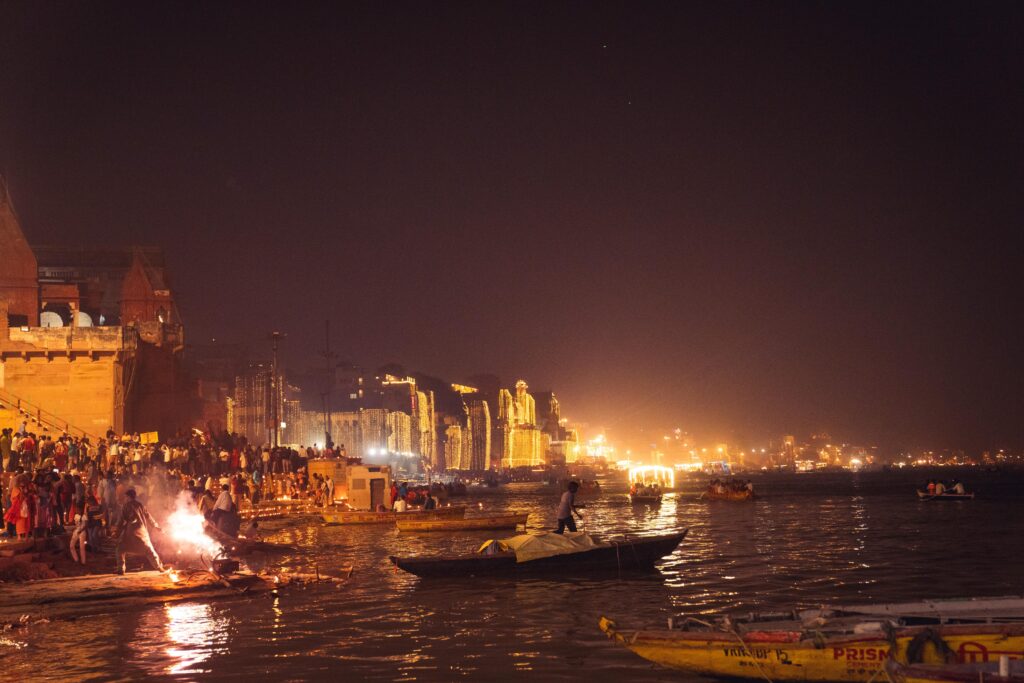
Nestled along the crescent-shaped banks of the Ganges in Uttar Pradesh, Banaras occupies a unique position both geographically and spiritually. The city’s layout itself is considered sacred, with its 88 ghats—stone steps leading down to the river—forming a spiritual staircase between the earthly and the divine. Each ghat has its own history, its own festivals, and its own stories that have been passed down through countless generations.
The narrow, winding lanes of the old city create a labyrinth where time seems to stand still. These alleys, barely wide enough for two people to pass, have witnessed centuries of processions, celebrations, and spiritual seekers. The geography of Banaras isn’t just about physical space; it’s about creating sacred ground where the divine and human worlds meet.
Imagine a city where there are more festivals than days that seem ordinary. That’s Banaras for you! The city celebrates an estimated 900 festivals annually, making it perhaps the most festival-rich destination on Earth. But why so many? The answer lies in its incredible cultural tapestry, woven over millennia by countless traditions, religious practices, and artistic expressions.
Banaras has always been a melting pot where different cultures, philosophies, and spiritual traditions converge. It’s the city where Hindu philosophy flourished, where Buddha gave his first sermon just a few kilometers away in Sarnath, and where countless saints, poets, and musicians have found inspiration. This rich heritage means that every tradition brings its own celebrations, and Banaras embraces them all.
While Banaras is predominantly known as a Hindu holy city—one of the seven sacred cities in Hinduism—its spiritual significance extends beyond single-faith boundaries. The city has been a center of learning, music, and spirituality that has attracted seekers from various traditions. This diversity adds layers to the festival calendar, making it remarkably inclusive and perpetually celebratory.
The concept of festivals in Banaras goes beyond mere religious observance. They represent the city’s heartbeat, its way of marking time, and its method of transmitting cultural values from one generation to the next. When you celebrate in Banaras, you’re not just participating in an event; you’re becoming part of a living tradition that spans millennia.
If regular Deepawali lights up homes, Dev Deepawali illuminates the entire cosmos—or at least it feels that way in Banaras! Celebrated fifteen days after Diwali, on the full moon night of Kartik Purnima, Dev Deepawali transforms the ghats into a breathtaking spectacle. Over a million earthen lamps are lit along the ghats, creating a river of light that reflects in the Ganges waters.
Legend says that on this night, the gods descend to Earth to bathe in the holy Ganges. The entire riverfront becomes a canvas of flickering flames, with each lamp representing a prayer, a hope, or a connection to the divine. Devotees believe that lighting lamps on this night brings immense spiritual merit. The sight of lakhs of diyas creating a golden glow against the dark waters is nothing short of magical—it’s poetry written in fire and faith.
The celebration includes elaborate aarti ceremonies, classical music performances, and a sense of collective devotion that’s palpable in the air. Thousands of pilgrims and tourists flock to witness this spectacle, making it one of the most photographed and cherished festivals in India.
Banaras is Lord Shiva’s city—his cosmic home on Earth—and Maha Shivaratri here isn’t just a festival; it’s the biggest spiritual gathering of the year. The city transforms into a massive celebration ground as millions of devotees pour in to offer prayers at the Kashi Vishwanath Temple, one of the twelve Jyotirlingas (sacred shrines of Shiva).
The night is filled with chants of “Har Har Mahadev” echoing through narrow lanes, processions of decorated palanquins, and devotees maintaining vigil through the night. The atmosphere is electric with devotion as people queue for hours—sometimes days—to get a glimpse of the main deity. Sadhus from across India, adorned with ash and rudraksha beads, perform ritual dances and meditation.
What makes Shivaratri special in Banaras is the belief that worshipping Shiva here on this night grants liberation from the cycle of birth and death. The entire city stays awake, temples remain open, and the spiritual energy is so intense you can almost touch it. Streets fill with bhang (a traditional preparation), sweets, and an atmosphere of joyous devotion that’s uniquely Banarasi.
For five days each November, Banaras pays tribute to its lifeline—the River Ganges—through Ganga Mahotsav. This cultural extravaganza showcases the best of Banaras’s artistic heritage, including classical music, dance performances, handicraft exhibitions, and boat races. The ghats become open-air theaters where India’s finest artists perform under the stars.
The festival beautifully blends devotion with culture. Morning prayers and rituals at the ghats are followed by daytime cultural programs and spectacular evening presentations. The boat processions decorated with flowers and lights create a moving gallery of beauty on the water. Traditional wrestlers demonstrate their skills, and food stalls offer authentic Banarasi cuisine that tempts every palate.
Ganga Mahotsav isn’t just about entertainment; it’s a celebration of the river that has sustained this civilization for thousands of years. It’s a reminder of the deep connection between the people of Banaras and their sacred river, a relationship built on reverence, gratitude, and mutual sustenance.
While the entire country celebrates Holi, Banaras adds its own spiritual dimension to this festival of colors. The celebration here extends beyond the typical one-day affair, starting weeks in advance with musical gatherings called “Holi Sammelan” where people sing traditional folk songs and devotional music dedicated to Lord Krishna.
On the main day, the city explodes in a riot of colors. But what makes Holi special in Banaras is how it breaks down all social barriers. The narrow lanes become equalizers where everyone—regardless of age, status, or background—becomes fair game for colorful attacks. Temples organize special celebrations, and the atmosphere is thick with the fragrance of traditional thandai and the sounds of drums and laughter.
The Holi at Kashi Vishwanath Temple and the celebrations at various ashrams attract thousands. It’s not uncommon to see sadhus, tourists, locals, and devotees all drenched in colors, dancing together in spontaneous celebration. This is Banaras at its most democratic—where joy recognizes no boundaries.
Here’s something remarkable: while most cities have festivals occasionally, Banaras has created a festival that happens every single evening. The Ganga Aarti at Dashashwamedh Ghat is a daily spectacle that draws thousands of spectators, yet never loses its power to mesmerize.
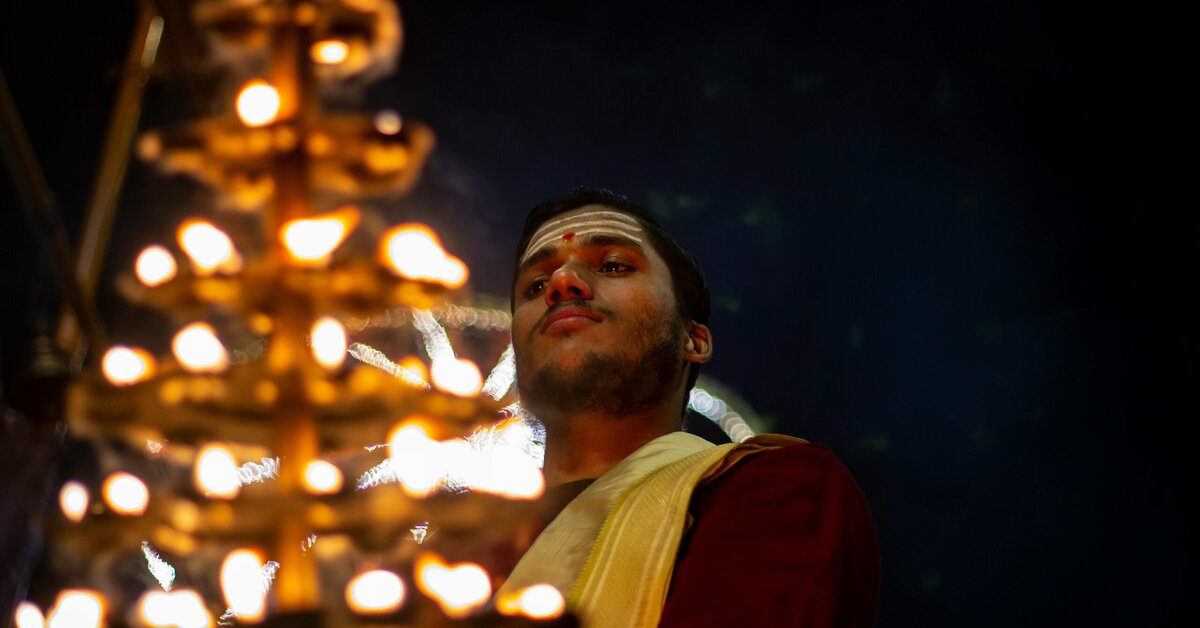
As the sun sets, priests dressed in saffron robes perform a synchronized ritual with massive brass lamps, each containing multiple wicks. The choreography is precise, the chants are ancient, and the atmosphere is charged with devotion. The flames arc through the air in graceful patterns while bells ring, conch shells blow, and the crowd watches in reverent silence punctuated by occasional “Har Har Gange” chants.
This isn’t a performance in the theatrical sense; it’s a living prayer, a conversation between the human and the divine that happens to be incredibly beautiful to witness. The reflection of the flames dancing on the water, the fragrance of incense, and the collective energy of hundreds of people sharing this moment create an experience that stays with you long after you’ve left the ghat.
For first-time visitors, the Ganga Aarti can be overwhelming. Where else in the modern world do you see such unabashed displays of faith? Where else does ancient tradition play out with such vitality in the 21st century? The experience challenges your notions of what’s possible, what’s relevant, and what connects us across time.
Many visitors describe feeling something shift inside them during the aarti—skeptics find themselves moved, the spiritual feel validated, and everyone leaves with a sense of having witnessed something profoundly significant. It’s this transformation that makes Banaras not just a city to visit but an experience that changes you.
Beyond the famous celebrations lie festivals that reveal the depth of Banaras’s cultural richness. Nag Nathaiya, celebrated in the Nag Panchami month, features a unique tradition where a symbolic serpent is carried through the streets in elaborate processions. This festival honors the serpent deities and their connection to Lord Shiva, who is often depicted wearing serpents as ornaments.
The processions are vibrant affairs with traditional music, dancers, and devotees who believe participating brings protection from snake bites and other dangers. It’s a reminder of how Banaras maintains ancient traditions that have disappeared elsewhere, keeping alive practices that connect modern residents with their ancestral past.
The day after Dussehra, Banaras celebrates Bharat Milap, commemorating the reunion of Lord Rama with his brother Bharat after Rama’s fourteen-year exile. This festival unique to Banaras features a grand procession where effigies representing the two brothers are brought together at Nati Imli crossing in a dramatic reenactment.
The emotional intensity of this reunion, witnessed by lakhs of devotees, creates moments of collective joy that are hard to find elsewhere. Families who have been separated reunite on this day, and the festival becomes a celebration of all brotherly bonds. The atmosphere is festive yet touching, reminding everyone of the values of loyalty, love, and family that underpin Indian culture.
Given Banaras’s proximity to Sarnath, where Buddha delivered his first sermon, Buddha Purnima holds special significance. The celebrations include processions, special prayers at Buddhist temples, and cultural programs that highlight Buddhist philosophy. Pilgrims from across Asia visit during this time, adding an international flavor to the festivities.
The celebration creates a beautiful contrast in this predominantly Hindu city, showcasing Banaras’s inherent pluralism and its historical role as a center of multiple spiritual traditions. It’s a living example of how different faiths can coexist and enrich each other.
No celebration in Banaras is complete without music—and we’re not talking about recorded songs played on loudspeakers. Classical music forms the soundtrack of Banaras festivals, with legendary musicians often performing at major celebrations. The city has produced some of India’s greatest classical musicians, and this musical heritage infuses every festival with artistic excellence.
During festivals, you’ll encounter impromptu performances of classical ragas, devotional bhajans sung by groups of devotees, and folk music that has been passed down through generations. The Sankat Mochan Music Festival, though dedicated to music, represents how art and devotion intertwine in Banaras. The entire night is spent in musical offerings to Lord Hanuman, with India’s top classical musicians considering it an honor to perform.
Traditional arts like silk weaving, clay lamp making, and flower arrangement all peak during festival seasons. Artisans work overtime to create the materials needed for celebrations, and their crafts become integral parts of the festival experience. When you light a handmade diya during Dev Deepawali, you’re participating in an artistic tradition that’s centuries old.
In an age where communities are fragmenting and people barely know their neighbors, Banaras festivals serve as powerful social glue. The preparation for major festivals begins weeks in advance, with neighborhood committees forming, funds being collected, and tasks being distributed. These activities create opportunities for interaction that transcend normal social boundaries.
During festivals, the entire city becomes one large family. Strangers share sweets, neighbors help decorate each other’s homes, and the usual social hierarchies dissolve in collective celebration. A wealthy merchant and a daily wage worker might stand shoulder to shoulder during the aarti, united in devotion and celebration.
The festivals also serve as occasions for resolving disputes, renewing relationships, and strengthening community bonds. Families who have fallen out make peace during festivals, old friendships are rekindled, and new connections are formed. In this way, festivals aren’t just religious or cultural events—they’re social technology that maintains the fabric of community life.
While spirituality drives the festivals, economics follows closely behind. The festival calendar creates year-round economic activity in Banaras. Hotels, guesthouses, restaurants, and tour operators see booking spikes around major festivals. Local artisans, priests, boatmen, flower sellers, and countless others depend on festival seasons for significant portions of their annual income.
During Dev Deepawali alone, the city hosts hundreds of thousands of visitors, creating a massive economic surge. Small businesses thrive, temporary employment opportunities emerge, and the entire city’s economy gets a boost. The handicraft sector particularly benefits as visitors purchase silk saris, brass lamps, and other Banarasi specialties as souvenirs.
However, this economic impact isn’t just about tourism revenue. Festivals sustain traditional occupations that might otherwise disappear. The demand for handmade diyas keeps potters employed, the need for fresh flowers supports generations of flower growers, and the requirement for priests maintains a class of religious specialists. In preserving festivals, Banaras also preserves livelihoods and traditional skills.
Want to experience festival-rich Banaras at its best? Timing matters. The period from October to March is ideal, as this window captures most major festivals while offering pleasant weather. The scorching summer months can be challenging, though dedicated festival enthusiasts brave the heat for Maha Shivaratri in February-March.
November stands out as particularly spectacular, with Dev Deepawali typically falling in this month, along with Ganga Mahotsav. The weather is perfect, the ghats are beautifully decorated, and the cultural programs are in full swing. If you can only visit once, November offers the best festival experience.
However, each season has its charm. The spring festival of Holi (March) offers a completely different vibe, summer brings unique rituals related to water and cooling traditions, and the monsoon season, while less tourist-friendly, has its own mystical quality with the swollen Ganges and rain-washed ghats.
Planning to dive into Banaras’s festival madness? Here are some insider tips to enhance your experience:
Book accommodations well in advance—hotels fill up quickly during major festivals, sometimes months ahead. Consider staying near the ghats to be at the heart of the action, though be prepared for noise and crowds.
Dress modestly and respectfully, especially when visiting temples. Remove shoes where indicated, and be mindful of photography restrictions in sacred spaces. Many devotees are happy to be photographed, but always ask permission first.
Arrive early for major events like the Ganga Aarti. Prime viewing spots fill up hours before the ceremony begins. Consider watching from a boat for a different perspective and potentially fewer crowds.
Stay hydrated and protect yourself from the sun during daytime festivals. The ghats offer minimal shade, and India’s sun can be intense even in winter months.
Keep your valuables secure—crowded festival conditions attract pickpockets. Carry minimal cash and documents, and keep them in secure, inside pockets.
Hire a knowledgeable local guide for your first festival experience. They can explain the rituals, navigate the crowds, and help you understand the deeper significance of what you’re witnessing.
Be patient and flexible—Indian festivals operate on their own timeline. Events might start late, crowds can be overwhelming, and things rarely go exactly as planned. Embrace the chaos as part of the experience.
Try the local festival foods, but be cautious with street food if you have a sensitive stomach. Festival times bring out special sweets and snacks that you won’t find other times.
Respect the sacred nature of these celebrations. These aren’t performances staged for tourists—they’re genuine expressions of faith. Participate respectfully, observe quietly when appropriate, and approach the experience with humility and openness.
Banaras stands as a testament to the enduring power of tradition, faith, and community celebration. In a rapidly modernizing world where ancient practices often give way to contemporary convenience, this city maintains its identity as a living, breathing festival ground. The celebrations here aren’t museum pieces or tourist attractions—they’re vital expressions of a culture that has remained unbroken for millennia.
What makes Banaras truly special isn’t just the grandeur of its festivals or the beauty of its rituals. It’s the way these celebrations create space for the sacred in everyday life, the way they bring millions together in shared purpose, and the way they offer glimpses of something beyond the mundane. Whether you approach these festivals as a devotee, a cultural enthusiast, or a curious traveler, Banaras has a way of touching something deep within you.
The city teaches us that celebration is essential to the human spirit, that rituals connect us across generations, and that there’s profound wisdom in maintaining traditions even when their origins are ancient. In celebrating continuously, Banaras reminds us to find joy in the present, to honor the past, and to create meaningful connections with both the divine and with each other.
While Banaras celebrates countless festivals, Maha Shivaratri holds special significance as the city is considered the earthly abode of Lord Shiva. However, Dev Deepawali is equally spectacular and attracts massive crowds for its visual grandeur. The importance of any festival often depends on personal devotion and the specific temple or tradition you’re following.
Yes, Banaras is generally safe during festivals, though the massive crowds require extra vigilance regarding your belongings. The city has enhanced security during major celebrations, and locals are typically helpful to visitors. However, the sheer number of people can be overwhelming, especially for those uncomfortable with crowds. It’s advisable to stay aware of your surroundings and follow basic safety precautions.
Absolutely! Banaras welcomes people of all faiths to witness and participate in its festivals. The city has a long history of pluralism, and most celebrations are open to everyone. However, certain temple inner sanctums may have restrictions. When participating, approach with respect and genuine interest rather than as mere spectacle, and most locals will be happy to include you in the celebrations.
The festivals themselves are free to attend—you can watch the Ganga Aarti, participate in processions, and experience most celebrations without spending anything. However, costs for accommodation, food, and travel to Banaras increase during major festivals due to high demand. Budget travelers can still manage with modest accommodation, while those seeking comfort should expect to pay premium rates during peak festival seasons.
Modest, comfortable clothing is recommended. For women, covering shoulders and knees is respectful, and traditional Indian attire like salwar kameez or long skirts with dupattas work well. Men should avoid shorts when visiting temples. Comfortable walking shoes are essential as you’ll be navigating uneven ghats and crowded lanes. Light cotton fabrics work best for most of the year, with warmer layers needed in winter months. When attending evening ceremonies, carrying a shawl is practical for both modesty and warmth.