Your cart is currently empty!
You may check out all the available trips and book one that suits you.
Continue Browsing Trips
Custom Temple Circuit Planning , Learn how to plan a custom temple circuit across North India. Deity-based routes, aarti timings, transport tips & expert help from Tripcosmos.
There is no single right way to visit temples. A Shaivite devotee arriving in Varanasi has an entirely different priority list than a Vaishnava family travelling from Mathura to Ayodhya. A retired couple seeking peace at lesser-known shrines has different needs than a group of young devotees completing the Pancha Tirtha in five days. And yet, most temple tour packages offer the same fixed route for everyone.
This is the core problem with pre-packaged temple tours — they are designed for an average traveller who does not really exist. A custom temple circuit, planned around your faith tradition, your group’s pace, your specific deities, and your available days, is a fundamentally different kind of journey. This guide explains exactly how to design one.
Planning a temple circuit is not the same as planning a leisure holiday. The logic that drives it is different from the start.
In leisure travel, you balance sightseeing with restaurants, shopping, and rest. In a temple circuit, your primary non-negotiables are the temples themselves — their opening hours, their aarti timings, their darshan queues, their ritual requirements, and sometimes their auspicious dates on the Hindu calendar. Everything else — accommodation, food, transport — is arranged in service of these.
This is why standard travel apps and generic tour operators frequently get temple circuits wrong. They treat temples like attractions you visit and move on from. Experienced pilgrims know the difference between being inside the Kashi Vishwanath Corridor during the Shringar Aarti at sunrise and simply “visiting” it at noon.
Getting this right requires working backwards from the temples — not forwards from a map.
Before you plot a single route, identify which type of temple circuit you are building. The four most common types for North India are:
These circuits are organized around a specific deity. A Shiva devotee might plan a circuit covering Kashi Vishwanath in Varanasi, Omkareshwar Mahadev in Prayagraj, and Vindhyavasini Devi in Mirzapur — each stop connected not by geography alone but by devotional significance. A Vishnu devotee might focus on Mathura, Vrindavan, and Ayodhya’s Ram Mandir.
The advantage of this approach is clarity of intention. Every stop reinforces the same spiritual thread.
These circuits follow the most logical route between sacred cities, minimizing backtracking and travel fatigue. Varanasi → Vindhyachal → Prayagraj → Chitrakoot → Ayodhya is a natural west-to-east (or east-to-west) arc. You can read more about how these destinations connect in our guide to the 7-Day Temple Tour Across Uttar Pradesh.
Some devotees follow the sacred geography laid out in ancient texts — the Char Dham, the Pancha Kedar, the Dwadasha Jyotirlinga, or the Shakti Peethas. In North India’s context, the Kashi Karvat, the Triveni Sangam in Prayagraj, and the Sapta Puri (seven sacred cities) provide a scriptural framework for the circuit.
Some pilgrims plan temple circuits around a specific occasion — a Mundan, a Pitru Paksha Pind Daan, a Saptah Yagna, or a family member’s last rites and subsequent rituals. The entire circuit is sequenced based on what rituals need to happen, in what order, and at which tirthas. This requires deep local knowledge that a generic tour operator simply cannot provide.
Once you know your circuit type, list every temple you want to visit. Then honestly map them against your available days. This is where most self-planned temple circuits fall apart — the list is always longer than the days.
A practical rule: plan no more than two major temples per day, with one travel day between cities. This sounds conservative, but consider what two major temples actually involves:
That is already a full day for most groups, especially those with seniors or young children.
For temples that require special rituals — Pind Daan at Gaya, Mundan at Kashi Vishwanath, Sangam snan at Prayagraj — budget a full day for that temple alone.
The sequence in which you visit temples matters — both spiritually and logistically.
Spiritually, many traditions have a specific order. In Kashi, for instance, the Panchakaroshi Yatra has a defined clockwise route through 108 specific temples. Attempting it in random order misses the point entirely. Similarly, the Prayagraj Triveni Sangam snan is traditionally followed by visits to specific temples along the Sangam banks — not preceded by them.
Logistically, the sequence determines how much time you waste in transit. A poorly sequenced circuit might have you crossing the same stretch of road three times in a day. A well-designed one moves you through the city in a single continuous arc.
This is where a local travel partner who knows these sacred cities from the inside — their lanes, their temple rhythms, their crowd patterns — becomes genuinely valuable.\
This is the single most overlooked element in temple circuit planning.
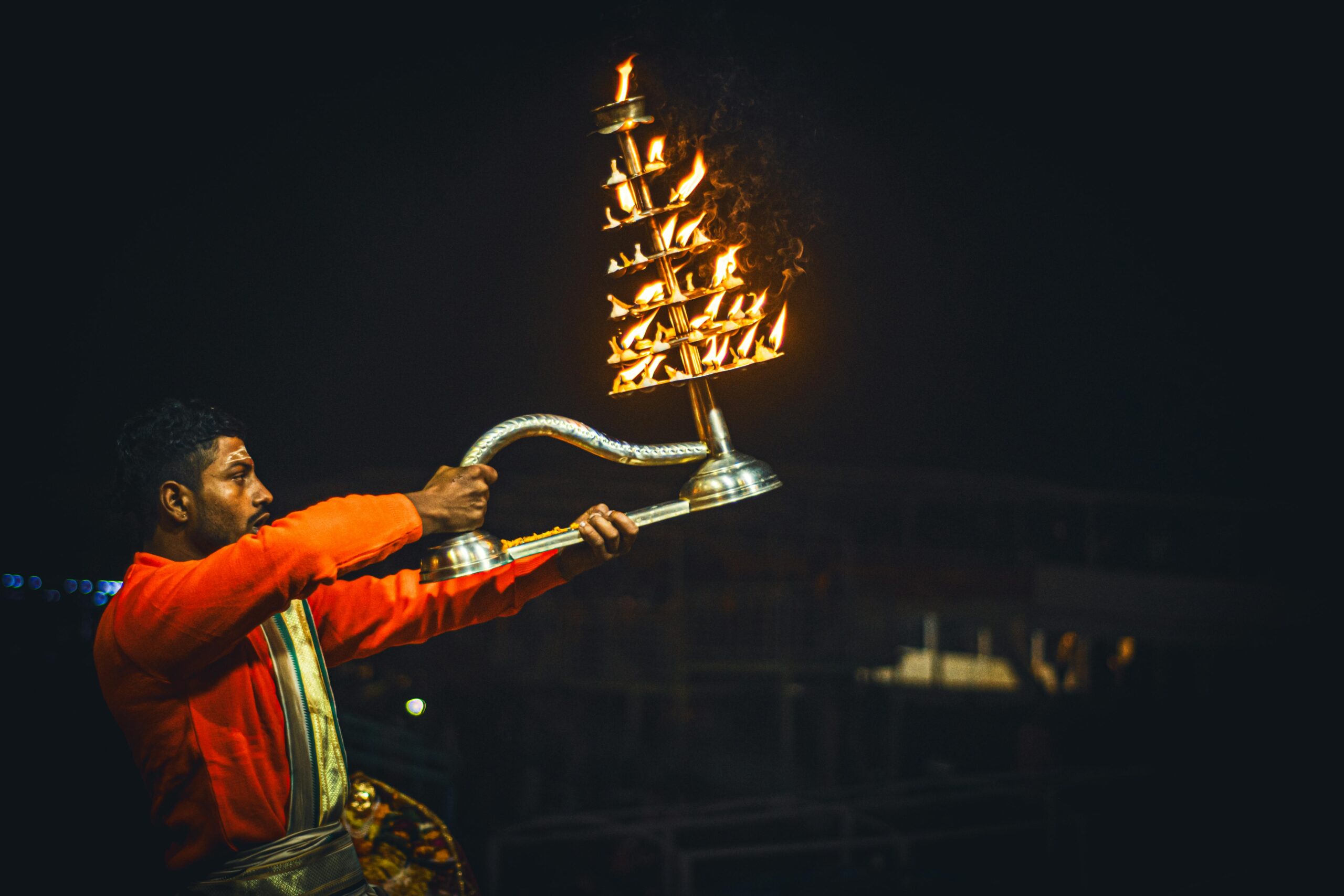
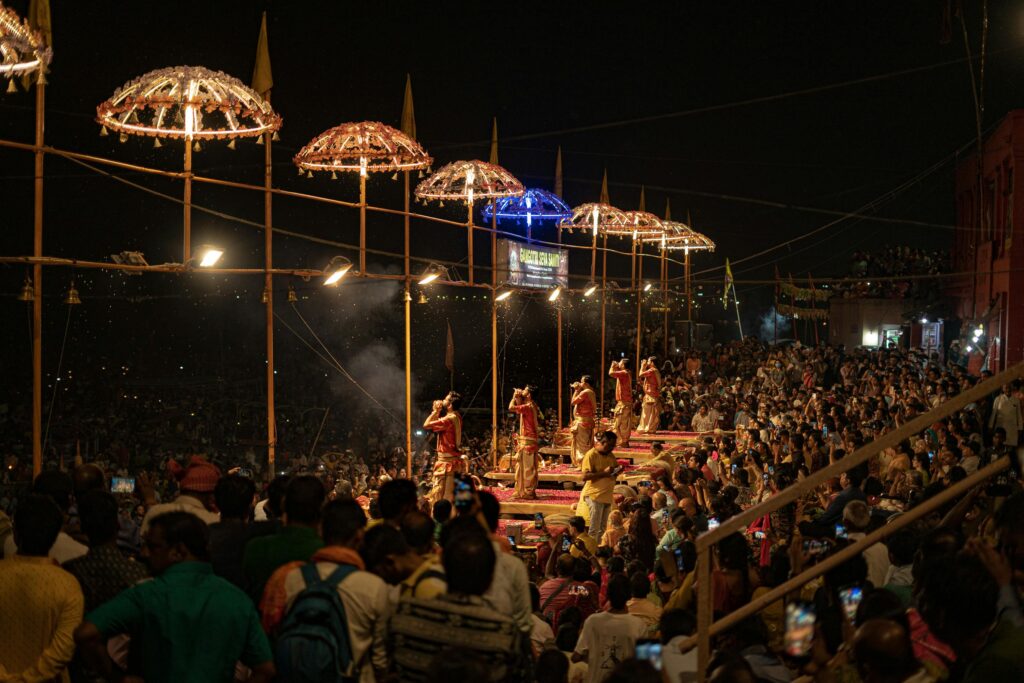
Every major temple has a daily schedule of six or seven aartis, and these aartis vary dramatically in spiritual significance and sensory experience. The Mangala Aarti at Kashi Vishwanath begins at around 3 AM and is considered the holiest. The evening Ganga Aarti at Dashashwamedh Ghat — best witnessed from a boat on the river — begins at sunset and typically draws thousands of devotees.
If you are not planning around these timings, you are planning around the wrong thing entirely. Your transport, your accommodation location, your meal schedule — everything needs to be arranged so that you are at the right place at the right time, not wandering in at 11 AM when the spiritual atmosphere has already shifted.
Booking a Varanasi boat ride for the Ganga Aarti is a perfect example of this — the experience is completely different when you witness it from the water rather than the crowd on the ghat steps.
Transport is not a detail you figure out after planning the temples. It is part of the plan itself.
A small family of four visiting Varanasi and Ayodhya over three days needs a different vehicle than a group of fifteen pilgrims covering five cities in seven days. Getting this wrong means either overpaying for unused seats or cramming people into a vehicle that is too small for long inter-city stretches.
Here is a practical guide:
The right vehicle also needs a driver who knows the roads — including the narrow lanes around ancient temples that no GPS handles well. Local knowledge matters here.
If you are starting from scratch and need a framework, here are three circuit templates that work well for different types of devotees:
Circuit A — The Kashi-Prayag-Ayodhya Arc (5–7 days) Varanasi → Vindhyachal (Mirzapur) → Prayagraj → Chitrakoot → Ayodhya. This covers Shaiva, Shakta, and Vaishnava traditions in one continuous journey. Read more about the Chitrakoot and Ayodhya destinations before planning.
Circuit B — The Forest Pilgrimage (3–4 days) Varanasi → Naimisharanya → Lucknow (optional) → return. Naimisharanya is one of the most profoundly sacred and least-crowded pilgrimage forests in all of Hindu scripture — an essential circuit for those seeking depth over spectacle.
Circuit C — The Buddhist Sacred Trail (4–5 days) Varanasi (Sarnath) → Bodhgaya → Rajgir → Nalanda. For Buddhist pilgrims and those interested in the Dharmic traditions beyond Hinduism. The Bodhgaya destination page on Tripcosmos covers what to expect.
According to Hindu sacred geography, the temples across Uttar Pradesh and Bihar represent the most concentrated sacred landscape in Asia — and a custom circuit is the only way to truly do justice to it.
Building a custom temple circuit requires two things: genuine knowledge of the sacred destinations and the operational expertise to make it work on the ground. Tripcosmos brings both.
The team at Tripcosmos — based in Prayagraj and Varanasi — has been planning spiritual and pilgrimage journeys across North India for years. They understand the difference between a Shaivite itinerary and a Vaishnava one. They know which temples open at 3 AM, where the darshan queues are shortest, and which routes save you three hours of backtracking.
Here is what Tripcosmos can help you with:
Also see the Family Pilgrimage Planner for First-Time Visitors on the Tripcosmos blog if you are bringing the entire family and want a ground-level planning guide.
📍 Website: https://tripcosmos.co 📱 WhatsApp: +91 9336116210
Share your group size, your temple wishlist, and your travel dates — and Tripcosmos will put together a circuit that actually works.
A custom temple circuit is a travel plan built specifically around your chosen temples, your spiritual tradition, your group’s pace, and your available days. Unlike a standard packaged temple tour that follows a fixed route, a custom circuit is designed from scratch based on your priorities — whether that is deity-specific darshan, ritual completion, auspicious date alignment, or simply visiting temples that matter to your family tradition.
Start with your primary spiritual intention — is there a specific deity, a specific ritual, or a specific tithi you are planning around? That anchor determines your most important stop. Then add secondary temples in the same city or region that align with your tradition. Avoid the temptation to add every famous temple you have heard of; a meaningful circuit is focused, not exhaustive.
Costs vary significantly based on group size, cities covered, accommodation preference, and duration. A 3-day Varanasi circuit for a family of four typically ranges from ₹8,000 to ₹15,000 (transport, accommodation, and guided darshan). A 7-day multi-city circuit for a group of 10 can range from ₹35,000 to ₹70,000 depending on vehicle choice and hotel category. Tripcosmos can provide a specific quote based on your exact requirements.
October through March is generally the best period — temperatures are comfortable, the pilgrimage crowds are manageable, and most major festivals fall within this window. Avoid May and June, when heat across UP and Bihar is extreme and physically taxing for elderly pilgrims. The Shravan month (July–August) is spiritually very significant for Shiva temples but brings heavy rainfall and crowds.
Absolutely. Varanasi and Ayodhya are approximately 200 kilometres apart and are frequently combined into a single circuit. Tripcosmos regularly plans Varanasi–Ayodhya itineraries for families and groups, often including Prayagraj and Chitrakoot in the same journey. The routing, transport, and accommodation are all handled end-to-end.
A custom temple circuit is not just a travel itinerary — it is a structured act of devotion. The difference between a circuit planned with intention and one assembled hastily from a generic package is the difference between a pilgrimage that stays with you for years and a trip you forgot by the time you got home.
Take the time to identify your primary temple, your tradition, your available days, and your group’s honest pace. Build around aarti timings, not just opening hours. Choose transport that matches your group. And if the planning feels overwhelming, trust a team that has done this before.
The temples are waiting. The question is whether you arrive with the right preparation to truly receive what they offer.




Comments are closed.