
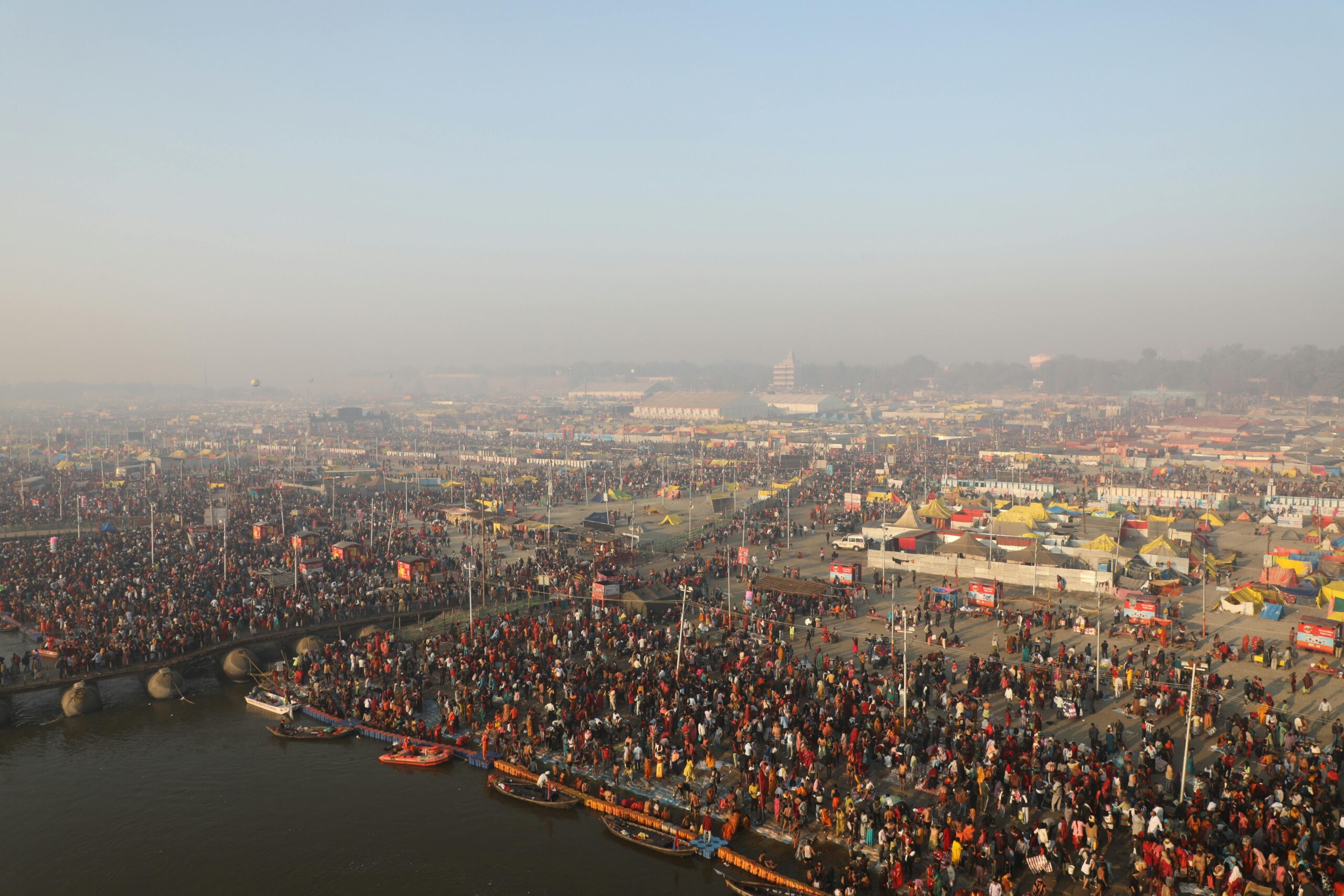
Ganga Snan at Magh Mela Kashi Vishwanath Darshan , There are moments in life when the spiritual and material worlds converge, when ancient traditions become living experiences, when the divine feels tangibly close. Two such moments stand unparalleled in Hindu spirituality: taking a holy bath (Ganga Snan) at the sacred Sangam during Magh Mela, where three rivers merge in cosmic confluence, and standing before the eternal Jyotirlinga at Kashi Vishwanath Temple, where Lord Shiva resides in his most powerful form.
Combining these two profound spiritual experiences in a single pilgrimage isn’t just travel planning—it’s crafting a journey of transformation, purification, and divine connection. This is about washing away accumulated karmas in the sacred waters and then standing in the presence of the deity who grants liberation itself. It’s about experiencing two of Hinduism’s most potent spiritual practices in their authentic settings, supported by millennia of tradition and the faith of billions.
This comprehensive guide reveals everything you need to know about undertaking this sacred dual pilgrimage—the spiritual significance, practical planning, ritual procedures, timing considerations, and how to approach both experiences with the reverence and preparation they deserve.
The Spiritual Significance: Why These Two Experiences Together?
Ganga Snan at Sangam – Purification and Renewal
The Sangam at Prayagraj represents one of Hinduism’s most sacred spaces. Here, the visible Ganga (representing purity and knowledge), the visible Yamuna (representing devotion and love), and the invisible Saraswati (representing wisdom and learning) merge. This triadic confluence symbolizes the meeting of trideva (Brahma, Vishnu, Shiva), the balance of trigunas (sattva, rajas, tamas), and the union of body, mind, and spirit.
Taking Ganga Snan here during Magh Mela—especially on auspicious dates—is believed to wash away sins accumulated across lifetimes, break karmic cycles, cleanse spiritual impurities, and create an opening for divine grace to enter one’s life. Ancient texts declare that bathing at Sangam during Magh month carries the spiritual merit of thousands of ordinary baths and opens the gateway to moksha (liberation).
Kashi Vishwanath Darshan – Liberation and Divine Grace
Kashi (Varanasi) is Shiva’s eternal abode, the city he never leaves. The Kashi Vishwanath Temple houses one of twelve Jyotirlingas—self-manifested lingams representing infinite cosmic energy. Having darshan (sacred viewing) of this Jyotirlinga is considered among the most potent spiritual experiences available to humans.
The significance is profound: Shiva himself is believed to whisper the Taraka Mantra (mantra of liberation) in the ears of those who die in Kashi, granting instant moksha. But you don’t need to die to receive blessings—simply standing in the presence of the Vishwanath (Lord of the Universe) with devotion opens channels of transformation that can redirect one’s entire life trajectory.
Why Combine Them?
The logic is spiritually elegant: First, purify yourself completely at Sangam—wash away the accumulated debris of past actions, mistakes, negative patterns. Arrive at the confluence burdened; leave it cleansed. Then, in this state of spiritual cleanliness, present yourself before Shiva at Kashi Vishwanath. Approach the ultimate deity not covered in karmic dust but freshly purified, receptive, open.
This sequence—purification followed by divine darshan—mirrors the classical spiritual path: shuddhi (purification) before sakshatkar (realization). You’re not just visiting two religious sites; you’re enacting a profound spiritual process that sages have followed for millennia.
Understanding Magh Mela and Ganga Snan
What is Magh Mela?
Magh Mela is an annual religious gathering held in Prayagraj during the Hindu month of Magh (mid-January to mid-February in the Gregorian calendar). While less famous internationally than the Kumbh Mela (which occurs every 12 years), Magh Mela is equally sacred and attracts millions of pilgrims annually.
Magh Mela 2025 Dates:
- Duration: January 13 – February 26, 2025
- Major Bathing Dates (Shahi Snan):
- Paush Purnima: January 13 (opening sacred bath)
- Makar Sankranti: January 14 (sun’s transition, extremely auspicious)
- Mauni Amavasya: January 29 (most sacred, millions bathe)
- Basant Panchami: February 3 (spring arrival, highly auspicious)
- Maghi Purnima: February 12 (concluding major bath)
The Sangam: Geographic and Spiritual Confluence
The Sangam is the precise point where three rivers meet:
Ganga (visible): Flowing from the Himalayas, carrying cosmic purity, represented by yellowish-brown water
Yamuna (visible): Flowing from Yamunotri, carrying devotional energy, represented by slightly clearer, bluish water
Saraswati (invisible): Believed to flow underground, carrying divine wisdom, detected only spiritually
At the exact confluence point, you can visibly see the different colored waters meeting—a striking physical manifestation of this sacred geography. Priests and boatmen can precisely point out this tricolored juncture.
What is Ganga Snan?
Ganga Snan literally means “bath in the Ganges,” but it’s far more than physical bathing. It’s a ritual purification involving:
- Physical immersion in sacred water
- Prayers and mantras
- Offerings to the sun, ancestors, and deities
- Spiritual intention for cleansing and renewal
During Magh Mela, taking Ganga Snan specifically at the Sangam—the confluence point—multiplies the spiritual benefit exponentially. This isn’t about physical cleanliness (though that occurs); it’s about washing the subtle body, cleansing karmic impressions, and creating spiritual rebirth.
Understanding Kashi Vishwanath Temple and Darshan
The Temple’s Ancient Legacy
Kashi Vishwanath Temple has stood as Shiva’s primary earthly dwelling for over 3,500 years, though the current structure dates to 1780, rebuilt by Maharani Ahilyabai Holkar after multiple destructions during invasions. The temple complex has been magnificently redeveloped recently, with the Kashi Vishwanath Corridor (inaugurated December 2021) creating a grand approach befitting this sacred site.
The Jyotirlinga: Infinite Light Manifested
The Vishwanatha Jyotirlinga is one of twelve across India where Shiva is believed to have manifested as an infinite pillar of light (jyoti = light, linga = symbol). These weren’t man-made—tradition holds they’re self-manifested (swayambhu), cosmic energy taking form.
The lingam at Kashi Vishwanath is approximately 60 cm tall and 90 cm in circumference, housed in a silver altar within the central sanctum. The top portion is visible to devotees during darshan, and simply viewing it with devotion is considered immensely purifying and blessing-bestowing.
What is Darshan?
Darshan means “sacred viewing” or “auspicious sight.” But it’s understood as bidirectional—you’re not just seeing the deity; the deity is seeing you. In that mutual gaze, divine energy transfers to the devotee. Proper darshan involves:
- Approaching with clean body and pure intention
- Standing before the deity with folded hands
- Gazing at the sacred form while chanting mantras
- Opening yourself to receive divine grace
- Accepting prasad (blessed offering) afterward
At Kashi Vishwanath, darshan is particularly powerful because you’re in Shiva’s primary earthly abode, standing before the Jyotirlinga that has received billions of prayers across millennia.
Planning Your Ganga Snan + Kashi Vishwanath Pilgrimage
Ideal Duration: 4-7 Days
Minimum (4 days):
- Day 1: Arrive Prayagraj, Magh Mela orientation
- Day 2: Ganga Snan at Sangam dawn, travel to Varanasi
- Day 3: Kashi Vishwanath darshan, ghat exploration
- Day 4: Final morning activities, departure
Comfortable (5-6 days):
- Days 1-2: Prayagraj (Magh Mela exploration, Sangam bath)
- Days 3-4: Varanasi (boat ride, Kashi Vishwanath, temples)
- Day 5: Sarnath visit, final rituals
- Day 6: Departure
Ideal (7 days): Adds buffer days for rest, additional spiritual practices, flexibility for weather or crowds, and deeper absorption of both experiences.
Best Time to Visit
This specific dual pilgrimage works during Magh Mela season: mid-January through mid-February. Time your Sangam bath for one of the major bathing dates listed above for maximum spiritual benefit, especially Mauni Amavasya (most auspicious).
Weather: Expect cold mornings (5-10°C), pleasant days (20-25°C), and cool evenings (10-15°C). The Sangam water will be cold—brace yourself but know millions do this annually.
The Complete Ganga Snan Ritual at Magh Mela
Preparation (Days Before)
Physical Preparation:
- Begin reducing heavy, tamasic foods (meat, alcohol, excessive spice)
- Increase sattvic foods (fruits, vegetables, milk, ghee)
- Practice daily bathing and cleanliness
- Women: Track menstrual cycles (traditionally, women don’t enter water during menstruation; plan accordingly)
Spiritual Preparation:
- Daily meditation or prayer practice
- Chanting “Om Namah Shivaya” or Ganga mantras
- Reading about the Sangam’s significance
- Setting clear spiritual intentions (What do you seek from this bath? Clarity? Healing? Karmic cleansing?)
Mental Preparation:
- Understand the bath will be cold—mental readiness reduces shock
- Visualize the experience—helps with anxiety
- Accept crowds as part of the energy, not obstacle
Practical Preparation:
- Get complete health check-up (heart, blood pressure)
- Inform doctor if you have concerns about cold water immersion
- Pack appropriate bathing clothes (men: dhoti or shorts; women: cotton saree or salwar kameez)
- Bring multiple towels, dry clothes, waterproof bag for valuables
The Night Before Ganga Snan
Fasting (Optional but Traditional): Many pilgrims fast or eat very lightly the evening before. This isn’t mandatory but traditionally believed to purify the body and sharpen spiritual receptivity.
Early Sleep: You’ll wake at 4 AM for the dawn bath. Sleep by 9 PM.
Mental Review: Before sleeping, mentally walk through tomorrow’s ritual. Visualize yourself at the Sangam, prayers flowing naturally, immersion happening smoothly.
Packing Your Bath Bag:
- Bathing clothes (wear under regular clothes for easy changing)
- 2-3 towels
- Complete dry clothing set
- Small brass or steel vessel for collecting Gangajal
- Small offerings (flowers, coins for priests)
- Waterproof pouch for any valuables you must bring
- Prayer beads if you use them
Dawn of Ganga Snan: The Sacred Morning
4:00 AM – Wake and Prepare
Wake naturally if possible. Drink a glass of water. Use bathroom. Wear your bathing clothes under regular clothes for ease.
Many pilgrims apply tilak (sandalwood or kumkum mark) on forehead. Chant a simple prayer: “Gange cha Yamune chaiva Godavari Saraswati, Narmade Sindhu Kaveri jale asmin sannidhim kuru” (May the sacred rivers be present in this water).
4:30 AM – Journey to Sangam
Depending on your camp’s distance:
- Walking distance (<1 km): Walk in groups (safer, more atmospheric)
- Farther: Arrange cycle rickshaw, e-rickshaw, or camp transport
- Best option: Book a private boat (₹1,000-2,000) for sunrise arrival at Sangam—approaching the confluence by boat as dawn breaks is extraordinarily beautiful and avoids ghat crowds
5:00-5:30 AM – Arrival at Sangam
Arrive while it’s still dark. The atmosphere is electric—thousands of pilgrims gathering, priests chanting, diyas flickering, anticipation building.
If arriving by boat, your boatman positions at the exact confluence point. If walking to ghats, make your way to the Sangam bathing area. Priests (pandas) will offer to perform puja—you can accept (agree on price first: ₹101-501) or perform your own simple ritual.
5:45-6:15 AM – The Sacred Bath Ritual
As the sky begins lightening toward dawn, the ritual begins:
Step 1: Surya Arghya (Offering to the Sun) Stand facing east toward the rising sun. Cup water from the Sangam in your hands. Raise it overhead and offer back to the water while chanting: “Om Suryaya Namaha” (Salutations to the Sun). Repeat three times.
Step 2: Ancestor Prayers (Tarpan) Cup water and offer for your deceased ancestors: “Om Pitru devaya namaha” (Salutations to ancestral spirits). Name your ancestors if you know them, requesting their blessings and peace.
Step 3: Personal Prayers Standing waist-deep (or knee-deep if uncomfortable going deeper), speak or mentally articulate your intentions:
- “May this sacred bath wash away all karmic debts”
- “May I be purified in body, mind, and spirit”
- “May obstacles be removed from my spiritual path”
- State any specific prayers (health, family welfare, spiritual progress)
Step 4: The Immersion Take a deep breath. Fully immerse yourself in the Sangam water. Go completely under if possible—the complete immersion symbolizes total surrender and rebirth. Emerge and chant “Har Har Gange!” (Glory to Ganga!) or “Om Namah Shivaya.”
Repeat immersion at least three times—once for each of the three rivers present.
Step 5: Collecting Gangajal After your bath, fill your vessel with Sangam water. This Gangajal will be used at home for puja, given to sick relatives, or used during last rites. It never spoils if kept in sealed brass or steel containers.
Step 6: Final Offerings Offer flowers to the river. If you brought coconut or fruit, offer them. Make a small donation to the priests (₹51-101 is appropriate). Touch the water to your forehead in final reverence.
6:30 AM – Post-Bath
Change into dry clothes at designated changing areas (most camps and ghat areas have facilities, ₹10-20). Don’t rush this—take time to adjust to what you’ve just experienced.
Many pilgrims sit quietly for 15-30 minutes after bathing, simply absorbing the moment. This integration time is valuable—don’t immediately jump back into logistics.
The Complete Kashi Vishwanath Darshan Experience
Preparation for Darshan
Timing Your Visit:
The temple is open nearly 24 hours with specific darshan schedules:
- Morning Darshan: 3:00 AM – 11:00 AM (least crowded: 3-6 AM)
- Afternoon Darshan: 12:00 PM – 7:00 PM
- Evening Darshan: 7:00 PM – 11:00 PM (very crowded)
- Night Darshan: 11:00 PM – 3:00 AM (for special occasions)
Best for most pilgrims: 7:00-9:00 AM—you’ve had time to bathe, have breakfast, but crowds haven’t peaked.
Best for deep devotees willing to sacrifice sleep: 4:00-6:00 AM—minimal crowds, powerful pre-dawn energy, can spend more time in darshan.
Physical Preparation:
- Bath and clean clothes are mandatory (you’ve just come from Sangam bath, perfect)
- Remove leather items (belt, shoes, wallet if leather)
- Minimal belongings—temple has strict security
Spiritual Preparation:
- Morning prayers or meditation
- Chant “Om Namah Shivaya” 108 times before arriving
- Set clear intention: What do you seek in Shiva’s darshan?
- Approach with humility and devotion, not as tourist
Approaching Kashi Vishwanath Temple
Security Protocol: The Kashi Vishwanath Corridor has implemented strict security (similar to airport screening). Understanding this prevents frustration:
Prohibited Items:
- Mobile phones and cameras (absolutely prohibited)
- Large bags or backpacks
- Electronic devices of any kind
- Leather items
- Food or water bottles
- Weapons or sharp objects
Allowed:
- Small cloth purses with money, ID
- Prayer beads
- Small religious items
- Offerings (flowers, coconut, etc., can be purchased inside)
The Process:
- Deposit all prohibited items at the official locker facility (₹10-20, very secure, collect on exit)
- Pass through metal detectors and security pat-down
- Collect token for your locker (don’t lose this)
- Enter the corridor
The Kashi Vishwanath Corridor Experience:
The newly developed corridor is magnificent—a massive plaza leading to the temple, designed to accommodate thousands while maintaining spiritual atmosphere. Beautiful traditional architecture, marble floors, and impressive views of the Ganga create an uplifting approach.
Walk slowly. Don’t rush toward the temple. This walk is part of the pilgrimage—each step brings you closer to Shiva’s presence. Observe other devotees, feel the collective devotion, let anticipation build naturally.
The Darshan Ritual
Joining the Queue:
The temple maintains organized queues (lines) for darshan. VIP darshan is available (₹300-500, significantly shorter wait) but general darshan is spiritually equivalent—the waiting itself is a practice in patience and devotion.
Wait times vary:
- Early morning (4-6 AM): 15-30 minutes
- Morning (7-11 AM): 30-90 minutes
- Afternoon: 45-120 minutes
- Evening: 1-3 hours
During the Wait:
- Chant silently “Om Namah Shivaya”
- Observe the temple architecture
- Feel the energy building as you approach
- Maintain a meditative inner state
- Be patient—thousands before you have waited, you’re part of an eternal stream
Entering the Sanctum:
As you approach the inner sanctum (garbha griha), the energy intensifies. The queue moves continuously but slowly.
When your turn comes and you stand before the Jyotirlinga:
The Sacred Moment:
You’ll have approximately 5-15 seconds of direct darshan (during busy times) to 30-60 seconds (during quiet times). Use this powerfully:
- Fold hands in namaste
- Gaze directly at the lingam (the silver-covered stone in the center)
- Mentally or softly chant: “Om Namah Shivaya” or any Shiva mantra you know
- Open your heart completely—this is not the time for mental chatter; simply BE in Shiva’s presence
- Feel the darshan as mutual—you’re seeing Shiva, Shiva is seeing you
- Make your request (silently): “Grant me liberation,” “Guide my path,” “Remove my obstacles,” or simply “Grace me with your blessing”
- Bow deeply before moving on
Trust the Process:
Don’t worry if your mind was distracted or you forgot your elaborate prayer. The darshan’s power doesn’t depend on your perfect performance—it depends on your sincere devotion. Many pilgrims report that in that brief moment, despite their mental preparation, they simply stood speechless, overwhelmed. That speechlessness is perfect—it’s the mind stopping, the heart opening.
After Darshan
Receiving Prasad:
As you exit the sanctum, priests offer prasad (blessed food—usually sweets or dry fruits). Accept it with both hands or right hand only, touch it to your forehead before consuming. This prasad carries Shiva’s blessing—it’s sacred, not just snack.
Temple Circumambulation (Parikrama):
If time and crowd allow, walk clockwise around the temple (parikrama), completing the darshan experience. This circumambulation is a form of worship, honoring the deity.
Sitting in Contemplation:
If possible, find a quiet spot in the temple complex or corridor to sit for 10-15 minutes. Don’t immediately rush to the next activity. Let the darshan settle into your consciousness. Journal your experience while fresh. Many insights arise in these quiet post-darshan moments.
Collecting Your Belongings:
Exit through designated gates, collect your items from the locker using your token. Now you can take photos of the exterior, the corridor, and the surrounding area (just not inside the sanctum).
Combining Both Experiences: Suggested Itineraries
Compact 4-Day Itinerary
Day 1: Arrival Prayagraj
- Arrive by noon
- Check into Magh Mela camp
- Afternoon: Camp orientation, rest
- Evening: Visit Sangam area (don’t bathe yet), evening aarti
- Night: Early sleep (waking at 4 AM tomorrow)
Day 2: Ganga Snan and Transit
- 4:00 AM: Wake, prepare
- 5:00-7:00 AM: Sacred Ganga Snan at Sangam
- 7:30 AM: Return to camp, breakfast, rest briefly
- 11:00 AM: Check out, depart for Varanasi (3-hour drive)
- 2:00 PM: Arrive Varanasi, check into hotel, rest
- 6:00 PM: Evening ghat walk, Ganga Aarti at Dashashwamedh
- Night: Early sleep (waking early for darshan)
Day 3: Kashi Vishwanath Darshan
- 6:00 AM: Depart for Kashi Vishwanath
- 7:00-10:00 AM: Darshan at temple, sit in contemplation after
- 10:30 AM: Explore nearby temples (Annapurna, Kal Bhairav)
- 1:00 PM: Return to hotel, lunch, rest
- 5:00 PM: Boat ride on Ganges
- Evening: Personal reflection time
Day 4: Departure
- Morning: Final ghat visit, personal prayers
- Departure by noon
Balanced 6-Day Itinerary
Days 1-2: Prayagraj (Magh Mela)
- Day 1: Arrival, orientation, Magh Mela exploration
- Day 2: Dawn Ganga Snan at Sangam, rest, evening final Sangam visit
Days 3-5: Varanasi
- Day 3: Travel to Varanasi, settle in, evening Ganga Aarti
- Day 4: Sunrise boat ride, Kashi Vishwanath darshan, temple circuit
- Day 5: Sarnath visit, personal spiritual practices, shopping for religious items
Day 6: Integration and Departure
- Morning reflection and final rituals
- Departure
Practical Considerations
Budget Estimates (Per Person):
Budget Pilgrimage: ₹12,000-18,000
- Basic Magh Mela camp: ₹1,000-1,500/night
- Budget Varanasi hotel: ₹1,000-1,500/night
- Train between cities: ₹400-600
- Meals: ₹300-500/day
- Boats and offerings: ₹1,000-1,500
Mid-Range Pilgrimage: ₹25,000-40,000
- Standard Magh Mela camp: ₹3,000-5,000/night
- Decent Varanasi hotel: ₹3,000-5,000/night
- Private car: ₹4,000-5,000
- Restaurant meals: ₹800-1,200/day
- Private boats, guides: ₹3,000-5,000
Luxury Pilgrimage: ₹70,000-1,20,000
- Luxury Magh Mela camp: ₹15,000-25,000/night
- Heritage Varanasi hotel: ₹10,000-20,000/night
- Premium car service: ₹8,000-10,000
- Fine dining: ₹2,000-3,000/day
- All private experiences, guides: ₹10,000-15,000
Health and Safety:
- Drink only bottled water
- Carry basic medicines
- Don’t force cold water immersion if you have heart conditions
- Know location of nearest hospitals
Best Booking Approach:
- Book 2-3 months ahead for peak Magh Mela dates
- Combine DIY booking (accommodations) with local guides (for rituals)
- Consider tour packages if first-time visitor
Deepening the Spiritual Experience
Before the Pilgrimage:
- 40-day spiritual preparation (daily meditation, clean diet, celibacy if appropriate to your practice)
- Study the Ganga Stotram and Shiva mantras
- Read about the sacred geography and theology
During the Pilgrimage:
- Maintain silence periods daily
- Journal your experiences
- Limit phone use and social media
- Practice witness consciousness
After the Pilgrimage:
- Continue morning prayers using your Gangajal
- Implement one concrete life change inspired by the experience
- Share meaningfully (not just social media posts) with genuine seekers
- Plan how you’ll return or deepen your practice
Conclusion
The combination of Ganga Snan at Magh Mela’s sacred Sangam and Kashi Vishwanath darshan represents one of Hinduism’s most powerful spiritual journeys. You’re enacting an ancient pattern: purification followed by divine communion, cleansing followed by blessing, preparation followed by realization.
This isn’t tourism. This is sadhana—spiritual practice that has transformed countless lives across millennia. Approach with reverence, prepare thoroughly, surrender completely, and remain open to whatever unfolds. The divine responds to sincere seeking.
May your Ganga Snan wash away all obstacles. May your Kashi Vishwanath darshan grant you the vision of truth. May Shiva’s grace guide your path always.
Om Namah Shivaya. Har Har Gange. Jai Kashi Vishwanath.
Frequently Asked Questions (FAQ)
Q1: Is it necessary to take Ganga Snan before Kashi Vishwanath darshan, or can I do them in any order?
A: While there’s no absolute religious rule requiring Ganga Snan before darshan, the traditional sequence is purification before approaching the deity—it’s spiritually logical and symbolically powerful. However, practical circumstances may dictate reverse order: if you’re in Varanasi first, take morning bath in the Ganges there, do Kashi Vishwanath darshan, then proceed to Prayagraj for Sangam bath. The divine doesn’t operate on technicalities—sincere devotion matters more than perfect sequencing. That said, the Sangam bath during Magh Mela is considered more purifying than regular Ganga bath in Varanasi, so if timing allows, Sangam first creates optimal preparation for darshan. Many pilgrims actually do both: Sangam bath at Magh Mela for major karmic cleansing, then daily Ganga baths in Varanasi during their stay for maintaining purity, with Kashi Vishwanath darshan happening mid-stay. Trust your circumstances and intuition—Shiva sees your heart’s intention, not just external sequence.
Q2: What if I’m physically unable to do full immersion in the cold Sangam water—is partial bath spiritually valid?
A: Absolutely yes. Hindu tradition recognizes that physical capabilities vary, and spiritual intent matters more than physical completeness. Valid alternatives to full immersion: (1) Waist-deep standing with water poured over head using your hands or a vessel—this counts as full bath spiritually, (2) Ankle-deep wading with water sprinkled over body and head—valid if deeper entry is impossible, (3) Boat-based bath where you remain in boat but lean over to immerse hands and pour water over yourself—many elderly and infirm pilgrims use this method, (4) Touching Sangam water to forehead, heart, and crown while chanting mantras—minimum physical contact with maximum spiritual intent. What makes a bath “valid” isn’t the amount of water contact—it’s the conjunction of sacred place, auspicious time, and sincere devotion. Many saints and scriptures affirm that even touching Ganga water with reverence grants purification. Don’t let physical limitations prevent you from attempting this pilgrimage—adapt the ritual to your capabilities without guilt. The divine accommodates all sincere seekers.
Q3: How long should I wait between Ganga Snan and Kashi Vishwanath darshan—is there an ideal gap?
A: There’s no prescribed waiting period, but practical and spiritual considerations suggest timing: Same day is possible but rushed: You could do 5 AM Sangam bath, travel to Varanasi by 9 AM, darshan by 2 PM—physically feasible but doesn’t allow integration time. Next day is optimal for most: Sangam bath at dawn, rest and travel same day, darshan the following morning. This gives 24 hours to absorb the bath’s impact, rest from the intense experience, and approach Kashi Vishwanath fresh and centered. 2-3 days gap is ideal for deep practitioners: Use the interval for meditation, fasting, additional Ganga baths in Varanasi, reading sacred texts, and truly settling into the purified state before darshan. Some traditional pilgrims spend a week in Varanasi after Sangam bath, doing daily Ganga snan at Varanasi ghats, gradually preparing for Kashi Vishwanath darshan as the culmination. The principle: Don’t rush between these sacred experiences like checking items off a list. Each deserves space to resonate in your consciousness. That said, modern time constraints are real—even a few hours gap is infinitely better than not doing these experiences at all.
Q4: Can women take Ganga Snan and do Kashi Vishwanath darshan during menstruation, or must we avoid these times?
A: This is a sensitive question where tradition and contemporary understanding intersect. Traditional view: Women are generally advised not to enter temples or sacred waters during menstruation, considered a time of natural purification when spiritual practices are paused. Many women choose to respect this tradition, planning pilgrimages around their cycles. Contemporary/Reform view: Increasing number of spiritual leaders and modern practitioners argue that menstruation is a natural biological process, not “impurity,” and women should not be barred from any spiritual practice during this time. Some temples and practices have relaxed these restrictions. Practical middle path: (1) For Ganga Snan: The Sangam is vast open water, not an enclosed temple—many women do bathe during menstruation without traditional prohibition being enforced. Personal decision based on your beliefs and comfort. (2) For Kashi Vishwanath: The temple doesn’t explicitly check or bar entry, but traditional devotees self-regulate. Some women choose to do darshan even during menstruation, viewing their devotion as paramount; others wait for the cycle to complete. My recommendation: This is deeply personal. If you follow traditional practices, plan your pilgrimage dates accordingly (Magh Mela runs for 45 days—you have flexibility). If you interpret spirituality more flexibly, proceed with your personal conviction. Most importantly, don’t let this question prevent you from ever undertaking this pilgrimage—honor your body, respect tradition where it resonates, and trust your relationship with the divine.
Q5: What specific mantras should I chant during Ganga Snan and Kashi Vishwanath darshan for maximum spiritual benefit?
A: Mantras amplify spiritual practices, but sincerity matters more than perfect pronunciation or complex formulas. For Ganga Snan at Sangam: (1) Basic and powerful: “Om Gange Namaha” (Salutations to Ganga) or “Har Har Gange” (Glory to Ganga)—repeat throughout your bath. (2) Seven Sacred Rivers invocation: “Gange cha Yamune chaiva Godavari Saraswati, Narmade Sindhu Kaveri jale asmin sannidhim kuru” (May all seven sacred rivers be present in this water)—chant before entering water. (3) Purification mantra: “Om Apavitrah Pavitro Va SarvavasthamGatopi Va, Yah Smaret Pundarikaksham Sa Bahyabhyantarah Shuchih” (Whether pure or impure, whoever remembers the Lotus-Eyed Lord becomes pure internally and externally). (4) If you know Gayatri Mantra, chant it while bathing—it’s universally purifying. For Kashi Vishwanath Darshan: (1) Most essential: “Om Namah Shivaya” (Salutations to Shiva)—chant this continuously while waiting in queue and during darshan. (2) Powerful specific mantra: “Om Tryambakam Yajamahe Sugandhim Pushti Vardhanam, Urvarukamiva Bandhanan Mrityor Mukshiya Maamritat” (Maha Mrityunjaya Mantra—Shiva’s victory over death mantra). (3) Kashi Vishwanath specific: “Om Namah Kashi Vishwanathaya” (Salutations to the Lord of Kashi). If you don’t know these mantras: Simply speaking from your heart in any language works—”Lord Shiva, bless me,” “Ganga Ma, purify me” in English, Hindi, or your mother tongue is completely valid. The divine responds to devotion, not linguistic perfection. That said, learning key mantras before your pilgrimage deepens the experience—they’ve been charged with millions of repetitions over centuries, carrying accumulated power.