The Sacred Cities of Uttar Pradesh , Have you ever wondered where India’s spiritual heartbeat truly resides? The answer lies in Uttar Pradesh, a state where every corner whispers tales of devotion, mythology, and ancient wisdom. From the sacred waters of the Ganges to the birthplaces of gods and goddesses, Uttar Pradesh is a treasure trove of spiritual experiences that have drawn seekers, pilgrims, and travelers for thousands of years.
Walking through these sacred cities feels like stepping into a living museum where history, faith, and culture intertwine seamlessly. Whether you’re a devout pilgrim seeking divine blessings or a curious traveler eager to explore India’s rich cultural tapestry, Uttar Pradesh offers something profoundly moving for everyone.
Why Uttar Pradesh is Called the Land of Spirituality
Uttar Pradesh isn’t just another Indian state; it’s the cradle of Hindu civilization and spirituality. Think of it as the spiritual spine of India, connecting millions of devotees to their faith through temples, rivers, and rituals that have survived millennia.
The state is home to some of Hinduism’s most revered pilgrimage sites. It’s where Lord Rama was born, where Lord Krishna spent his childhood, and where the Ganges flows through ancient cities carrying prayers and hopes. The very air here seems charged with devotion, making it impossible not to feel the profound spiritual energy that permeates every sacred city.
Varanasi – The Eternal City
The Ghats of Varanasi
Varanasi, also known as Kashi or Benares, is arguably the oldest living city in the world. Imagine a place where time seems to stand still, where ancient rituals unfold exactly as they did thousands of years ago. The ghats—stone steps leading down to the Ganges—are the soul of Varanasi.
Each ghat has its own story, its own character. Dashashwamedh Ghat buzzes with life and ceremony, while Manikarnika Ghat, the main cremation site, reminds us of life’s impermanence. Walking along these ghats at dawn, watching pilgrims perform their morning rituals, is an experience that touches something deep within your soul.
Kashi Vishwanath Temple
The golden spires of Kashi Vishwanath Temple pierce the Varanasi skyline, drawing devotees like moths to a flame. This temple, dedicated to Lord Shiva, is one of the twelve Jyotirlingas and holds immense religious significance. The temple’s history is as layered as the city itself, having been destroyed and rebuilt multiple times over centuries.
Standing in the temple’s inner sanctum, surrounded by chanting priests and the fragrance of incense, you can feel the accumulated devotion of millions who have stood in that exact spot, seeking blessings from Lord Shiva.
Experiencing the Ganga Aarti
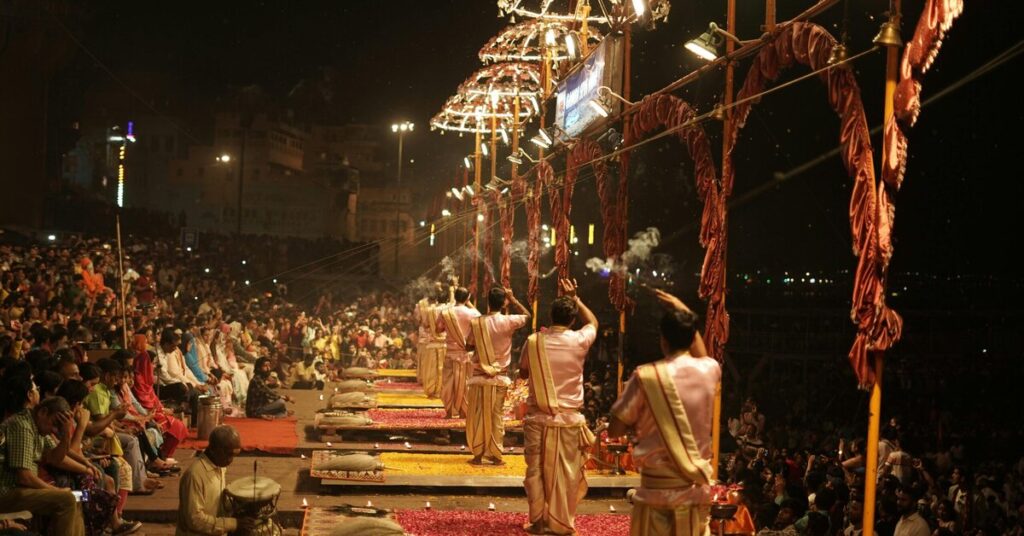
If Varanasi had to be distilled into a single moment, it would be the evening Ganga Aarti at Dashashwamedh Ghat. As the sun sets, priests in saffron robes perform a synchronized ritual with brass lamps, bells, and conch shells. The flames dance against the darkening sky while devotional songs echo across the river.
It’s not just a ceremony; it’s a symphony of faith that leaves even skeptics momentarily spellbound. The river becomes a mirror reflecting thousands of flickering diyas (oil lamps) set afloat by devotees, each carrying a prayer or wish downstream.
Ayodhya – The Birthplace of Lord Rama
Ram Janmabhoomi Temple
Ayodhya holds a special place in Hindu mythology as the birthplace of Lord Rama, the hero of the epic Ramayana. The Ram Janmabhoomi Temple stands at the site believed to be Rama’s exact birthplace, making it one of the most significant pilgrimage destinations for Hindus worldwide.
The temple complex, recently reconstructed, is a magnificent architectural marvel that blends traditional temple design with modern engineering. Walking through its corridors, you can almost hear echoes of the ancient epic, of Rama’s righteous rule and his unwavering commitment to dharma.
Hanuman Garhi
Perched atop a hill in Ayodhya, Hanuman Garhi is a fortress-temple dedicated to Lord Hanuman, Rama’s most devoted disciple. The temple requires climbing 76 steps, but the effort is rewarded with both spiritual fulfillment and panoramic views of Ayodhya.
The temple’s atmosphere is electrically devotional, with continuous chanting of “Jai Shri Ram” creating a powerful energy that envelops visitors. It’s said that no visit to Ayodhya is complete without seeking blessings at Hanuman Garhi first.
Cultural Significance of Ayodhya
Beyond its temples, Ayodhya represents the ideal of righteous governance—”Ram Rajya” or the rule of Rama—which has become synonymous with perfect administration and justice in Indian culture. The city’s every stone seems to resonate with stories from the Ramayana, making it a living epic where mythology and reality blur beautifully.
Mathura – The Land of Lord Krishna
Krishna Janmabhoomi Temple
Mathura, situated on the banks of the Yamuna River, is where Lord Krishna was born in a prison cell over 5,000 years ago according to Hindu tradition. The Krishna Janmabhoomi Temple marks this sacred spot, drawing devotees who come to celebrate the divine child who would grow up to deliver the Bhagavad Gita’s timeless wisdom.
The temple complex includes the prison cell where Krishna was supposedly born, now converted into a shrine. The atmosphere here is unique—simultaneously joyous and reverent, reflecting Krishna’s dual nature as both playful child and profound philosopher.
Dwarkadhish Temple
The Dwarkadhish Temple, dedicated to Krishna as the king of Dwarka, is an architectural gem in Mathura’s old city. Built in 1814, the temple showcases intricate carvings and a stunning black marble deity of Krishna that captivates devotees.
During festival seasons, especially Janmashtami (Krishna’s birthday), the temple transforms into a celebration hub with elaborate decorations, devotional music, and theatrical performances depicting Krishna’s life stories.
Festivals and Celebrations in Mathura
Mathura doesn’t just remember Krishna; it celebrates him constantly. The city’s festival calendar is packed with events, but Janmashtami stands out as the grandest celebration. Streets overflow with processions, temples are adorned with flowers and lights, and the air resonates with devotional songs.
Holi in Mathura and neighboring Vrindavan is legendary, replicating the playful color-throwing that Krishna pioneered. It’s not just a festival; it’s an immersive experience where everyone becomes part of Krishna’s eternal leela (divine play).
Vrindavan – Where Krishna Played
Banke Bihari Temple
Just a stone’s throw from Mathura lies Vrindavan, the forest where young Krishna performed his divine leelas with the gopis (cowherd girls). The Banke Bihari Temple is Vrindavan’s most beloved shrine, where Krishna is worshipped in his most charming form—standing in a tribhanga (three-bend) pose with a flute.
The temple has a unique tradition: the curtain in front of the deity is opened and closed repeatedly during darshan (viewing) because it’s believed that Krishna’s captivating gaze could enchant devotees so completely they’d forget to leave!
ISKCON Temple
The International Society for Krishna Consciousness (ISKCON) temple in Vrindavan is a modern architectural marvel that contrasts beautifully with the town’s ancient temples. With its marble corridors, lush gardens, and multimedia presentations about Krishna’s life, ISKCON makes spirituality accessible to contemporary seekers.
The temple’s evening aarti, accompanied by rhythmic chanting of “Hare Krishna,” creates an atmosphere of collective devotion that transcends cultural and linguistic boundaries.
The Essence of Bhakti in Vrindavan
Vrindavan breathes bhakti (devotion). It’s where love for the divine isn’t expressed through complex rituals but through simple, heartfelt devotion. Walking through Vrindavan’s narrow lanes, you’ll encounter sadhus (holy men) lost in meditation, widows who’ve devoted their lives to chanting Krishna’s names, and musicians whose instruments seem to channel divine melodies.
There’s something about Vrindavan that dissolves the ego and opens the heart. It’s as if Krishna’s playful spirit still dances through these streets, inviting everyone to join in the eternal celebration of divine love.
Prayagraj – The City of Confluence
Triveni Sangam
Prayagraj (formerly Allahabad) is where three sacred rivers—the Ganges, Yamuna, and the mythical Saraswati—meet. This confluence, called Triveni Sangam, is considered one of the holiest sites in Hinduism. Taking a dip here is believed to cleanse sins and break the cycle of rebirth.
The experience of bathing at the Sangam is profound. As you immerse yourself in the waters, you’re participating in a ritual that connects you to countless generations of seekers who’ve stood at this exact spot, seeking spiritual purification.
Kumbh Mela – The Largest Religious Gathering
Every twelve years, Prayagraj hosts the Maha Kumbh Mela, the largest peaceful gathering of humans on Earth. Millions of pilgrims, sadhus, and seekers converge on the Sangam to bathe on auspicious dates, creating a temporary city that’s visible from space!
Even the smaller Ardh Kumbh (held every six years) and annual Magh Mela draw enormous crowds. The Kumbh isn’t just a religious event; it’s a cultural phenomenon showcasing India’s incredible diversity and unshakeable faith.
Allahabad Fort and Anand Bhavan
Beyond its religious significance, Prayagraj played a crucial role in India’s independence movement. Anand Bhavan, the ancestral home of the Nehru family, has been converted into a museum documenting India’s struggle for freedom. The Allahabad Fort, built by Emperor Akbar in 1583, stands as a testament to the city’s historical importance.
These sites add layers to Prayagraj’s identity, making it not just a spiritual center but also a guardian of India’s political and cultural heritage.
Chitrakoot – The Abode of Peace
Ramghat
Chitrakoot is where Lord Rama, his wife Sita, and brother Lakshmana spent eleven of their fourteen years of exile. The Ramghat on the Mandakini River is where they reportedly bathed daily. Today, it’s a serene spot where devotees gather for evening aartis, the river reflecting the glow of countless lamps.
Unlike the bustling energy of Varanasi or Mathura, Chitrakoot offers tranquility. It’s a place for reflection, where the simplicity of surroundings helps quiet the mind and open the heart.
Kamadgiri Parikrama
Kamadgiri, a forested hill in Chitrakoot, is believed to be the original form of Lord Rama. Devotees perform a 5-kilometer parikrama (circumambulation) around this hill, visiting various small temples along the way. The walk through shaded forest paths, punctuated by chanting and the ringing of temple bells, becomes a moving meditation.
Gorakhpur – The Spiritual Gateway
Gorakhnath Temple
Gorakhpur is home to the Gorakhnath Temple, the headquarters of the Nath sect of yogis. This temple is dedicated to Guru Gorakhnath, a legendary yogi who mastered the art of hatha yoga. The temple complex is vast, housing living quarters for hundreds of yogis and serving as both a spiritual center and educational institution.
The temple’s atmosphere combines disciplined spiritual practice with welcoming hospitality, making it accessible to both serious seekers and casual visitors.
Geeta Press
Gorakhpur hosts the world-famous Geeta Press, which has published and distributed millions of copies of Hindu religious texts in multiple languages at nominal costs. For over a century, Geeta Press has been instrumental in making spiritual knowledge accessible to common people, democratizing access to ancient wisdom.
Visiting Geeta Press feels like stepping into a factory of faith, where massive printing machines work tirelessly to spread spiritual knowledge across the world.
Naimisharanya – The Sacred Forest
Naimisharanya, located in Sitapur district, is where the Puranas (ancient Hindu texts) were first recited. According to mythology, sages chose this forest for a 1,000-year-long yagna (ritual sacrifice), making it incredibly auspicious.
The Chakra Tirtha, a circular pond believed to be formed by Lord Vishnu’s chakra (discus), and the Lalita Devi Temple are the main attractions. Naimisharanya offers a quieter, more contemplative spiritual experience, perfect for those seeking to escape the crowds and connect with ancient energies.
Best Time to Visit These Sacred Cities
Timing your visit to Uttar Pradesh’s sacred cities can significantly enhance your experience. The best period is between October and March when the weather is pleasant, making temple visits and outdoor rituals comfortable.
However, if you want to experience these cities at their most vibrant, plan around major festivals. Janmashtami in Mathura-Vrindavan (August-September), Diwali in Ayodhya (October-November), and the Kumbh Mela in Prayagraj (dates vary) offer unforgettable spectacles of devotion and celebration.
Summer months (April-June) can be brutally hot, while the monsoon season (July-September) brings humidity and occasional flooding, though the rain-washed ghats of Varanasi have their own charm.
Travel Tips for Pilgrims and Tourists
Dress Modestly: These are sacred places with conservative values. Cover shoulders and knees, and remove shoes before entering temples.
Respect Local Customs: Photography might be restricted in some temple areas. Always ask permission before photographing religious ceremonies or people.
Stay Hydrated and Healthy: Carry bottled water, especially during summer. Be cautious with street food if you have a sensitive stomach.
Book Accommodation Early: During festivals, hotels fill up quickly. Book well in advance and expect higher prices during peak seasons.
Hire Local Guides: A knowledgeable guide can provide context and stories that transform sightseeing into genuine understanding.
Be Patient: These cities can be crowded, chaotic, and overwhelming. Take deep breaths, maintain your sense of humor, and remember that the chaos is part of the authentic experience.
Keep Valuables Safe: Unfortunately, crowded religious sites attract pickpockets. Keep your valuables secure and stay alert in dense crowds.
Conclusion
Exploring the sacred cities of Uttar Pradesh is more than a geographical journey; it’s a pilgrimage through time, faith, and the very essence of Indian spirituality. Each city offers a unique flavor of devotion—from Varanasi’s ancient mysticism to Vrindavan’s playful bhakti, from Ayodhya’s epic grandeur to Prayagraj’s confluential sanctity.
These cities don’t just preserve history; they live it daily through rituals that have remained unchanged for millennia. Whether you’re drawn by faith, fascinated by culture, or simply curious about one of the world’s oldest living civilizations, Uttar Pradesh’s sacred cities promise experiences that resonate long after you’ve returned home.
In our increasingly secular, digital world, these ancient cities remind us of something essential: the human need for connection with something greater than ourselves, for rituals that ground us, and for communities bound by shared belief. They offer not answers but the space to ask profound questions about existence, purpose, and the divine.
So pack your bags, open your heart, and prepare for a journey that might just transform how you see the world—and yourself.
FAQs
1. Is it safe for solo travelers to visit these sacred cities in Uttar Pradesh?
Yes, these sacred cities are generally safe for solo travelers, including women. However, exercise normal precautions: stick to well-lit areas at night, use registered taxis or ride-sharing apps, and inform someone of your itinerary. The heavy security presence at major temples and tourist areas adds an extra layer of safety.
2. Can non-Hindus visit these temples and participate in rituals?
Most temples in Uttar Pradesh welcome visitors of all faiths, though some inner sanctums might be restricted to Hindus only. Non-Hindus are usually welcome to observe rituals and experience the atmosphere. Always ask priests or guides if you’re unsure about any restrictions, and approach with respect and genuine interest.
3. How many days should I allocate to properly explore these sacred cities?
A comprehensive tour covering Varanasi, Ayodhya, Mathura-Vrindavan, and Prayagraj would ideally require 10-14 days. However, if you’re short on time, you could focus on two or three cities in 5-7 days. Varanasi alone deserves at least 2-3 days to truly absorb its spiritual essence.
4. What should I do if I’m invited to participate in a puja or religious ceremony?
Feel honored! Participation is usually a matter of following simple instructions from the priest—sitting in a specific position, offering flowers, or repeating mantras. Don’t worry about getting everything perfect; your sincere participation matters more than technical accuracy. It’s fine to politely decline if you’re uncomfortable, but participating can be a beautiful, memorable experience.
5. Are there vegetarian food options available in these cities?
Absolutely! Uttar Pradesh’s sacred cities are predominantly vegetarian zones, especially near temples. You’ll find an abundance of delicious vegetarian options, from street food like kachoris and jalebis to full traditional thalis. In fact, finding non-vegetarian food might be more challenging in the temple areas of these cities. Many restaurants near temples don’t even serve eggs or onion-garlic, catering to strict vegetarian diets.
Please don’t forget to leave a review.
Explore more by joining me on Patreon