
Uttar Pradesh Varanasi Ayodhya and Prayagraj , When travelers think of Uttar Pradesh, images of the Taj Mahal in Agra typically dominate their minds. Yet this vast northern state holds treasures far beyond its most photographed monument. Three cities in particular—Varanasi, Ayodhya, and Prayagraj—contain layers of hidden wonders that most tourists never discover, rushing instead between famous sites while missing the authentic soul hiding in plain sight.
What makes something a “hidden gem”? It’s not necessarily obscure or unknown to locals—rather, it’s overlooked by mainstream tourism, underappreciated in guidebooks, or tucked away where only those who take time to truly explore will stumble upon it. These are the neighborhood temples where families have worshiped for generations, the tiny food stalls serving better cuisine than famous restaurants, the craftspeople maintaining ancient traditions in cramped workshops, and the historical sites without entrance fees or tourist infrastructure.
Why should you care about hidden gems when these cities already offer spectacular famous attractions? Because the hidden places reveal authentic character, the unpolished reality beneath the tourism veneer. Here, you’ll encounter India as it actually exists for residents—complex, messy, beautiful, and deeply human. These discoveries create stories you’ll tell for years, the “you won’t believe what we found” moments that transform trips from pleasant to unforgettable.
Understanding Uttar Pradesh’s Cultural Landscape
The State That Shaped Indian Civilization
Uttar Pradesh isn’t just another Indian state—it’s arguably the civilizational heartland where Indian culture crystallized across millennia. Ancient kingdoms rose and fell here, leaving archaeological layers documenting human achievement from the Bronze Age through various empires to modern independence. The Buddha achieved enlightenment in Bodh Gaya and delivered his first sermon in Sarnath. Lord Rama’s legendary kingdom centered in Ayodhya. The Mughal Empire reached its zenith here before British colonialism transformed the landscape again.
This compressed history means you’re constantly walking on multiple time periods simultaneously. A sixteenth-century mosque might incorporate pillars from a destroyed Hindu temple that itself reused materials from Buddhist stupas demolished a millennium earlier. Understanding this palimpsest quality—layers upon layers of civilization—helps you recognize why seemingly insignificant corners often hide remarkable stories.
The state’s religious diversity also creates fascinating syncretism. While Hinduism dominates demographically, Buddhism was born here, Islam arrived with medieval conquests, and the British brought Christianity. Rather than existing separately, these traditions influenced each other, creating architectural fusion, shared saints, and hybrid festivals. The hidden gems often illustrate this mixing better than famous sites, showing how ordinary people navigated religious identity with more fluidity than official histories suggest.
Why These Three Cities Matter
Varanasi, Ayodhya, and Prayagraj form a spiritual triangle in eastern Uttar Pradesh, each representing different aspects of Hindu cosmology. Together, they’ve attracted pilgrims for thousands of years, creating concentrated spiritual energy and cultural accumulation. But their significance extends beyond religion—they’re repositories of art, music, literature, philosophy, and traditional knowledge systems that have shaped not just India but human civilization broadly.
UNESCO recognition has come to various elements: Varanasi’s cultural landscape, the musical traditions preserved here, and the intangible heritage of Prayagraj’s Kumbh Mela. Yet this recognition creates paradox—the famous sites receive conservation funding and tourist infrastructure while lesser-known treasures deteriorate from neglect. Your exploration of hidden gems isn’t just personally enriching; it draws attention to endangered heritage that needs protection.
These cities also matter economically to millions of residents whose livelihoods depend on spiritual tourism, traditional crafts, and cultural industries. When you seek hidden gems—eating at family restaurants, buying from local artisans, staying in small heritage properties—your tourism rupees support these authentic economies rather than international hotel chains and package tour operators extracting profits from local culture.
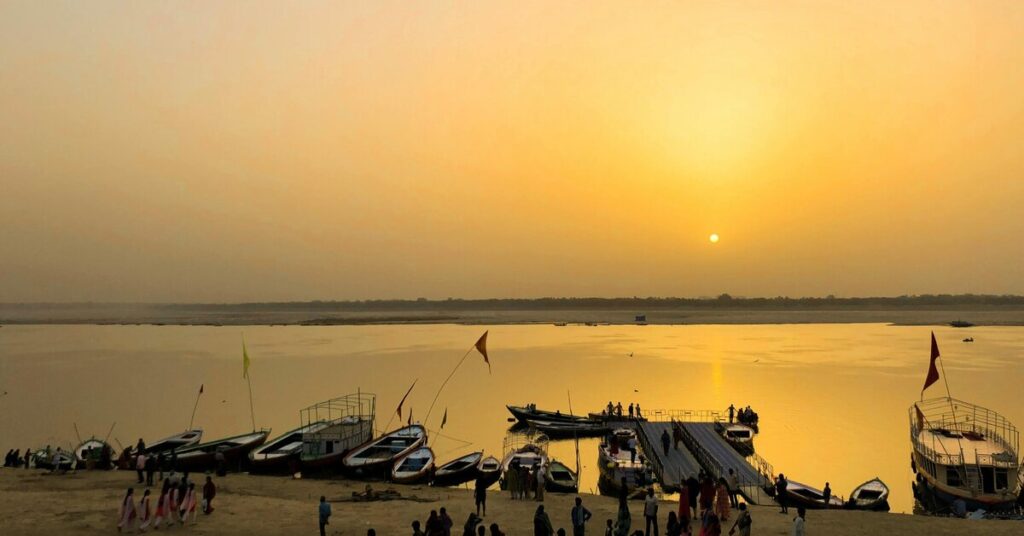
Varanasi – Hidden Treasures Beyond the Ghats
Lesser-Known Ghats Worth Exploring
Everyone knows Dashashwamedh Ghat with its famous evening aarti, and Manikarnika Ghat where cremations occur continuously. But Varanasi boasts 88 ghats along the Ganges, most receiving only local use and offering far more intimate experiences than the crowded tourist magnets.
Scindia Ghat contains one of Varanasi’s most photographed secrets: a partially submerged Shiva temple that toppled into the river decades ago due to the weight of its structure. The collapsed temple now sits at an angle, half-underwater, its spire jutting from the Ganges at a precarious tilt. Local boatmen know the best angles for photos during different water levels, and the ghat’s relative emptiness creates meditative atmosphere impossible at busier locations.
Tulsi Ghat carries literary significance as the place where the poet-saint Tulsidas composed the Ramcharitmanas, the Hindi version of the Ramayana that transformed regional vernacular into a respected literary language. A small temple marks the spot, and during certain festivals, traditional Ramayana recitations occur here. The ghat sees mainly local Brahmins performing daily rituals, offering a window into how Varanasi functions as a living city rather than just a tourist destination.
Panchganga Ghat supposedly marks the confluence of five rivers (though only the Ganges is visible, with others believed to flow underground or mystically). The ghat’s architecture is stunning—elaborate Mughal-era buildings, including a mosque, line the waterfront, illustrating the religious tolerance that historically characterized Varanasi. Early morning here offers spectacular light as sun rays pierce through buildings, creating dramatic shadows and illuminating the steam rising from the water.
Walking the entire riverfront from north to south takes several hours but reveals Varanasi’s diversity: ghats dedicated to specific castes or regional communities, privately owned ghats belonging to former royal families, ghats specializing in certain rituals, and completely neglected ghats where vegetation reclaims stone steps. Each tells stories if you take time to observe and inquire.
Secret Temples and Forgotten Shrines
Beyond the famous Kashi Vishwanath Temple (which non-Hindus cannot enter anyway), Varanasi contains thousands of temples ranging from grand to minuscule. Some hidden treasures offer extraordinary experiences without crowds or aggressive donations demands.
The Durga Temple, also called the Monkey Temple due to its resident simian population, sits away from the ghats in a slightly quieter neighborhood. Built in the 18th century with striking red sandstone in North Indian Nagara style, the temple’s most fascinating feature is its tank filled with holy water where turtles swim lazily. The monkeys provide entertainment—and occasional mischief—while the temple itself sees mainly devoted locals rather than tour groups. The prasad (sanctified sweets) here is particularly delicious, and the lack of commercial pressure makes the experience far more pleasant than busier temples.
The Nepali Temple (Kanthwala Temple) offers architectural surprises—built in the style of Kathmandu temples with distinctive terracotta and wood carvings, it stands out dramatically from surrounding buildings. The structure was commissioned by the King of Nepal in the 19th century and features erotic sculptures similar to those at Khajuraho, though on a smaller scale. Most tourists miss this gem entirely despite its proximity to the famous ghats, perhaps because it hides behind other buildings without prominent signage.
Sankat Mochan Hanuman Temple sits slightly outside the old city but remains deeply significant to locals. Founded by Tulsidas (yes, the same poet), the temple has a reputation for wish fulfillment, particularly regarding obstacles and challenges. Tuesday and Saturday mornings see considerable crowds, but weekday afternoons offer peaceful darshan (viewing of the deity). The temple also hosts one of India’s oldest classical music festivals annually, transforming the space into a concert venue where legendary musicians perform.
Don’t overlook tiny neighborhood shrines tucked into walls, adorning street corners, or occupying ground floors of residential buildings. These unassuming spots often have powerful local followings, and residents maintain them with fresh flowers, daily lamps, and evident affection. Asking shopkeepers about nearby temples often leads to discoveries—a shrine under a particular tree where wishes are granted, a goddess who specializes in children’s health, or a Hanuman who helps find lost items.
The Hidden Alleys of Old Varanasi
Varanasi’s old city is a labyrinth—narrow lanes twisting through neighborhoods with organic illogic that baffles GPS and confounds even experienced visitors. Getting lost is inevitable, but it’s also where hidden gems reveal themselves.
Bengali Tola district developed when Bengali scholars and artists migrated to Varanasi centuries ago, establishing a cultural enclave. Today, it retains distinct character with Bengali-style temples, shops selling Bengali sweets like sandesh and rosogolla (different from local Varanasi sweets), and old havelis where artistic traditions continue. Hidden here are workshops where Madhubani painting is practiced, Baul musicians occasionally perform in evening gatherings, and small publishing houses produce Bengali religious texts. The area feels distinctly different from surrounding neighborhoods, demonstrating how Varanasi absorbed and preserved regional cultures.
Vishwanath Gali, the lane leading to Kashi Vishwanath Temple, is always crowded during the day. But venture into side alleys branching off it, and you’ll discover a parallel universe of spiritual commerce: shops selling every imaginable puja item from rudraksha beads to brass lamps, astrologers offering palm reading services, Sanskrit text sellers with ancient-looking manuscripts, and tiny shrines to various deities every few meters. One particular shop—ask locals for “the old rudraksha place”—has been run by the same family for eight generations and carries knowledge about sacred beads that rivals academic scholarship.
Thatheri Bazaar specializes in brass and copper utensils, with artisans hammering metal into shape using centuries-old techniques. The rhythmic clanging creates a distinctive soundtrack as you walk past open workshops where multiple generations work side by side. These aren’t tourist trinkets but functional items used in traditional households and temples. Watching the craftsmen work proves mesmerizing—the skill required to shape flat metal into perfectly symmetrical vessels, the heating and cooling processes, and the finishing touches that create gleaming surfaces. Many workshops welcome observers, and purchasing directly from artisans ensures fair compensation for their skill.
Sarnath – The Buddhist Gem
Just 10 kilometers from Varanasi lies Sarnath, where Buddha delivered his first sermon after achieving enlightenment. Most visitors see the famous Dhamek Stupa, the archaeological museum, and perhaps one of the modern temples. But Sarnath holds additional treasures.
The actual “Deer Park” (Mrigadava) where Buddha taught still exists as a peaceful garden with, yes, actual deer wandering freely. This quiet space invites meditation and reflection far from tourist crowds at the main monuments. Early morning visits when mist hangs over grass and deer emerge from shadows creates almost mystical atmosphere, making it easy to imagine the Buddha’s presence.
The archaeological site extends beyond the main structures into areas many visitors skip. The Mulagandha Kuti Vihar ruins mark the spot where Buddha supposedly stayed during rainy seasons, and excavations have revealed foundations of monasteries housing hundreds of monks. These secondary ruins see far fewer visitors, allowing contemplative exploration. The site museum contains extraordinary Buddhist sculptures and artifacts, but few tourists venture beyond the famous Ashoka Lion Capital. Deeper in the collection are Jain sculptures, Hindu deities, and architectural fragments illustrating how religious identity shifted across centuries.
International Buddhist temples built by various countries create a diverse architectural showcase. The Japanese, Thai, Tibetan, Chinese, Myanmar, and Sri Lankan temples each reflect their home countries’ interpretation of Buddhism while honoring the tradition’s Indian origins. Most tourists photograph the Tibetan temple and leave, but taking time to visit all of them reveals Buddhism’s diversity—different architectural styles, ritual practices, artistic representations of the Buddha, and even different atmospheres. The Thai temple’s serenity contrasts with the Tibetan temple’s vibrant colors, while the Japanese temple’s minimalism provides a different aesthetic altogether.
Ayodhya – More Than Ram Janmabhoomi
Ancient Sites Overlooked by Tourists
The recently constructed Ram Janmabhoomi Temple dominates Ayodhya’s tourism landscape, drawing millions of pilgrims. But the city contains numerous other ancient sites with their own legends and significance, many predating current religious controversies.
Nageshwarnath Temple, supposedly established by Rama’s son Kush, predates most of Ayodhya’s visible structures. Dedicated to Shiva, it represents the tradition that even Rama, an incarnation of Vishnu, worshiped Shiva—demonstrating theological harmony between different Hindu streams. The temple’s quiet courtyard offers respite from crowded tourist circuits, and the ancient Shiva lingam inside radiates energy that sensitive visitors report feeling palpably. Local legend claims the temple marks the spot where Kush lost his armband while bathing, and Rama established a Shiva shrine in commemoration.
Moti Mahal (Pearl Palace) represents later Nawabi period architecture from when Awadh’s Muslim rulers controlled Ayodhya. The palace demonstrates respectful coexistence—Muslim rulers maintaining Hindu sacred sites and patronizing temples while building their own structures. The architecture blends Persian and traditional Indian elements, with beautiful jali (lattice) work and surviving frescoes depicting both courtly and mythological scenes. The palace is significantly deteriorated but remains hauntingly beautiful, particularly during golden hour when sunlight filters through damaged walls.
Treta Ke Thakur Temple claims to mark the exact spot where Rama performed the Ashvamedha Yajna (horse sacrifice) after returning from exile. The temple’s main attraction is black stone idols of Rama, Lakshmana, and Sita believed to have self-manifested (not human-carved). The story goes that these idols sank underground to escape destruction during various invasions and were rediscovered centuries later. True or not, the idols’ unusual style differs from typical representations, and the temple attracts devoted pilgrims who believe these particular icons carry special blessing power.
The Sarayu River’s Hidden Spots
The Sarayu River isn’t as grand as the Ganges, but for Ayodhya it holds equivalent sanctity as the river where Rama eventually took his final form before leaving the earthly plane. While Guptar Ghat sees considerable activity, other riverside locations offer tranquil beauty.
Raj Ghat, slightly removed from the main temple circuit, provides peaceful morning and evening experiences without crowds. The ghat’s relative obscurity means you might have long stretches of riverbank to yourself—rare in sacred cities. Locals come for personal prayers, elderly people practice yoga on the steps, and occasional traditional musicians perform devotional songs without the commercialized feel of tourist venues. The sunset here is particularly beautiful as the sky paints in oranges and purples, the river reflects the colors, and evening aarti at small shrines creates intimate spiritual moments.
Walk north along the river from the main ghats and you’ll discover essentially private stretches of riverbank where only neighborhood residents come. Women wash clothes on the stones, children splash in shallow water, fishermen cast nets (despite the religious prohibition on harming life in sacred rivers), and sadhus occupy permanent dwellings in riverside caves and huts. These areas reveal Ayodhya’s working-class reality beyond the sanitized temple tourism—poverty alongside faith, struggle alongside devotion, the complex human reality that religious sites often obscure.
Ayodhya’s Cultural Heritage
Beyond temples and myths, Ayodhya preserves cultural traditions worth discovering. Several generations-old sweet shops produce traditional items using recipes supposedly passed down from the time when Rama ruled. The shops themselves look ancient—crumbling walls, traditional equipment, and invariably an elderly patriarch overseeing operations while younger family members do physical labor.
The pedas here differ from other regions—less sweet, more grainy texture, and flavored with subtle saffron and cardamom. They’re specifically designed as prasad (temple offerings) rather than commercial sweets, made with religious purity standards. Watching the preparation process is fascinating: huge brass vessels cooking milk down for hours while being constantly stirred, the precise moment when the mixture reaches proper consistency, and the hand-shaping of individual pieces. Purchasing these sweets directly from source shops rather than tourist-facing vendors ensures authenticity and far better prices.
Local craft workshops produce clay idols for festivals, particularly during Ram Navami when Rama’s image is in high demand. These workshops welcome visitors during production periods, showing the entire process from initial clay mixing through molding, drying, painting, and final decoration. Unlike Kolkata’s famous Durga idol making which has become tourist-oriented, Ayodhya’s workshops remain functional operations serving local religious needs. The artisans often explain iconographic symbolism—why Rama is depicted with specific skin color, hand positions, and accompanying figures—transmitting religious knowledge alongside craft skills.
Folk music traditions, particularly Ram bhajans and traditional doha (couplet) singing, continue in evening gatherings at certain temples and community spaces. These aren’t performances for tourists but actual devotional practice by groups who’ve maintained the tradition for generations. If you’re fortunate enough to be invited or stumble upon such a gathering, the experience offers profound insights into how religion functions as living culture rather than museum artifact. The elderly singers possess encyclopedic knowledge of Ram’s stories expressed through songs, with younger participants learning through osmosis and participation.
Prayagraj – Beyond the Sangam
Colonial Architecture Gems
Prayagraj (formerly Allahabad) served as an important administrative center during British rule, resulting in impressive colonial architecture often overlooked by pilgrims focused on the Sangam. These buildings represent a fascinating historical layer—British imperialism attempting to impose Victorian order on an ancient sacred landscape.
All Saints Cathedral, built in the 1870s, stands as one of India’s finest examples of Gothic Revival architecture. The soaring spires, stained glass windows, and cool stone interior create a distinctly non-Indian atmosphere—step inside and you could be in Victorian England rather than the Gangetic plain. The cathedral sees relatively few visitors compared to Hindu and Muslim sites, making it a peaceful retreat. The compound’s well-maintained gardens provide green space rare in congested Indian cities, and the quiet invites contemplation. The building also illustrates religious colonialism’s complexities—the British built magnificent churches for a tiny Christian minority while Hindu and Muslim monuments received far less governmental investment.
The Public Library building combines classical European architecture with Indo-Saracenic elements—British architects attempting to incorporate “Oriental” features into Western forms. The result is unique: domes and arches reminiscent of Mughal architecture married to Georgian proportions and Victorian ornamentation. The library itself contains rare books and manuscripts, including some related to India’s independence movement that was coordinated partially from Allahabad. Book lovers can spend hours here, though you’ll need permission for rare text access.
The Civil Lines neighborhood preserves dozens of colonial-era bungalows, many still functioning as government offices or residences for officials. Walking or cycling through these tree-lined streets feels like time travel—wide boulevards unlike the compressed lanes of old Indian cities, large compounds with gardens, and architecture that seems transplanted from English countryside. Some bungalows are deteriorating beautifully, creating an atmosphere of faded grandeur that photographers and history enthusiasts find captivating. The contrast between these spacious colonial areas and the dense, organic growth of Indian neighborhoods visualizes the psychological and physical distance the British maintained from local populations.
Underground Secrets of Allahabad Fort
Allahabad Fort, built by Emperor Akbar in 1583, sits at the confluence itself but is partially restricted as it houses military installations. However, the publicly accessible sections contain extraordinary hidden treasures.
The Ashoka Pillar inside the fort dates to approximately 232 BCE, making it over two millennia old. Emperor Ashoka erected such pillars across his empire inscribed with edicts promoting Buddhist dharma and good governance. This particular pillar has additional inscriptions from the Gupta emperor Samudragupta (4th century CE) detailing his military victories, essentially a proclamation of power added to ancient monument. The pillar’s polish remains remarkably lustrous despite its age—ancient Indian metallurgical skills created a finish that has survived centuries of weathering. Most tourists photograph it quickly and move on, but taking time to contemplate this object’s journey through time—witnessing the rise and fall of countless kingdoms, surviving invasions and nature’s assaults—connects you to deep historical continuity.
Patalpuri Temple exists entirely underground within the fort complex, requiring descent into darkness via narrow stairs. Legend claims an underground tunnel connects this temple to the Ganges, allowing sacred water to flow in. The temple dedicated to Hanuman sees local devotees who believe prayers offered in this subterranean space carry special potency. The atmosphere is extraordinary—damp, dark, claustrophobic, lit only by oil lamps that create dancing shadows. The sense of descent into earth’s womb, into hidden depths, makes the experience almost shamanic. Not for the claustrophobic, but profound for those comfortable with enclosed spaces.
The Akshayvat, or “immortal tree,” supposedly grows inside the fort’s most restricted section, inaccessible to general public. This ancient banyan tree appears in Hindu texts as the tree that survives cosmic dissolutions—when the universe ends and begins anew, this tree persists, making it literally eternal from mythological perspective. While you cannot see it directly, asking local guides about it yields fascinating stories about people who’ve managed access, descriptions of the tree’s appearance, and legends about its miraculous properties. Sometimes the hidden gem isn’t what you see but the mystery and stories surrounding what you cannot access.
Literary and Academic Heritage
Prayagraj holds distinguished intellectual heritage as a center of Hindi literature, Urdu poetry, and academic excellence. These cultural dimensions remain largely invisible to religious tourists.
Allahabad University, established in 1887, counts former Prime Ministers Jawaharlal Nehru and several other national leaders among its alumni. The historic campus with its Gothic and Indo-Saracenic buildings, ancient trees, and academic atmosphere offers pleasant walking. The university’s museum contains art and archaeological collections, and the library houses rare manuscripts and books. During term time, the campus buzzes with student energy—tea stalls serving cutting chai, impromptu political debates, and that particular intellectual fervor universities cultivate. Visitors interested in contemporary India beyond religious tourism find the campus experience invaluable for observing educated young Indians grappling with tradition and modernity.
The Hindustani Academy promotes North Indian classical music and houses a museum documenting the region’s musical heritage. Concerts occur regularly, often featuring accomplished artists performing for small knowledgeable audiences rather than tourist crowds. Attending a classical music performance here—whether Hindustani vocal, sitar, tabla, or other forms—provides far more authentic experience than tourist-oriented shows. The academy’s library contains recordings of legendary musicians, and staff members often possess encyclopedic knowledge about musical traditions, genealogies of musician families, and the evolution of different gharanas (stylistic schools).
Literary landmarks pepper the city—homes where famous Urdu poets lived, spots where Hindi literary movements coalesced, and the offices of important journals and publishing houses that shaped Indian literature. A literary walking tour (which you’d need to arrange through knowledgeable local guides or literary societies) reveals this hidden layer. Coffee houses where writers gathered, bookstores specializing in Urdu poetry or Hindi literature, and even the printing presses that produced influential texts illuminate how ideas and culture circulated before digital age.
Hidden Ghats of Prayagraj
While Sangam dominates Prayagraj’s riverine geography, numerous other ghats line both the Ganges and Yamuna, most seeing only local use.
Saraswati Ghat holds archaeological significance as excavations here revealed artifacts suggesting ancient settlement. The ghat itself is unremarkable visually but occupies a spot where the mythical Saraswati River supposedly flowed before disappearing underground. The area attracts scholars and history enthusiasts interested in the relationship between mythology and archaeological evidence—did a real river called Saraswati exist, or is it purely legendary? Standing here, the question becomes more than academic; it’s about how myths encode historical memory and how sacred geography reflects psychological and spiritual truths rather than merely physical geography.
Bharadwaj Ghat commemorates the sage Bharadwaj who supposedly had his hermitage nearby and hosted Rama, Sita, and Lakshmana during their exile. The ghat sees pilgrims performing specific rituals related to ancestor worship. Early morning visits reveal traditional practices: people offering water to the rising sun, performing shraddha ceremonies for deceased relatives, and bathing in ways unchanged for generations. The absence of commercial pressure or tourist spectacle makes these encounters feel like witnessing living tradition rather than culture commodified for outsiders.
During non-festival times, walking along less-visited ghats offers peaceful river experiences impossible at the famous Sangam. You’ll encounter local life—boys flying kites from ghat steps, elderly couples sitting companionably watching water flow, occasional wandering sadhus, and the general rhythm of riverside existence. These quiet moments often provide more insight into Prayagraj’s soul than the crowded famous spots.
Culinary Hidden Gems Across the Three Cities
Varanasi’s Street Food Secrets
Varanasi’s culinary scene extends far beyond the famous Blue Lassi shop (which, despite deserving its fame, has become too touristy for hidden gem status). The city’s food culture reflects its ancient character—vegetarian dishes refined over millennia, intense flavors, and sweets that function as religious offerings and culinary delights simultaneously.
Kachori Gali earns its name from the dozens of tiny shops selling this deep-fried, spiced pastry breakfast item. Morning visits (around 7-9 AM) find queues of locals waiting for fresh kachoris served with spicy potato curry and tangy tamarind chutney. The best shop? Ask locals, as loyalties run deep and recommendations vary by neighborhood allegiance. But wandering the lane, smelling the frying aromas, watching grandmothers expertly rolling dough, and finally eating hot kachori while standing on the street captures Varanasi’s food culture authentically.
Deena Chat Bhandar and similar no-name stalls scattered through old city serve chaat—the category of savory snacks involving combinations of fried dough, yogurt, chutneys, spices, and various toppings. These aren’t formal restaurants but simple operations, sometimes just a cart with a few ingredients, producing remarkably complex flavors. Tamatar chaat (tomato-based), palak chaat (spinach), and various seasonal chaats reflect ingredient availability. The layering of flavors—sweet, sour, spicy, creamy, crunchy—in a single bite demonstrates Indian cuisine’s sophistication. These stalls see mainly local clientele, and the lack of English signage or tourist infrastructure means you’re experiencing food as residents do.
Multiple hidden lassi shops compete with the famous one. Venture into neighborhoods away from tourist circuits and ask for “best lassi”—you’ll inevitably find shops claiming that distinction. Traditional lassi involves just yogurt, sugar, and sometimes cardamom or saffron, served in disposable clay cups that you smash on the ground after drinking (the clay returns to earth, making them ecologically sound despite appearing wasteful). Some shops prepare lassi in massive brass vessels using ancient wooden churning equipment, the process itself becoming performance. The taste difference between commercial and traditional lassi is profound—the latter possesses depth and complexity that factory-processed versions cannot replicate.
Ayodhya’s Traditional Sweets
Ayodhya’s sweets carry religious significance—they’re not just desserts but offerings intended for deities and distribution as prasad. This sacred purpose elevates their preparation to ritual status, with purity standards exceeding normal commercial food production.
Several families have produced pedas for generations, each claiming their recipe descends from the time when Ayodhya was Rama’s capital. Whether historically accurate or not, these sweets taste distinctly different from mass-produced versions—less cloyingly sweet, more nuanced flavors, better textures. The shops asi):** Houses the famous Ashoka Lion Capital and extensive Buddhist artifacts.
Bharat Kala Bhavan (Varanasi): BHU’s museum with diverse collections including ancient sculptures, miniature paintings, and decorative arts.
Allahabad Museum: Comprehensive collections spanning prehistory to modern times, including archaeological findings from the region.
These museums provide context for understanding the cities’ historical development, displaying artifacts that bring ancient history tangibly alive.
Guided Heritage Tours
Multiple organizations offer heritage-focused tours that go beyond standard pilgrimage circuits:
- Archaeological and historical walking tours
- Architecture-focused explorations
- Museum guided visits with expert explanations
- Academic programs connecting with universities and research institutions
These specialized tours cater to visitors interested in depth historical understanding rather than just surface-level sightseeing.
The Archaeological Future
Ongoing Excavations
Archaeological work continues in all three cities, constantly revealing new information:
Ayodhya sees ongoing excavations around the Ram Janmabhoomi site, with findings regularly adding to historical understanding.
Varanasi has several active archaeological projects, including underwater archaeology in the Ganges exploring submerged structures.
Prayagraj periodically conducts surveys and limited excavations, particularly in older city sections and around the fort area.
New Technologies Revealing Ancient Secrets
Modern technology revolutionizes archaeology:
Ground-Penetrating Radar (GPR): Allows detection of buried structures without excavation—particularly valuable in living cities where extensive digging is impractical.
LiDAR (Light Detection and Ranging): Creates detailed three-dimensional maps revealing subtle landscape features that indicate ancient structures.
Advanced Dating Techniques: Improved radiocarbon dating and other methods provide more precise chronologies.
DNA Analysis: Reveals information about ancient populations, migrations, and connections between archaeological sites.
Digital Reconstruction: Computer modeling recreates ancient structures and cityscapes from fragmentary evidence.
These technologies promise exciting discoveries in coming decades, potentially pushing back the documented history of these cities and revealing details about ancient life that traditional archaeology couldn’t access.
Conclusion: Living History
Varanasi, Ayodhya, and Prayagraj stand as monuments to human civilization’s continuity. Unlike abandoned ruins that speak only of past glory, these cities demonstrate that ancient traditions can remain vital and meaningful across millennia.
Walking these streets connects you directly to thousands of years of human experience. The stones beneath your feet, worn smooth by countless pilgrims, the rituals performed in essentially unchanged form for centuries, the architectural elements preserving ancient design principles—all create tangible bridges between past and present.
These cities also demonstrate resilience. Despite invasions, destructions, political upheavals, and social transformations, their essential character persists. The sacred geography that drew the earliest settlers continues drawing millions today. The spiritual practices that gave these cities meaning millennia ago still provide meaning in our modern age.
For historians and archaeologists, these cities present both treasure troves and challenges—living sites where excavation is difficult but where cultural continuity provides insights unavailable at abandoned sites. The ongoing dance between preservation and development, between honoring the past and accommodating the present, will shape how future generations experience these ancient marvels.
Whether you visit as a pilgrim seeking spiritual connection, a historian exploring cultural heritage, or a traveler curious about humanity’s achievements, these three ancient cities of Uttar Pradesh offer inexhaustible fascination. They remind us that while empires rise and fall, while technologies transform, while societies evolve, certain places retain sacred power across time—not despite change but through it, continuously renewing while maintaining essential identity.
FAQs
1. Which of these three cities is actually the oldest, and how do we know?
Determining the “oldest” is complex because all three have extremely ancient origins with ongoing debate about exact dating. Based on current archaeological evidence, Varanasi likely holds the title with confirmed continuous habitation for approximately 3,800 years (dating to around 1800 BCE), possibly longer in unexcavated layers. However, “oldest” can mean different things—oldest confirmed archaeological evidence versus oldest continuous religious significance versus oldest mentioned in texts. Varanasi appears in the Rigveda (possibly composed 1500 BCE), Prayagraj is mentioned in later Vedic texts, and Ayodhya’s textual references are also ancient. The honest answer is that all three are extraordinarily old by any standard, with their origins disappearing into the mists of prehistory, making precise ranking somewhat arbitrary.
2. How much of the Ramayana’s Ayodhya story is supported by archaeological evidence?
This is archaeology’s most politically charged question in India. Objectively: (1) Archaeological evidence confirms significant settlement at Ayodhya from at least 1000 BCE. (2) The site shows continuous occupation across millennia. (3) Various structural remains from different periods have been found. However, correlating specific archaeological findings with specific Ramayana events requires interpretive leaps that go beyond what archaeology can definitively prove. The Ramayana itself was composed centuries or millennia after the events it describes, meaning it blends historical memory, mythology, and literary creation. Most scholars conclude that Ayodhya was indeed an important ancient city, the Ramayana contains some historical memory of real places and possibly real dynasties, but proving specific mythological events occurred archaeologically is impossible with current evidence.
3. Why don’t more ancient structures survive in these cities if they’re so old?
Multiple factors explain this: (1) Building materials: Early structures used wood, mud brick, and other perishable materials that don’t survive millennia in India’s climate. (2) Continuous rebuilding: Religious sites were built, destroyed, and rebuilt repeatedly on the same locations—later structures sit atop earlier ones, destroying or burying them. (3) Political destruction: Invasions and conflicts across centuries resulted in deliberate destruction of temples and public buildings. (4) Natural processes: Flooding (especially at Prayagraj), earthquakes, and gradual decay eliminated ancient structures. (5) Urban development: Living cities continuously build over earlier structures, making systematic excavation impossible without displacing current residents. What survives—and what archaeology reveals through excavation—represents a tiny fraction of what once existed.
4. Can non-academic visitors access archaeological sites and learn about the ancient history?
Yes, though experiences vary by location. Sarnath near Varanasi has excellent facilities—well-maintained archaeological park, informative museum, and clear signage explaining significance. Allahabad Museum in Prayagraj offers comprehensive historical collections. In Ayodhya, access to active archaeological sites is restricted, but museums display findings and provide historical context. All three cities offer heritage walks and knowledgeable guides (some excellent, quality varies) who can bring history alive beyond what signs and museums convey. The challenge is separating genuinely knowledgeable guides from those offering superficial or inaccurate information. Booking through reputable tour companies or universities often ensures better quality. Additionally, several excellent books and documentaries about these cities provide historical background that enhances on-site experiences.
5. Are these ancient cities being adequately preserved for future generations?
This question generates heated debate. Positive developments include increased funding for heritage preservation, ghat restoration in Varanasi, careful archaeological work in Ayodhya, and museum expansions. However, significant challenges remain: pollution (especially Ganges pollution threatening Varanasi’s ghats), overcrowding, inadequate resources for comprehensive preservation, occasional construction damaging heritage sites, and the fundamental tension between preserving ancient cities and accommodating modern residents’ needs. Some critics argue that recent developments, while improving infrastructure, sacrifice authenticity and character. Others counter that cities must evolve or die, and thoughtful modernization can coexist with heritage preservation. The honest assessment is mixed—some preservation successes, ongoing challenges, and uncertain future depending on political will, funding, and balancing competing priorities.