Your cart is currently empty!
You may check out all the available trips and book one that suits you.
Continue Browsing Trips

Complete Bodhgaya pilgrimage guide for first-time Buddhist pilgrims — Mahabodhi Temple, Bodhi Tree, monasteries & how to reach from Varanasi. Tripcosmos 2026.
Under a tree in a small town in Bihar, Siddhartha Gautama sat for forty-nine days and became the Buddha. That tree — or rather, its direct descendant — still stands today behind the Mahabodhi Temple in Bodhgaya, marking the single most significant location in the entire history of Buddhism. The Buddha himself identified four places every follower should visit: his birthplace at Lumbini, his first teaching at Sarnath, his passing at Kushinagar, and his enlightenment here, at Bodhgaya. Of the four, this is the one pilgrims return to throughout their lives.
For first-time visitors, the spiritual weight of Bodhgaya can feel almost overwhelming to plan for. This guide covers everything — what to see, how to get there, the right pace, and the practical details that let you arrive prepared and leave changed.
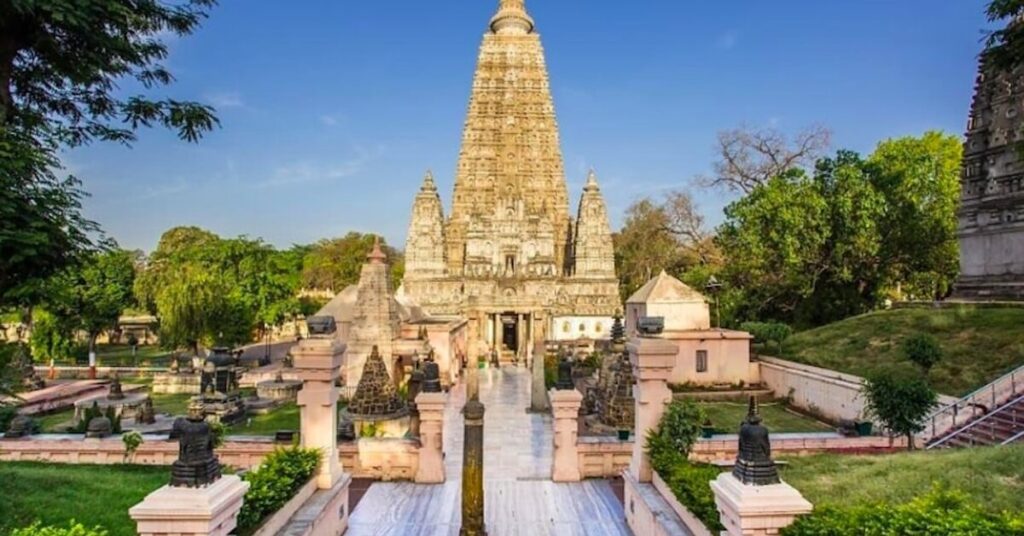
Bodhgaya is not simply one of Buddhism’s four sacred sites — it is the pivotal one. Without this moment under this tree, there would be no Dharma, no Sangha, no Buddhism at all. Every tradition that followed — Theravada in Sri Lanka and Southeast Asia, Mahayana across East Asia, Vajrayana in Tibet — traces its entire lineage back to this single point of origin.
The Mahabodhi Temple complex, a UNESCO World Heritage Site, marks the exact spot. Emperor Ashoka first built a shrine here in the 3rd century BCE; the temple has been rebuilt and expanded across the centuries since, but the Bodhi Tree and the Vajrasana — the stone “diamond throne” marking where the Buddha sat — remain the unbroken spiritual centre of the site.
The temple is open from 5:00 AM to 9:00 PM daily, and entry is completely free (a small fee applies only for photography — ₹200 for camera, ₹300 for video). Plan two to three hours minimum for a proper visit, more if you want time to sit quietly near the tree, which most pilgrims do.
The Bodhi Tree itself stands directly behind the main temple spire, its branches spreading wide over the Vajrasana. Pilgrims circumambulate the temple, meditate beneath the tree, and light lamps in the evening as the complex takes on a particularly luminous quality at dusk. Early morning (around sunrise) and evening are the two most spiritually charged times to visit — the crowds are smaller and the chanting from resident monks carries a different stillness.
Practical note: Dress modestly, remove your shoes before entering, and keep your voice low throughout the grounds — this remains an active site of meditation for monks and pilgrims, not a monument to observe from a distance.
One of Bodhgaya’s most distinctive features is its cluster of monasteries built by different Buddhist nations — Thai, Japanese, Tibetan, Bhutanese, Sri Lankan, Myanmar, Vietnamese, and Chinese temples, each reflecting its home country’s architectural and devotional style. Walking between them in a single afternoon is genuinely remarkable — a compressed tour through the way Buddhism took root differently across Asia after spreading from this exact location. Most are open to respectful visitors and several hold specific prayer times worth checking in advance.
An 80-foot seated Buddha statue, one of the tallest in India, located a short distance from the main temple complex. A striking visual landmark and a popular meditation and photography stop.
About 12–15 km from the main temple, these caves mark where Siddhartha practiced severe asceticism for several years before discovering the Middle Way — the balanced path between indulgence and extreme self-denial that became central to his teaching. Reaching the cave shrine involves walking uphill on a paved road and some stairs; palanquin carriers are available for those who cannot manage the climb. The caves hold both Buddhist and Hindu shrines, including an image associated with the goddess Dungeshwari, reflecting the layered devotional history of the site.
Sujata Village, across the Niranjana River, is linked to the story of Sujata, the village woman who offered the Buddha milk-rice after his years of austerity — restoring his strength before his enlightenment. Vishnupad Temple in nearby Gaya is a significant Hindu pilgrimage site in its own right, dedicated to Lord Vishnu, and many travelers combine both Buddhist and Hindu devotional stops on the same trip given the proximity.
By air: Gaya International Airport is the closest, approximately 15–17 km from the Mahabodhi Temple — about 25 minutes by taxi. It has regular connectivity to Kolkata and seasonal international routes serving Buddhist pilgrim traffic from Southeast Asia.
By rail: Gaya Junction, roughly 16 km from the temple, connects to most major Indian cities.
By road from Varanasi: Bodhgaya is approximately 250–252 km from Varanasi, a comfortable combination for pilgrims wanting to cover two of the four great Buddhist sites — Bodhgaya and Sarnath — in a single circuit, since Sarnath sits just outside Varanasi itself.
November through February offers the most comfortable weather for temple visits and walking between monasteries. Summer (March–June) is intensely hot but coincides with Buddha Jayanti celebrations, drawing large crowds for the festival despite the heat. Monsoon (July–September) brings heavy but intermittent rain and notably fewer crowds — many budget-conscious pilgrims specifically choose this window.
For pilgrims based in or passing through Varanasi, combining Bodhgaya with Sarnath — where the Buddha delivered his first sermon — completes two of the four sacred sites in a single, well-planned circuit. Sarnath sits just 10 km from central Varanasi, making it an easy half-day addition to any Varanasi visit, while Bodhgaya requires a dedicated day or overnight trip given the 250 km distance.
A typical combined circuit: explore Varanasi and Sarnath first, then travel to Bodhgaya for one to two nights to properly cover the Mahabodhi Temple, the international monasteries, and Dungeshwari Caves without rushing.
Tripcosmos provides outstation private cab service from Varanasi to Bodhgaya for pilgrims undertaking this two-site Buddhist circuit — a dedicated vehicle for the 5–6 hour highway journey, with the flexibility to stop at points of interest along the route
Tripcosmos arranges private outstation cab service for the Varanasi to Bodhgaya route, allowing pilgrims to combine Sarnath and Bodhgaya into a single, well-coordinated Buddhist heritage circuit. The team can also assist with planning the broader spiritual journey if you are combining this with the Hindu sacred triangle of Varanasi, Prayagraj, and Ayodhya.
📍 Website: https://tripcosmos.co 📱 WhatsApp: +91 9336116210
Bodhgaya is approximately 250–252 km from Varanasi, a 5–6 hour drive by private cab. This is the most practical option for pilgrims wanting to combine Bodhgaya with Sarnath as part of a single Buddhist heritage circuit, since both sites can be covered without backtracking.
Two to three full days allows a meaningful first visit — one day for the Mahabodhi Temple and Bodhi Tree at an unhurried pace, a second day for the international monastery circuit and the Great Buddha Statue, and a half-day for Dungeshwari Caves and Sujata Village if time allows.
Yes, entry to the Mahabodhi Temple is completely free; a small fee applies only for photography. Visitors should dress modestly, remove their shoes before entering, and maintain a quiet, respectful demeanor throughout the grounds, as the site remains an active place of meditation and prayer for monks and pilgrims, not merely a heritage monument.
Bodhgaya does not announce itself loudly. There is no grand spectacle demanding your attention — just an ancient tree, a stone platform, and a quiet that settles over you the moment you step inside the temple grounds. For Buddhist pilgrims, this is not a place visited once and crossed off a list. It is the place pilgrims return to, again and again, for as long as they live.
Plan it properly. Give it the days it deserves. And let the place where it all began work its quiet, lasting effect.
TripCosmos guarantees verified Kashi Vishwanath Sugam Darshan passes (zero line waiting), private Dev Deepawali & Ganga Aarti Bajra boats, and verified Toyota Innova Crysta cabs with trusted local chauffeurs.


Comments are closed.