Your cart is currently empty!
You may check out all the available trips and book one that suits you.
Continue Browsing Trips
Chitrakoot Darshan Planning Guide , Most Chitrakoot visitors know the names of the sacred sites. Very few know the correct sequence to visit them, what the tradition says should happen at each one, or how the darshan at one place prepares you for the darshan at the next.
This guide is not about logistics or costs. It is about the darshan itself — the correct sequence, the ritual protocols at each site, the timings that matter, and why the order in which you visit Chitrakoot’s sacred sites changes the quality of the experience entirely.Why Sequence Matters in Chitrakoot
Chitrakoot is a living sacred landscape — the exact forests, rivers, rocks, and hills where the Ramayana’s most intimate chapters unfolded.The darshan sequence at Chitrakoot mirrors the narrative sequence of Lord Rama’s time here — beginning at the river where he first arrived, moving to the hill where he resided, and extending into the forest where the most significant encounters of the exile took place.
VIP Sugam Darshan passes, verified outstation cabs, Ganga aarti boat allocations, and clean hotel stays — fully coordinated by our on-ground team.
Visiting in the wrong sequence — Gupt Godavari first, Kamadgiri last — is like reading the Ramayana from the middle. Nothing is wrong with it, but something essential is missing.
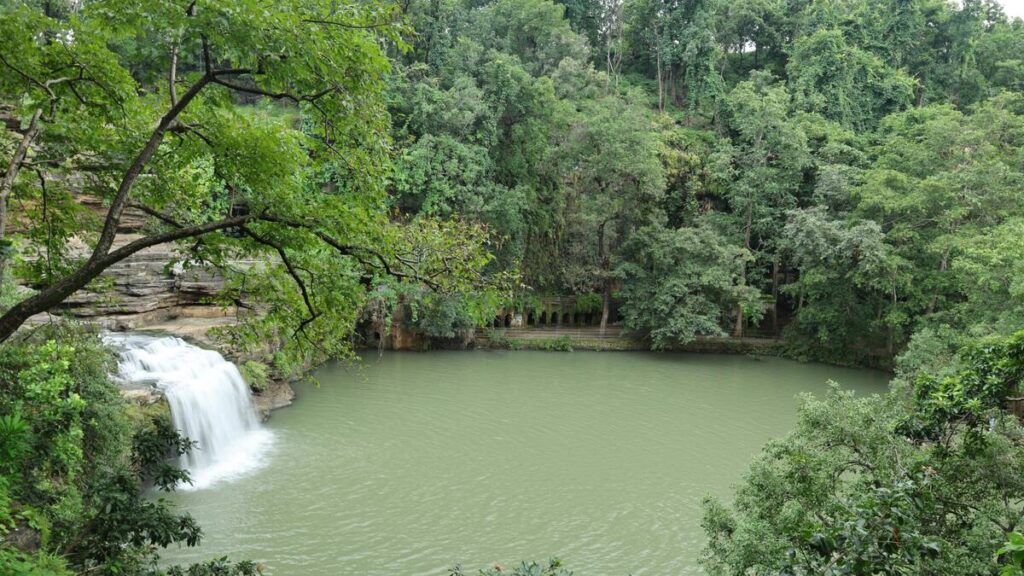
Every Chitrakoot visit begins at Ramghat on the Mandakini river. This is where Lord Rama, Sita, and Lakshmana are believed to have first arrived in Chitrakoot after leaving Ayodhya — bathing in the Mandakini before settling into their forest heritage.
What to do at Ramghat:
The evening aarti significance: The Ramghat aarti is offered to Lord Rama in his forest-exile form — not the royal Ram of Ayodhya, but the wandering Ram of the forest who chose the earth over the throne. The lamps on the Mandakini in the forest twilight carry a specific devotional weight unlike any urban ghat ceremony.
Timing: Evening, Day 1. Begin your Chitrakoot darshan here without exception.
Before the Kamadgiri parikrama, before any other temple, return to Ramghat at dawn for the Mandakini sunrise boat ride.
What happens on the boat:
Why dawn specifically: The Kamadgiri parikrama at dawn and the Mandakini river in morning mist create the most spiritually charged conditions of any time in Chitrakoot.The river at 5:30 AM is different from the river at 9:00 AM. The light, the silence, the temperature — all change what the experience offers.
Timing: 5:30–6:30 AM, before the Kamadgiri parikrama begins.
The barefoot 5-kilometre circumambulation of the Kamadgiri hill — worshipped as the living form of Lord Rama — is the single most important sacred act in Chitrakoot. The path passes through ancient forest alongside 33 temples, and around the sacred hill that Lord Rama is said to have called home during his exile.
Ritual protocol:
The 33 temples: Each marks a different episode from Rama’s time on Kamadgiri. Local priests and guides know the narrative of each temple — hiring a Chitrakoot-based guide for the parikrama transforms the walk from exercise into genuine darshan.
Timing: Begin no later than 7:00 AM. A morning parikrama beginning at 6:00 AM is the most spiritually charged timing.Complete before 9:30 AM to avoid heat and crowd build-up.
A short distance from Ramghat on the Mandakini bank. Sphatik Shila is the sacred crystalline rock bearing the footprints of Sita — the spot where Lord Rama and Sita sat together by the river during the exile, where the mythological encounter with the crow Jayanta is believed to have occurred.
What to do: Offer flowers at the footprint impressions. Sit for a few minutes in silence at the riverbank — this is one of the few places in all of Chitrakoot where sitting quietly by the water for 10 minutes is both appropriate and deeply rewarding.
Timing: Mid-morning, after the Kamadgiri parikrama.
The natural pool on the Mandakini where Sita is believed to have bathed during the exile. Adjacent to Sphatik Shila.
What to do: Offer flowers on the water. Women devotees often take a brief ritual dip here — the kund is shallow and calm.
Timing: Immediately after Sphatik Shila, late morning.6. Bharat Milap Temple — The Reunion Darshan
The temple marking the precise spot where Bharata met Lord Rama during his exile — carrying Rama’s padukas (sandals) back to Ayodhya after Rama refused to break his vow of exile. This is one of the most emotionally powerful fraternal scenes in the Ramayana — Bharata’s grief at his brother’s exile and his refusal to take the throne.
What to do: This is a darshan of devotion rather than formal ritual — stand before the temple, reflect on Bharata’s love for Rama, and offer whatever prayer feels natural. The temple is small and uncrowded; linger here longer than you think you need to.
Timing: Late morning to early afternoon, after Sphatik Shila and Janaki Kund.
Eighteen kilometres from the main Chitrakoot complex — the caves where Lord Rama held royal court during the exile. The sacred underground river flowing through the cave is considered a manifestation of the Godavari.
What to do: Wade through the cave — knee-deep water in sections — toward the inner sanctum where the throne is represented. No formal puja is required; the cave itself is the darshan.
Important: Not suitable for elderly pilgrims or anyone with claustrophobia or mobility limitations. Plan this for late afternoon</cite> when the main circuit is complete and energy levels can be allocated accordingly.
Timing: 3:00–5:00 PM, Day 2.
Sixteen kilometres into the forest from the main complex — the ashram of Sage Atri and his wife Anusuya, who welcomed Rama, Sita, and Lakshmana during the exile. The Trimurti — Brahma, Vishnu, and Mahesh — are believed to have appeared here in child form to test the sage’s wife.
What to do: Sit in the ashram courtyard after darshan. The deep forest silence here is the darshan — there is no queue, no formal puja pressure, no sound except forest. For many pilgrims, this is the moment the entire Chitrakoot visit crystallises into something they carry home.
Timing: Late afternoon, Day 2 — the forest light at 4:30–5:00 PM at Sati Anusuya is extraordinary.
Before leaving Chitrakoot, return to the Kamadgiri entrance temple for a final brief darshan. Many pilgrims describe this farewell as the most quietly profound moment of the complete visit — the hill receiving the traveller’s gratitude before the return journey begins.
No formal ritual is required — simply stand before the hill, offer Ram Naam, and take leave.
Dress code: Modest clothing throughout. Remove footwear at all temple premises — carry a small bag for footwear that can be held during the parikrama.
Puja samagri: Marigold flowers, small clay diyas, incense, and a coconut are sufficient for the complete Chitrakoot darshan circuit. Available from stalls near Ramghat (₹50–₁00 per person).
Photography: Permitted at most sites including the parikrama path. Not permitted inside the Kamadgiri temple sanctum or the Gupt Godavari inner cave.
Guide: A Chitrakoot-based guide for the parikrama and the caves is strongly recommended for first-time visitors — the narrative of each temple transforms the walk into something entirely different. TripCosmos coordinates local Chitrakoot guides as part of every Chitrakoot Tour Package.
For travel planning, the Chitrakoot Spiritual Trip Planning Guide on TripCosmos covers the complete itinerary with costs. For group travel from Varanasi, the Chitrakoot Tour Package from Varanasi covers both cities with private cab and guided darshan. Private cab bookings for all gateway cities are available through TripCosmos cab service.
Website: https://tripcosmos.co WhatsApp: +91 9336116210
Begin at Ramghat (evening aarti, Day 1). Day 2: sunrise Mandakini boat ride, Kamadgiri parikrama, Sphatik Shila, Janaki Kund, Bharat Milap Temple, Gupt Godavari caves, Sati Anusuya Ashram. Close with a final Kamadgiri darshan before departure. This sequence mirrors the Ramayana narrative of Rama’s time in Chitrakoot and gives each site its proper spiritual weight.
A morning parikrama beginning at 6:00 AM is the most spiritually charged timing — cool air, minimal crowds, and the quality of early morning light through the forest changes the experience significantly.Begin no later than 7:00 AM. Complete before 9:30 AM.
Not strictly required — all sites are clearly marked and accessible without guidance. However, for the Kamadgiri parikrama specifically, a local guide who knows the significance of each of the 33 temples along the path transforms a 5 km walk into a complete Ramayana darshan. TripCosmos coordinates local Chitrakoot guides as part of every tour package.
Yes — both are manageable in a single afternoon if you depart the main complex by 3:00 PM. Gupt Godavari is 18 km (30 minutes by cab) and takes 60–75 minutes. Sati Anusuya is 16 km in a different direction and takes 45–60 minutes. Allow the full 3:00–6:30 PM window for both with travel time between them.
Contact TripCosmos on WhatsApp at +91 9336116210 with your travel dates, group size, and origin city. The team books the complete package — cab from your gateway city, accommodation near Kamadgiri or Ramghat, local Chitrakoot guide for the parikrama and caves, and darshan timing coordination. The Chitrakoot Tour Package is available from ₹3,375 per person for a family of four from Prayagraj.
VIP Sugam Darshan passes, verified outstation cabs, Ganga aarti boat allocations, and clean hotel stays — fully coordinated by our on-ground team.
TripCosmos guarantees verified Kashi Vishwanath Sugam Darshan passes (zero line waiting), private Dev Deepawali & Ganga Aarti Bajra boats, and verified Toyota Innova Crysta cabs with trusted local chauffeurs.

Comments are closed.