Your cart is currently empty!
You may check out all the available trips and book one that suits you.
Continue Browsing Trips
Vrindavan has over 5,000 temples. Most visitors know four or five by name. The challenge is not finding temples — it is knowing which ones genuinely matter, in what sequence, and at what time of day. A poorly sequenced Vrindavan circuit means arriving at closed temples, missing the most powerful darshan windows, and returning home feeling you experienced the surface of a city that runs very deep.
This guide gives you the complete Vrindavan temple circuit — the right temples, the right sequence, the right timings, and the practical information that makes each visit meaningful rather than rushed.
Every temple in Vrindavan operates on a darshan schedule divided into sessions — typically opening at dawn, closing for a midday rest period, and reopening in the afternoon through evening. The exact timings vary by temple and by season, but the pattern is consistent.
VIP Sugam Darshan passes, verified outstation cabs, Ganga aarti boat allocations, and clean hotel stays — fully coordinated by our on-ground team.
The most important rule: Plan your circuit around the temple that has the most restrictive timing first. Banke Bihari Temple’s Mangal Aarti darshan window is extremely brief — if you miss it, you wait until the next session. Nidhivan closes at sunset and does not reopen. Build your day around these anchors and everything else fits around them.
Banke Bihari is the spiritual centre of Vrindavan and the most visited temple in the city. The black idol of Lord Krishna — in his characteristic tribhanga posture, with a Shyama Tulsi garland and a distinctive parda (curtain) that opens and closes during darshan — is unlike any other deity experience in North India.
Best timing: The 7:00 AM to 8:00 AM window on weekday mornings is the quietest and most devotionally focused. By 9:30 AM the temple becomes extremely dense. On weekends and festival dates, arrive by 6:45 AM.
What to know: Photography is not permitted inside the temple. The parda system — where the curtain opens for a few seconds at a time — is not a quirk. It is a devotional design that keeps darshan intimate and prevents devotees from staring at the deity for too long. Enter this experience without expectation and it will surprise you.
Walking distance from Banke Bihari, the Radha Raman Temple is one of Vrindavan’s oldest and most musically significant temples. The idol of Radha Raman — believed to be self-manifested from a shaligram shila — has been worshipped here continuously since 1542. The temple is run by the Gaudiya Vaishnava tradition and maintains elaborate bhog and seva schedules that give it a living, devotional character throughout the day.
Best timing: The morning seva between 8:30 AM and 10:00 AM is when the temple is most active and the classical music performances that accompany the bhog offering are often audible. A genuinely rare experience in any pilgrimage context.
The ISKCON temple on Bhaktivedanta Swami Marg is the most internationally recognizable temple in Vrindavan — and for genuine reasons. The complex is exceptionally well-maintained, spacious, and has a quality of devotional atmosphere that surprises visitors who arrive expecting a tourist attraction.
Best timing: The evening aarti between 7:00 PM and 8:00 PM is the ISKCON temple’s most powerful daily experience — full kirtan with mridanga and kartal, hundreds of devotees, and a synchronized darshan of all three shrines (Krishna Balaram, Gaura Nitai, Radha Shyamsundar).
Practical note: The ISKCON temple also has a quality restaurant that serves hot, clean vegetarian meals — the best option in Vrindavan for families needing a proper midday meal.
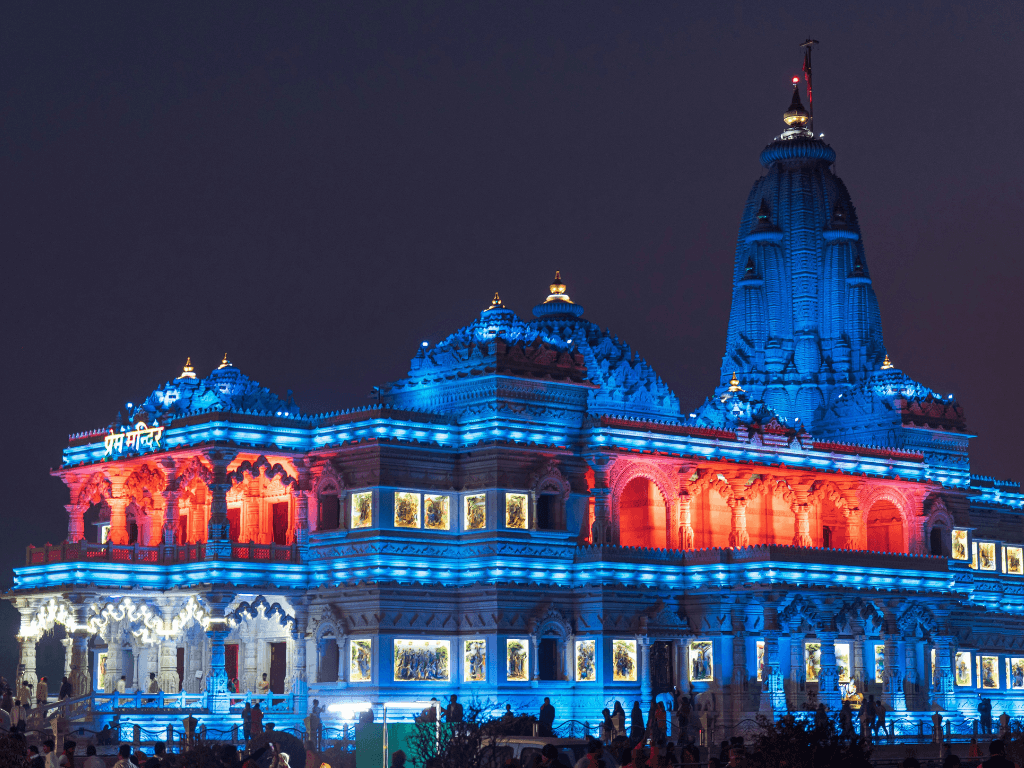
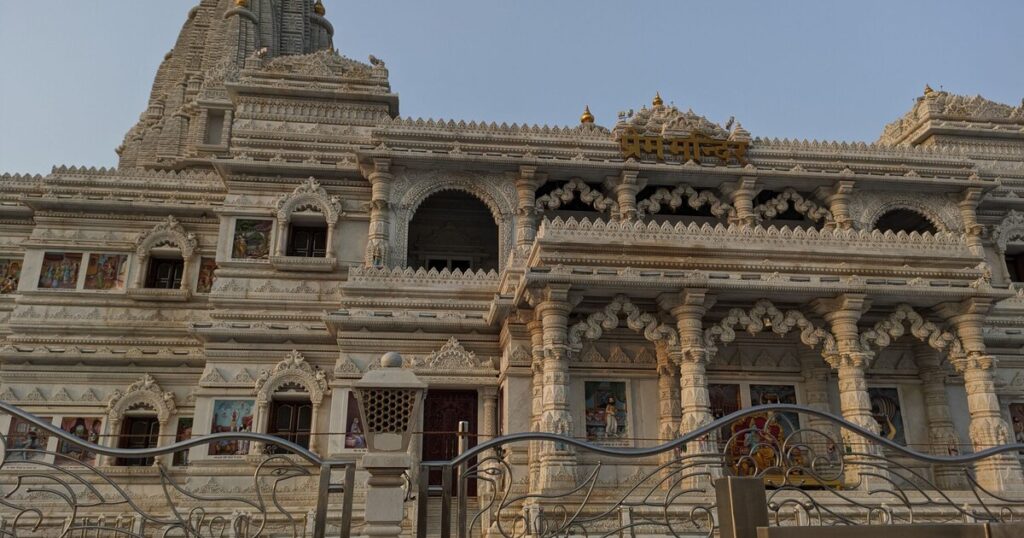
Prem Mandir is the most architecturally spectacular temple in Vrindavan — an entirely white marble complex built in 2012 that lights up in a full colour display each evening. During the day it is beautiful but essentially static. After 7:30 PM, the colour-changing light show transforms the entire complex.
Plan Prem Mandir exclusively for the evening. Arriving at 7:00 PM allows you to explore the marble carvings of the Ramayana and Krishna Leela panels before the light display begins. It is one of the most photographically dramatic temple experiences in Uttar Pradesh.
Nidhivan is Vrindavan’s most mysterious site — a dense, protected forest where Lord Krishna is said to perform the Raas Leela every night. The trees inside Nidhivan are famously gnarled and intertwined, appearing bowed in reverence. The site closes at sunset and does not reopen.
Visit between 4:00 PM and 5:30 PM for the best experience — the forest light during this window has an otherworldly quality, and the combination of genuine mystery with the sensory experience of a sacred forest is unlike anything else in the Vrindavan circuit.
Important: Visitors are asked to leave before the sunset closing. No one, including the temple priests, stays inside after dark.
The Madan Mohan Temple sits on a hillock overlooking the Yamuna — the oldest surviving temple in Vrindavan, built in the sixteenth century. The views of the Yamuna from this height at sunrise or sunset are extraordinary, and the temple’s ancient character provides a sharp, meaningful contrast to the more modern structures elsewhere in the circuit.
Best timing: Early morning (6:30 AM to 7:30 AM) for the Yamuna view at dawn, or late afternoon before heading to Nidhivan and Prem Mandir for the evening.
A full Vrindavan temple circuit over one day works best in this order:
Morning (6:45 AM – 11:00 AM): Madan Mohan Temple (dawn Yamuna view) → Banke Bihari Temple (early window) → Radha Raman Temple (morning seva)
Midday rest (11:00 AM – 4:00 PM): Essential in summer. Use this window for the ISKCON restaurant, accommodation rest, or lane exploration.
Afternoon–Evening (4:00 PM – 8:30 PM): Nidhivan (before sunset) → Prem Mandir (light display) → ISKCON Temple evening aarti
For those with two days in Vrindavan, add Seva Kunj, Radha Damodara Temple, and a Yamuna sunrise parikrama on the second day. Read the One-Day vs Two-Day Vrindavan Trip guide for a detailed format comparison.
Vrindavan’s temples are spread across a walkable but sizeable area. The main cluster around Banke Bihari and Radha Raman is genuinely walkable. Madan Mohan, Nidhivan, and Prem Mandir require a vehicle or e-rickshaw.
For families, joint groups, or anyone who wants complete daily flexibility, a pre-booked cab from Tripcosmos handles the full circuit without any ghat-side or street-side negotiation. A dedicated vehicle also ensures your 6:45 AM Banke Bihari departure happens without uncertainty — a critical timing point.
Common mistakes to avoid on the circuit — wrong temple timings, photography rules, dress code issues — are covered in detail in the Mathura Vrindavan Travel Mistakes guide on the Tripcosmos blog.
According to Vrindavan’s sacred geography in Vaishnava tradition, this forest city is considered the most sacred location associated with Lord Krishna’s earthly pastimes — making the temple circuit here one of the most spiritually significant pilgrimages in all of Vaishnavism.
Tripcosmos handles complete Mathura–Vrindavan tour packages for individuals, couples, families, and groups — with pre-planned temple sequencing, verified transport, and accommodation recommendations matched to your budget. Whether you are visiting from Varanasi, Delhi, or combining the trip with Prayagraj, the team plans the logistics end-to-end.
📍 Website: https://tripcosmos.co 📱 WhatsApp: +91 933611621
Start with Madan Mohan at dawn for the Yamuna view, move to Banke Bihari by 7:00 AM for the early darshan window, then Radha Raman for the morning seva. Rest through midday. Return for Nidhivan before sunset (by 5:00 PM), then Prem Mandir for the evening light show, and finish with the ISKCON evening aarti. This sequence aligns every temple with its best window.
Yes — the six-temple circuit in this guide is designed as a single-day itinerary with a midday rest built in. It requires an early start (6:30–6:45 AM) and runs through approximately 8:30 PM. For families with elderly members or young children, two days at a slower pace is more comfortable. The One-Day vs Two-Day Vrindavan Trip guide covers this decision in detail.
Photography rules vary by temple. Banke Bihari Temple strictly prohibits photography and phone use inside. ISKCON and Prem Mandir allow photography in open areas. Nidhivan permits photography of the forest but not during the closing ritual. Always check the notice at the entrance before raising your phone inside any temple in Vrindavan.
The Vrindavan temple circuit is not a checklist — it is a progression. Each temple in this guide adds a different dimension to the devotional experience: the intimacy of Banke Bihari, the antiquity of Radha Raman, the musical grandeur of ISKCON, the mystery of Nidhivan, the spectacle of Prem Mandir, and the historical stillness of Madan Mohan.
Sequence them correctly, time them around their natural windows, and Vrindavan gives you something that stays long after the journey ends.
VIP Sugam Darshan passes, verified outstation cabs, Ganga aarti boat allocations, and clean hotel stays — fully coordinated by our on-ground team.
TripCosmos guarantees verified Kashi Vishwanath Sugam Darshan passes (zero line waiting), private Dev Deepawali & Ganga Aarti Bajra boats, and verified Toyota Innova Crysta cabs with trusted local chauffeurs.

Comments are closed.